

International SEO for B2B Companies Expanding Overseas

International SEO begins with a real difference in language, service availability or buyer requirements. Create country or language variants when they help those buyers make a better decision. Then make the variants accessible through stable URLs, reviewed content and consistent locale signals. Country names alone do not justify separate pages.
A Singapore supplier wants customers in several countries. The first proposal creates six copies of the same page and swaps the country name. Nothing explains whether the service is available, how documents are reviewed or who handles the enquiry. The website looks international while the buyer's most important questions remain unanswered.
This guide focuses on public website and search implementation. It does not replace market-entry research, export advice or a regional marketing strategy. The worked example uses a fictional B2B supplier considering Singapore, Malaysia, Australia, Germany, France and the UK. Each country appears only where it changes a page or operating decision.
Download the regional page planning workbook or editable CSV pack. Five web tables show the working records. Generated photographs are illustrative. Locale architecture and numeric inputs are original teaching models, not client results or forecasts of overseas demand.
Separate language from market
A multilingual website offers more than one language. A multi-regional website targets more than one market. They can overlap, but they are different decisions. English content may serve several countries if the relevant offer is the same. A German-language page may serve readers in several places without claiming a local German office.
Google's multi-regional and multilingual guidance explains that distinction and recommends separate URLs for language versions. Use the guidance to choose accessible variants rather than making one URL change content invisibly according to a visitor's assumed location.
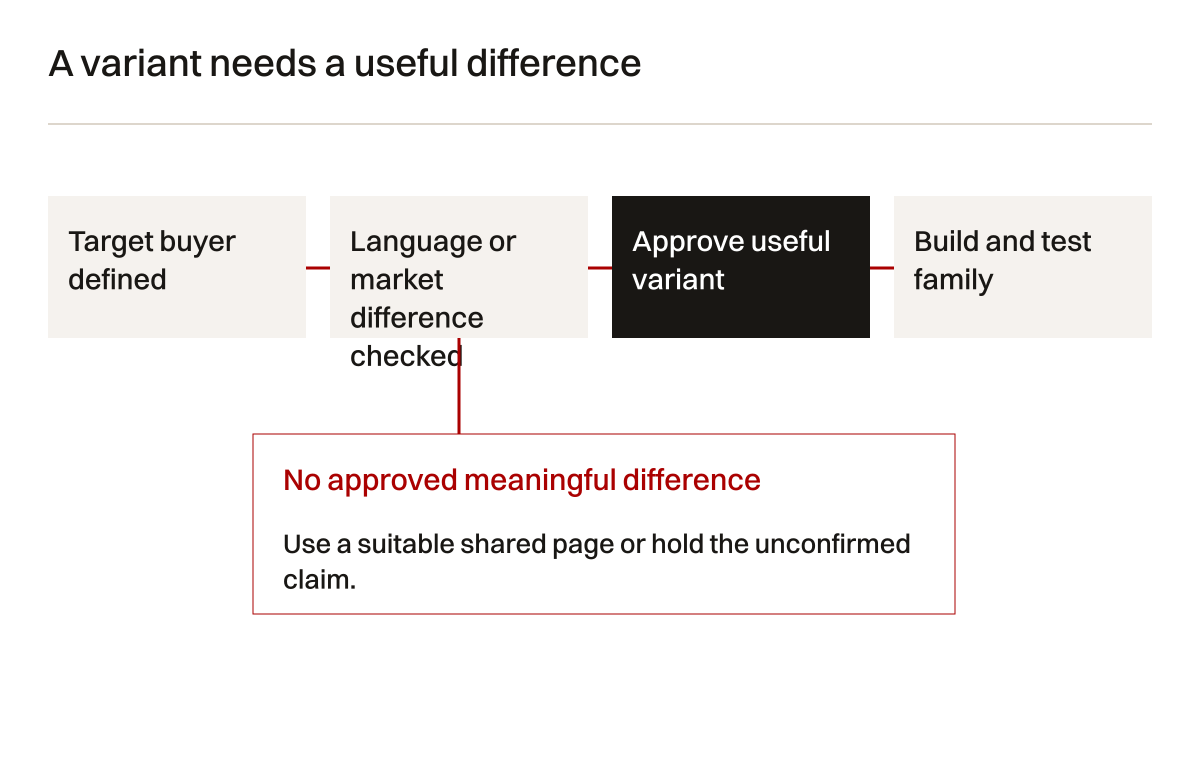
Record the business reason for each proposed variant. A language difference can justify reviewed translation. A different service route can justify a regional explanation. A local legal entity can change contact and document requirements. A country name in a keyword list is not itself a business reason to create a page.
The fictional supplier can accept enquiries in English from Singapore and the UK under the same central intake route. It has a distinct distributor arrangement in Australia. Germany and France require reviewed language content. Malaysia remains under review because the team has not confirmed the service arrangement. These are declared assumptions, not general facts about those markets.
Inspect market differences before building URLs
Ask the responsible commercial team what changes for the buyer. Availability, delivery, technical terminology, approved documents, contact route and after-sales responsibility can matter. Do not invent a local promise merely because the design calls for a country page. If the business cannot approve the service statement, the page is not ready.
Table 1: fictional market differences. These examples are decisions for one assumed supplier, not claims about national buyer preferences.
| Market or language | Declared difference | Page consequence | Owner decision |
|---|---|---|---|
| Singapore English | Central service and intake | General English page can describe it | Approve actual scope and contact |
| Malaysia English | Availability not confirmed | Do not publish cloned availability claim | Confirm service arrangement first |
| Australia English | Distributor handles defined work | Explain approved distributor boundary | Verify role and permitted contact details |
| Germany German | Reviewed language required | Translate service and technical context | Name language and technical reviewers |
| France French | Reviewed language and enquiry route | Localise copy and intake guidance | Confirm handling capability |
| UK English | Same declared central scope | Shared page may be sufficient | Assess whether a variant adds information |
Keep country assumptions out of general claims. A local-language reviewer can identify terminology that matters in the specific sector. A sales team can describe actual enquiries. Neither should be replaced by an unsupported statement that buyers in a country always prefer a particular tone or layout.
Review adjacent operating tasks. A translated page can attract enquiries the company cannot read or fulfil. The public variant should explain the permitted route accurately. International website work is incomplete if the page's promise depends on a commercial process nobody owns.
Choose the smallest useful architecture
Country domains, subdomains and subdirectories have different administration requirements. There is no universal choice for every B2B company. Consider account control, existing domains, publishing workflow and the number of genuinely distinct variants. A smaller firm may benefit from a shared platform, but the actual constraints should decide.
Google's regional-site documentation discusses these URL options. A country-code domain can signal a country context, while a subdirectory can keep variants within a common site. These are technical and operating considerations, not a ranking guarantee. Check registry eligibility before assuming the business can register or use any desired country domain.
Table 2: URL architecture options. Choose according to approved scope and maintainable ownership.
| Option | Example placeholder | Operating consequence | Question before approval |
|---|---|---|---|
| Shared language directory | example.com/en/ | One language version can serve several markets | Is the offer actually the same? |
| Language-region directory | example.com/en-au/ | Explicit variant within shared platform | What useful Australian difference exists? |
| Subdomain | de.example.com | Separate host and configuration responsibilities | Is separation operationally useful? |
| Country domain | example.de | Separate registration and site responsibilities | Are eligibility and maintenance confirmed? |
| One adaptive URL | example.com/service | Variants may be hard to discover consistently | Can every required version be accessed directly? |
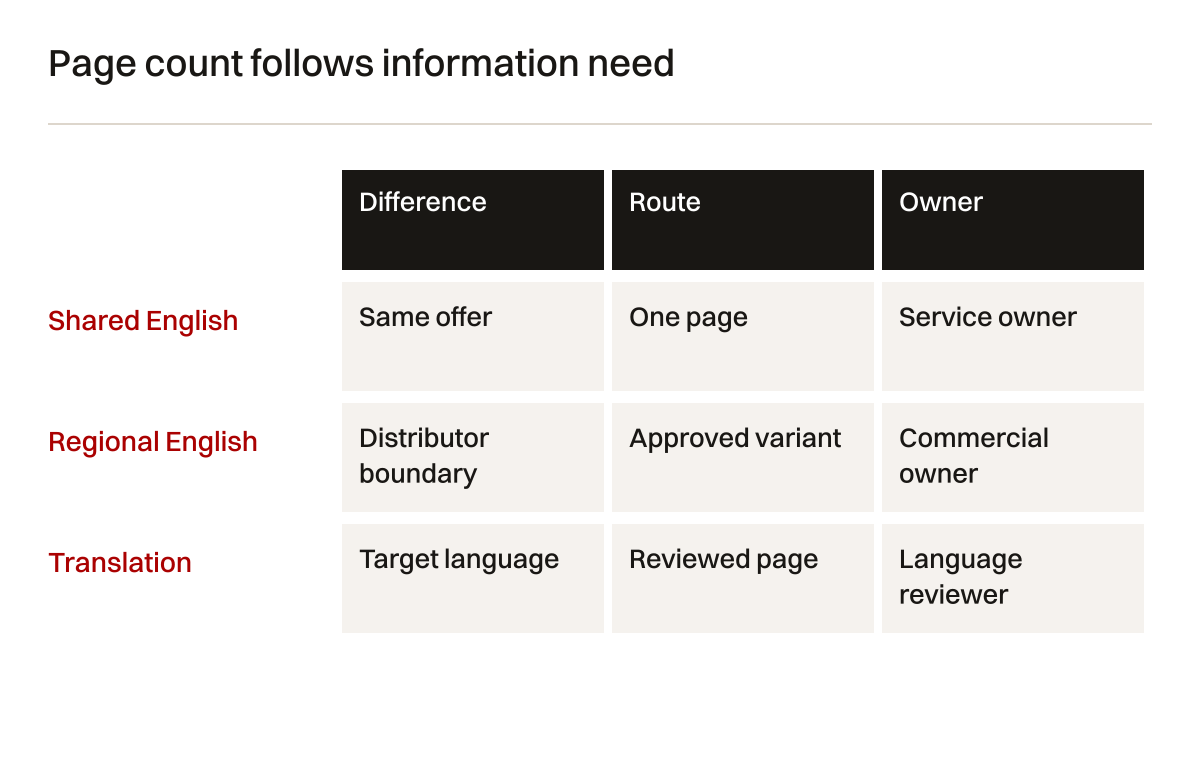
Use stable routes that the team can explain. Avoid a parameter scheme chosen only because it was easy in the initial prototype. Keep canonical, sitemap and language-switching behaviour predictable. If the architecture later changes, the migration guide provides the route-preservation method.
Give visitors a deliberate choice
Let visitors choose an available language or region through working links. An engineer in Singapore may need a German document. A purchasing manager travelling in Australia may represent a UK organisation. The current IP address does not reliably establish the page they need.
Google recommends avoiding automatic language redirects that prevent users and crawlers from viewing variants. A suggestion can help, but access should remain deliberate. Record what happens when the preferred variant is unavailable. The system should not imply that a missing translation exists or silently send the visitor to an unrelated page.
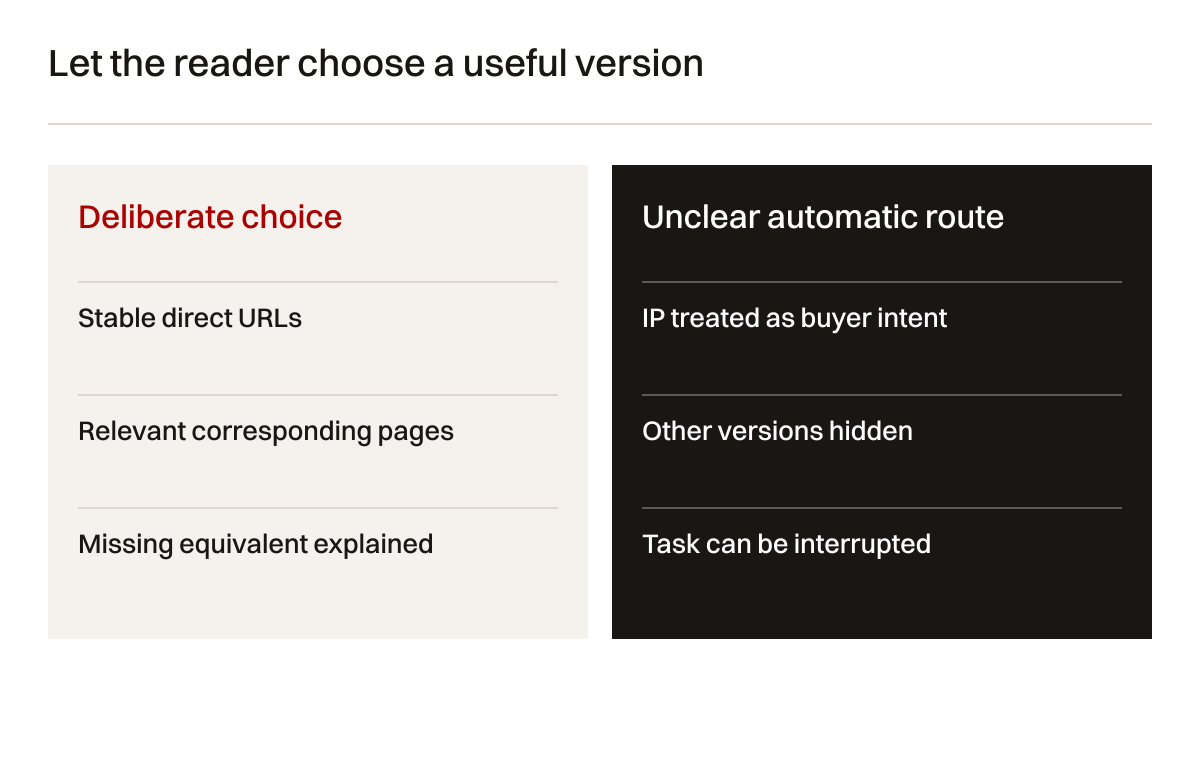
Test language switching on the corresponding service page. A switch that always sends the visitor to another homepage can interrupt the task. If no equivalent exists, explain the available destination clearly. Page-level correspondence is an information architecture decision before it becomes a technical annotation.
Check cookie and browser-setting behaviour without assuming it covers discovery. Each public variant should have a direct address that can be requested independently. A browser preference can improve experience, while stable public routes allow sharing, testing and consistent observation. Keep those roles separate in the implementation brief.
Translate the technical meaning
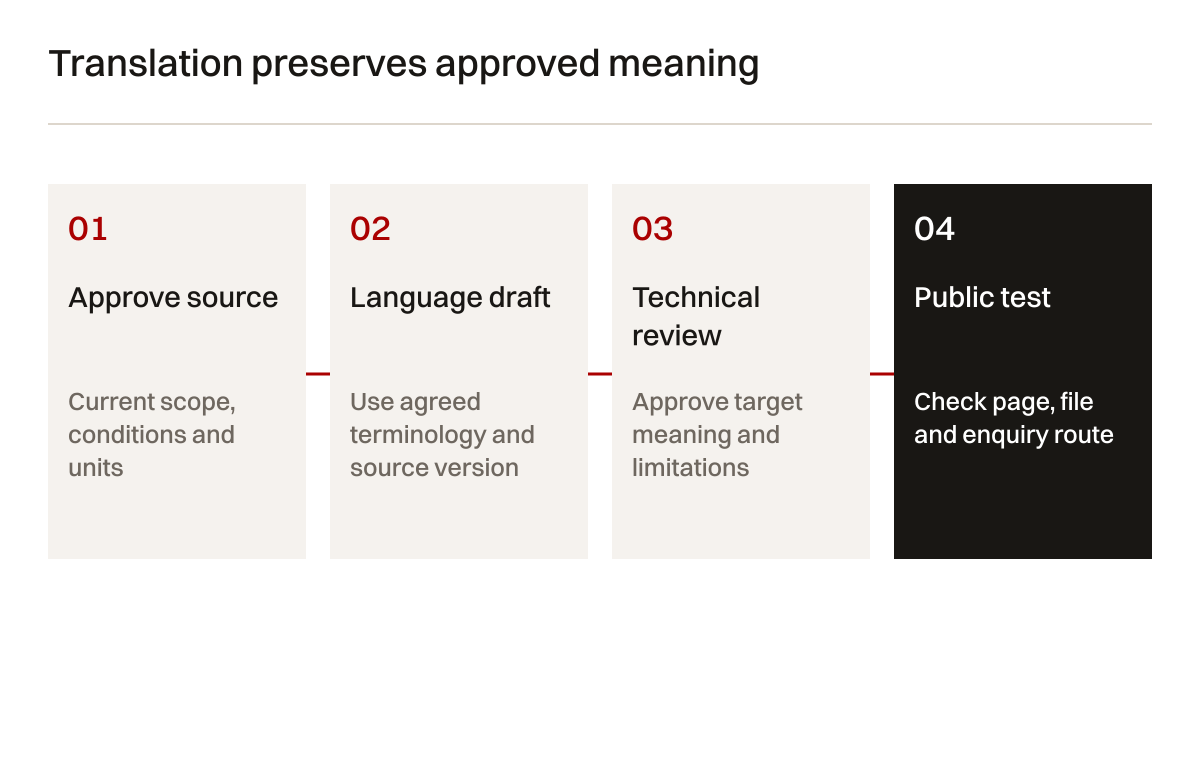
Translation needs an approved source. Start with accurate service content, conditions and terminology. If the English page is ambiguous, translation can reproduce the ambiguity in several languages. Resolve scope and units before asking a reviewer to approve the local text.
Use a terminology register for process names, materials, units and certification language. Record whether a term is translated, retained or explained. A fluent general translator may still need a technical owner's review. A technical reviewer may need a language reviewer to assess whether the final wording is natural and unambiguous.

Table 3: localisation requirements. Approval follows meaning and operating facts, not only grammar.
| Material | Source to approve | Review needed | Release condition |
|---|---|---|---|
| Service explanation | Current approved source page | Language and service owners | Scope preserved in target wording |
| Specifications | Controlled technical record | Technical and language reviewers | Values, units and conditions agree |
| Certification statement | Current authorised certificate | Relevant business owner | Entity and scope not extended |
| Contact route | Actual operating arrangement | Regional commercial owner | Enquiry can be received and handled |
| Download | Approved current document | Document and language owners | Page and file versions correspond |
| Enquiry guidance | Required intake fields | Technical and commercial owners | Buyer knows permitted next step |
Automatic translation can support drafting under the business's chosen process. It is not technical approval. If the team cannot review a language, record that limitation before publishing capability statements in it. A page can be linguistically polished while making the wrong promise about a method or service.
Treat units and documents as dependencies
Do not silently convert a specification just to make the page appear local. A value's units, tolerance, test conditions and source matter. If an approved conversion is needed, retain the original meaning and record the method. A rounded value can change a technical statement even when it looks easier to read.
Consider the fictional source record: a dimension is stated in millimetres under a defined condition. The target document should preserve the value and unit unless an authorised technical reviewer approves an alternative representation. The translator should not infer a different standard or test method from the target country's language.
Keep page and download versions aligned. A translated service page can link to an English PDF if that is the approved current document and the limitation is explained. It should not label an unreviewed file as a complete translated specification. The buyer needs to know what is available before using it in an enquiry.
Document metadata belongs in the register. Include source version, translated version, approval owner and next change trigger. A source update should create a review task for dependent locales. Otherwise the English page can become current while the French and German pages remain confidently obsolete.
Explain hreflang as correspondence
Hreflang annotations describe language or regional alternatives for corresponding content. They do not create a translation, prove service availability or guarantee which result a user sees. Google's localised-version guidance documents supported implementation methods and values.
Use the correct language and, where appropriate, region combination. For a UK English variant, the supported region component is GB rather than UK. That is a code choice in the technical annotation; public labels can still say United Kingdom. Verify the current supported format rather than guessing from a country abbreviation in internal notes.
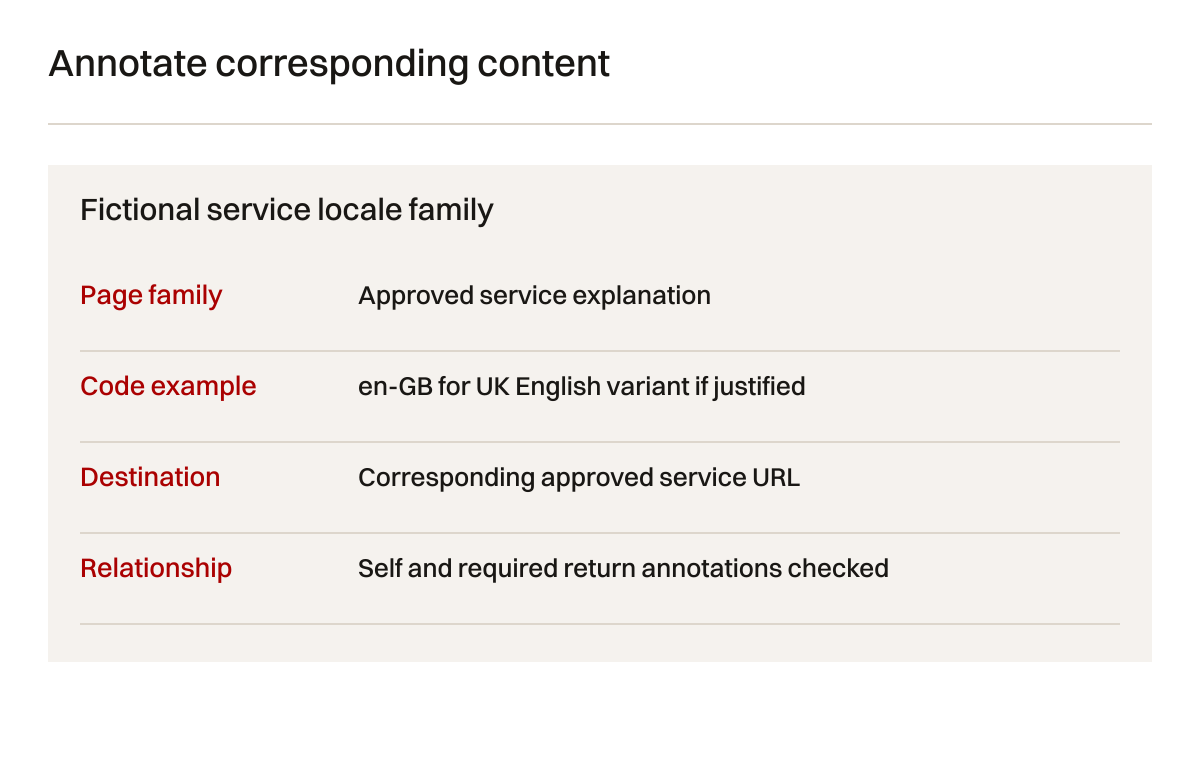
In the example, the service family has English, German and French pages. Each annotation points to the corresponding approved page. The set includes the page itself and the required return relationships. A service page should not point to a generic regional homepage merely because both have the same language label.
Choose one maintainable implementation method for the project, or understand how multiple methods stay consistent. HTML, HTTP headers and sitemap approaches have different operating implications. Duplicating them without a reliable source can produce conflicts. The important requirement is accurate correspondence and reproducible output, not the number of annotation methods used.
Align canonical and locale intent
Canonical and hreflang have different purposes. Canonical signals identify a preferred URL for duplicate or similar content. Hreflang identifies corresponding language or regional alternatives. A template that canonicalises every translated page to the English homepage can conflict with the intended public variant.
Google's canonical documentation describes preferred URL signals and their limits. Review the actual content relationship before choosing a canonical. Distinct translations generally need an implementation consistent with their intended availability, while similar same-language regional pages require deliberate handling rather than a copied default.
Test the public response for each variant. Inspect its canonical, locale annotations and relevant links. A CMS field can be correct while a shared template outputs the wrong host. A build can contain the right markup while a cache serves an earlier version. Keep the observed deployment reference with the test.
Do not interpret canonical selection as a country-availability decision. Search systems can process signals differently from the business's preference. The business must still publish accurate scope and provide a usable route when a visitor arrives on a different version. A language switch and clear availability statement support that task independently of search processing.
Make discovery consistent across variants
Link to important locale content through public navigation and relevant page-level alternatives. Google's crawlable-link guidance describes supported link implementation. A language selector that exposes only script actions may not behave like ordinary public links. Inspect its actual output and destination behaviour.
Use a sitemap to describe intended public addresses and, if chosen, supported locale annotations. A sitemap is a discovery aid rather than a guarantee of indexing. Keep it consistent with the approved current variants. Do not include draft locales that the business has not approved.
Check descriptive titles in each language. Google's title-link guidance explains how title presentation can draw on page signals. The translated title should describe the actual service rather than repeat an English keyword block. Keep visible headings and source scope aligned with it.
Google's helpful-content guidance emphasises useful information for people. Cloned country pages that add no meaningful difference do not answer a new buyer task. The international architecture should make the approved offer clearer, not simply produce more URLs.
Test the whole locale family
Build a representative acceptance set. Include the general English page, a real regional difference, a reviewed translation and an unavailable equivalent. Test direct access, page switching, annotations, files and enquiry handling. Record the role and language of the reviewer so the evidence can be interpreted.
Table 4: locale acceptance tests. These tests concern an approved fictional page family.
| Area | Test | Acceptance evidence | Remaining limit |
|---|---|---|---|
| Direct URL | Request each approved variant | Correct language and intended public content | Does not establish indexing |
| Language switching | Follow page-level alternatives | Relevant corresponding destination | Missing variants need explicit handling |
| Hreflang | Inspect the declared family | Valid codes and accurate return relationships | Annotation does not guarantee result selection |
| Canonical | Compare content intent and output | Consistent preferred destination | Search-selected state may differ |
| Technical content | Compare approved source and translation | Meaning, units and scope retained | Later source changes require review |
| Enquiry route | Submit marked request in supported language | Received record and capable owner | Delivery is not suitability confirmation |
Use deliberate failure examples. An annotation links the German service to a French homepage. A translated page links to an obsolete PDF. A contact form sends French enquiries to a team that cannot interpret them. These failures require different repairs. The acceptance set should expose the specific route rather than report that international SEO passed.
Model scope without forecasting demand
The guide's synthetic planning model starts with six proposed market variants. Three have an approved meaningful difference, two can use the current shared English explanation and one remains unconfirmed. Three plus two plus one equals six. The categories describe planning decisions under declared assumptions.
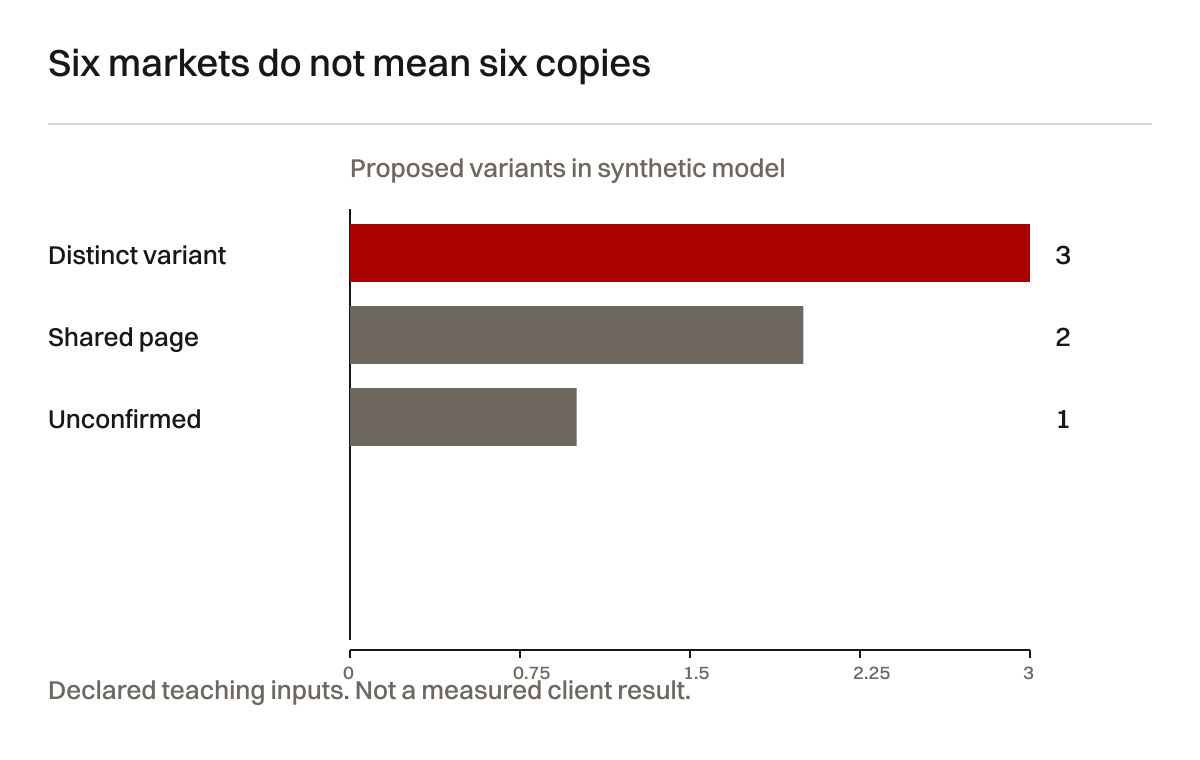
The CSV preserves the inputs and definitions. The chart does not recommend that half of every company's markets need variants. It does not forecast leads or national demand. Its purpose is to show why proposed country count and required page count are different.
Some services may justify several regional pages in one language. Others may need only a general language version and a clear availability statement. The number follows the inspected differences and the ability to maintain them. Do not multiply content beyond the team's approval and operating capacity simply because the market list is long.
Keep unresolved scope explicit. The fictional Malaysia variant remains unpublished until availability is confirmed. That is a concrete decision, not a failure of ambition. Publishing a confident local promise without an owner would create the more serious problem: buyers enquiring against a service arrangement the business cannot explain.
Measure region and language carefully
Country-level search data describes the observed search context. It does not automatically reveal the buyer's organisation, contractual market or service location. A person travelling overseas can search from one country for a project in another. Keep the measurement interpretation narrower than the business question.
Google's Search Console performance documentation explains available dimensions and filters. Use page groups, country filters and query context where the data supports them. Keep ranges and property coverage consistent when comparing. Query data can be limited, and small samples can make apparent changes difficult to interpret.
Table 5: measurement limits. Each observation needs a defined commercial relationship before it becomes a success claim.
| Observation | What it describes | Does not establish | Useful next question |
|---|---|---|---|
| Country-filtered clicks | Recorded search clicks in that context | Buyer organisation or service market | Which locale pages and queries are involved? |
| Language-page visits | Requests to a chosen page set | Reader fluency or suitability | Does the enquiry match the supported scope? |
| Form submissions | Defined intake events | Qualified overseas opportunity | Can the commercial team assess the request? |
| Indexed variant | Search processing observation | Guaranteed country result selection | Are signals and public content consistent? |
| Translation release | Approved content version | Long-term factual accuracy | Has the source changed since approval? |
Avoid comparing different page families as though they were identical cohorts. A German translation may launch later than an English regional page. A distributor page may handle different enquiries. State those differences before interpreting totals. The review should explain the decision the evidence can support, not conceal it in a combined international traffic number.
Give each variant a source and owner
The general service source needs a factual owner. Each translation needs a language reviewer and technical approval. Regional availability needs a commercial owner. The website implementation needs a maintainer for routes and annotations. These responsibilities can sit with a small team, but they should be named.

Set change triggers. A new service condition affects dependent locales. A distributor agreement affects the regional page. A document revision affects downloads. A contact-team change affects intake. A translation register should preserve these relationships so updates are not discovered by a customer months later.
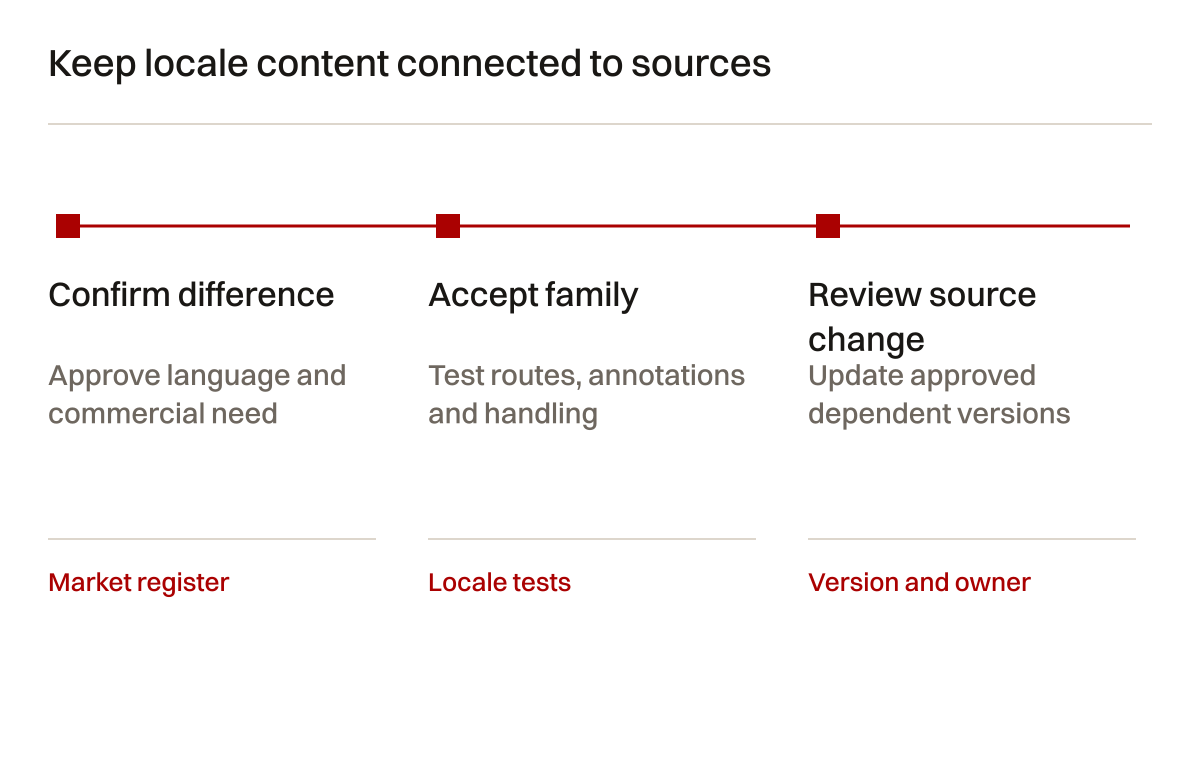
Decide what happens when a reviewer is unavailable. The answer may be to hold a new claim, publish a clear approved limitation or temporarily remove an obsolete statement. It should not be to update every language through unchecked automatic text. The operating model protects meaning as the business changes.
Work through one regional difference
The fictional supplier has a shared English service page. It confirms an Australian distributor relationship for defined work. The company creates an Australian English variant explaining that boundary and the approved enquiry route. It does not claim a company-owned Australian office or extend the distributor's scope beyond the agreement.
German and French pages are translations of the current approved service explanation. Technical reviewers check terms and units. The page family has accurate correspondence links and annotations. The UK remains on the shared English explanation because the business has not identified a useful distinct requirement. The proposed Malaysia page stays on hold.
During acceptance, the French page's PDF link points to the old English document. The document owner decides that the current approved English PDF is the available technical attachment and labels the route accurately. The team fixes the link and records the translation limitation rather than presenting an unreviewed French file as complete.
A marked French enquiry arrives, but the intake destination is initially unclear. The commercial owner assigns the capable reviewer and updates the operating note. The technical and language checks now have a usable downstream process. Search observations remain separate from that acceptance evidence.
This example produces fewer pages than the original country list. It produces more useful decisions. The result is a maintainable family whose differences are approved and whose operating limits are visible. It does not claim a measured overseas growth outcome or a guaranteed search placement.
Test an unavailable equivalent
A locale family should describe what happens when a corresponding page does not exist. In the fictional pilot, a German reader opens a narrow service explanation available only in English. The language selector should not claim a German version exists. It can offer the approved English source and explain the available next step.
The business decides whether the topic merits translation. That decision follows actual usefulness and review capacity. The developer should not produce an automatic copy simply to complete the selector. A technically complete list of languages can contain unapproved meaning, while a smaller accurate list lets the reader understand the limitation.
Test the route from both directions. The general German page may link to the English detail with a clear language note. The English detail may offer the German overview when that is the relevant available alternative. The hreflang family for the detailed service should contain only corresponding approved versions. A broader overview is not automatically equivalent content.
The acceptance record identifies the missing variant, the approved fallback and the owner who can decide on later translation. It also checks enquiry handling. If the reader submits a German question about the English-only detail, the team needs a capable review route or an accurate limitation before submission. The page should not imply a language capability the business lacks.
This scenario preserves the difference between content architecture and commercial promise. A fallback is useful when it is clear and relevant. It is misleading when it silently replaces the requested task or pretends a translation was reviewed. The objective is a usable route through the actual available material.
Propagate a source correction deliberately
In the fictional supplier, the English service condition changes after German and French pages are accepted. The source owner records the correction and identifies both dependent translations and a linked document. The operating register creates review tasks rather than updating the target text through unchecked substitutions.
The technical reviewer confirms the new meaning. Language reviewers approve the target wording. The website maintainer replaces the approved versions and tests their public routes. If one review is incomplete, the business decides whether to hold the changed claim or publish an approved temporary limitation. It does not leave contradictory confident statements without an owner.
The team checks page titles and enquiry guidance only where the correction affects them. A technical-condition update does not automatically require a new URL or a rewrite of every regional page. Change the dependent information deliberately, preserve stable routes where appropriate and retain the source version behind the decision.
The result is a traceable update across the family. The record states which source changed, which variants were reviewed and which exception remains. It does not claim that all language content is permanently accurate. Ongoing accuracy depends on the same source relationships and named people continuing to operate them.
Retain the previous approved version where the business's record process requires it. A later question about what a customer saw should be answerable from the release record, rather than reconstructed from someone's memory. This also helps distinguish a source correction from a translation correction when reviewing subsequent enquiries.
Frequently asked questions
Does every country need its own page?
No. Create a variant when it explains a real language or commercial difference. A shared page can serve several markets when its approved scope is genuinely the same. Country-name substitution alone leaves the buyer's task unchanged and creates maintenance work without new information.
Is hreflang enough to localise a website?
No. It describes corresponding variants for search systems. It does not translate meaning, confirm availability or establish an enquiry-handling process. Reviewed content, stable routes, page-level choice and operating ownership are separate requirements.
Should visitors be forced to their detected country?
Avoid assuming the detected location represents the task. Users can work across countries and languages. Offer a clear choice and preserve direct access to approved variants. Test what happens when the desired equivalent is unavailable rather than sending the user to an unrelated route.
Can automatic translation be published immediately?
Only under an approved process that provides the necessary factual and language review. Technical meaning, units and scope can change through translation. The business needs a reviewer capable of approving the target statement. A fluent-looking draft is not evidence of correctness.
Can country clicks measure market entry?
They describe a search observation, not the whole commercial process. Connect them to defined page families and qualified enquiry records where appropriate. Keep limitations visible. A visitor's location alone does not establish the project location or the company's ability to serve it.
Start with the difference that changes the buyer's decision
Bring the current service scope, the target market and the actual language or operating difference. Identify who can approve it and handle the resulting enquiry. The website architecture can then follow the facts instead of a country list.
Creatif Work can scope international website implementation and search management around approved differences and maintainable content. Technical approval and regional service promises remain with the business. Start with the problem.
Sources and limits
Official documentation checked on 4 October 2026. Country scenarios, architecture and numeric inputs are original fictional planning material.