

Service Page SEO: How to Explain Your Offer and Attract Buyers

A service page should let the intended buyer recognise a relevant problem, understand the actual scope and judge the evidence before enquiring. Research the buyer's terminology, approve the facts and make the next step usable. Search visibility supports that work, but no keyword formula guarantees qualified leads.
The company performs useful work, yet its service page says little beyond a broad capability label. Buyers ask whether a process is included, whether the company supplies installation or whether a particular material is suitable. Those repeated questions reveal information the page could explain before a call. A longer page is not automatically the answer. A clearer decision path is.
This guide focuses on implementing one service page. It does not replace a broader keyword-research project or a lead-generation strategy. Its original example follows a fictional industrial testing service. Every capability, record and number is a teaching assumption rather than a claim about a real provider. Photographs are generated illustrations.
Download the service-page brief workbook or editable CSV pack. Five captioned tables show the working registers. The earlier technical repair guide helps when a useful page is affected by a confirmed implementation fault.
Start with the buyer's decision
A visitor can arrive with a problem, a process name, a supplier category or a required outcome. The page should help that person decide whether the company is relevant. Ask what the buyer knows already and what must be clarified before a useful enquiry. The answer differs between an engineering reviewer and a founder buying an unfamiliar service.
Collect actual questions from authorised enquiry records, staff interviews and existing materials. Remove private details from working examples. Separate direct observations from assumptions. A phrase that one salesperson prefers is not evidence that every buyer uses it. A query observed in search data is evidence of a particular search context, not automatic proof of commercial intent.
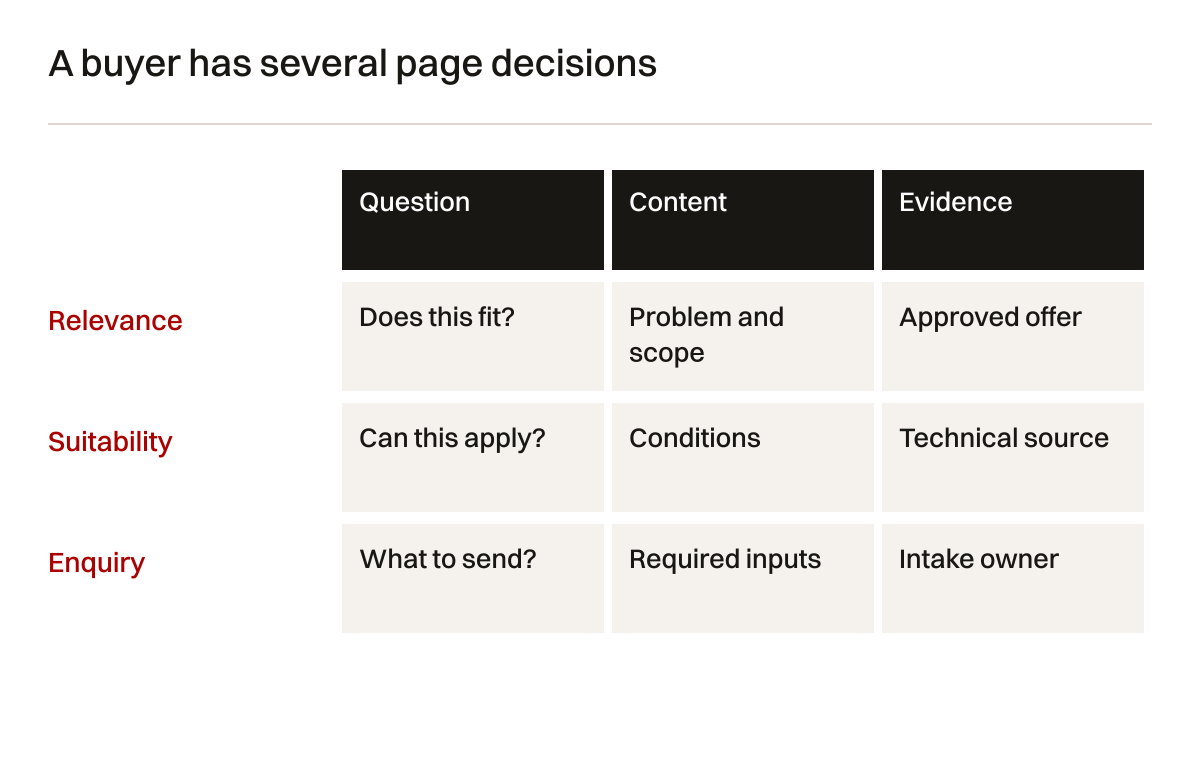
Table 1: buyer intent. This fictional industrial service uses different content for different decisions.
| Buyer task | Likely question | Useful page content | Evidence to seek |
|---|---|---|---|
| Recognise relevance | Can this service address the application? | Plain problem and use-case explanation | Approved scope and observed buyer questions |
| Check boundary | Is this process included? | Included work and conditions | Technical owner confirmation |
| Assess suitability | Can the required material be tested? | Materials, limitations and method context | Current approved capability record |
| Compare suppliers | What evidence can be reviewed? | Relevant project or process evidence | Permission and factual source |
| Prepare enquiry | What information should be sent? | Required inputs and safe document route | Commercial and technical intake needs |
| Continue research | Where are related details? | Relevant internal links and downloads | Actual destination usefulness |
The page should not try to answer every industry question. Choose the decisions that belong to this service and connect deeper topics where they help. A service page is a practical qualification route. A research article can explore a narrower technical question without carrying the whole commercial explanation.
Define the service boundary before drafting
Write what the company performs, under what conditions and where responsibility ends. Separate assessment from approval, supply from installation and inspection from certification where those distinctions apply. The factual owner should approve the language. A writer should not infer a regulated or technical authority from a generic service title.
List exclusions that prevent a misleading enquiry. A company may accept particular materials but exclude others. It may provide a report without guaranteeing acceptance by a third party. It may operate in one geography while accepting requests from elsewhere under different arrangements. State the limits that actually change the buyer's decision.
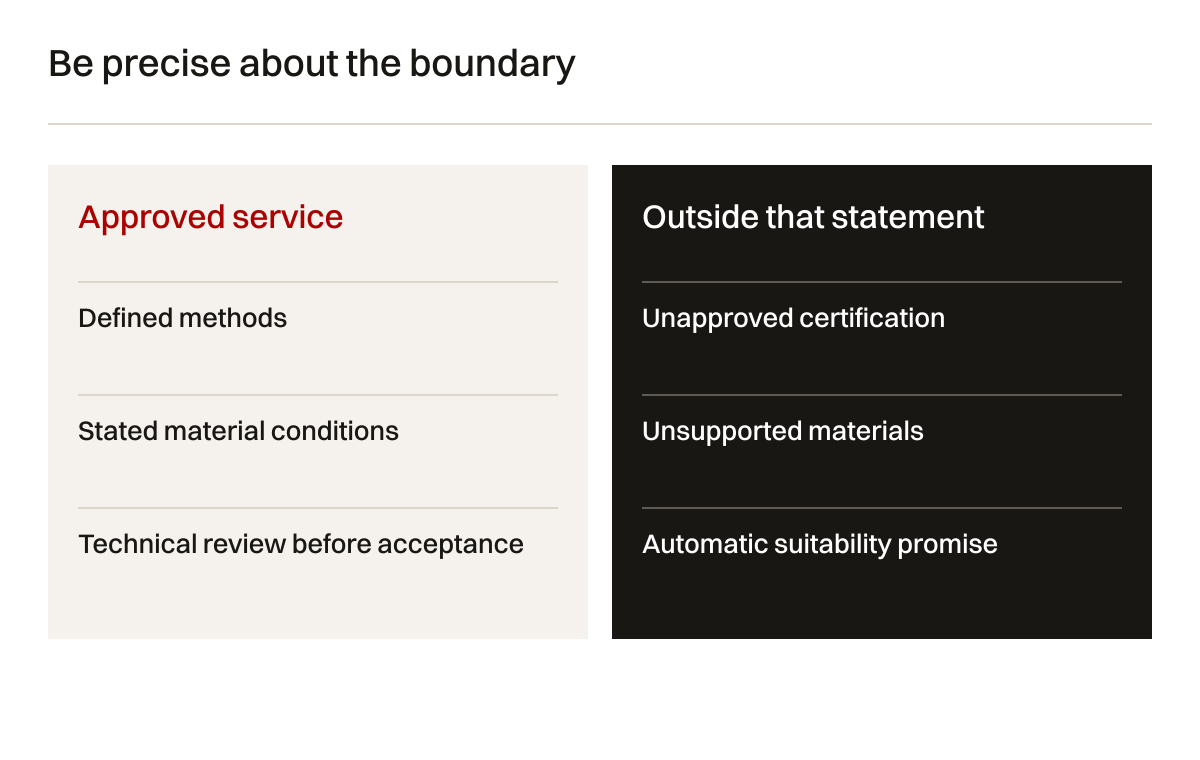
An exclusion can be useful without becoming a wall of disclaimers. Place it near the related scope statement. If a buyer asks about a different task, connect to the correct page only when that service genuinely exists. Do not imply that the company performs everything adjacent to the topic merely to retain the visitor.
In the fictional testing service, the approved page says the team evaluates specified components through defined methods. It does not claim every industry approval. It asks the buyer for material, application and required evidence. That wording narrows the conversation so the technical reviewer can respond usefully.
Translate terminology without flattening meaning
Use the terms buyers recognise while preserving technical accuracy. A buyer may name the symptom, while a technical lead names the process. The page can connect both. Explain the relationship in ordinary language rather than replacing precise terms with vague benefits.
Keep a terminology note in the brief. Record the buyer phrase, approved technical term and any ambiguity. If two phrases refer to different work, do not combine them merely because a keyword tool groups them. Search similarity is not technical equivalence. The subject owner decides whether a statement is accurate.
Google's SEO starter guide describes practices that help users and search systems understand content. It does not prescribe a universal keyword density. Use descriptive headings and natural terminology where they explain the task. Repeating the same phrase in every paragraph makes a page harder to assess.
Test the draft with someone outside the writing process. Ask what they believe is included, what they would send and what remains uncertain. Their interpretation can reveal missing conditions or confusing terms. Record the observed misunderstanding and revise the relevant explanation. This is a bounded comprehension check, not a prediction of conversion performance.
Build the page around information dependencies
The buyer needs context before detailed evidence. Begin with the relevant problem and a direct explanation of the service. Then explain scope, conditions, evidence and enquiry preparation. The exact sequence can vary, but each section should answer a question the preceding section creates.
Do not add blocks because a competitor uses them. A three-column feature list may conceal important conditions. A decorative process graphic may duplicate a short sentence. A long list of adjectives may leave the actual service unclear. Choose a presentation that preserves the facts and supports the buyer's next decision.
Table 2: page content brief. Required content follows this fictional service's qualification tasks.
| Section | Reader decision | Required information | Approval owner |
|---|---|---|---|
| Opening answer | Is this relevant? | Problem, service and intended use | Commercial and technical owners |
| Scope | What is included? | Activities, conditions and exclusions | Service owner |
| Application detail | Does my situation fit? | Materials, method context and limits | Technical reviewer |
| Evidence | What can I assess? | Approved examples and source context | Evidence owner |
| Enquiry preparation | What should I send? | Minimum inputs and safe file route | Intake owner |
| Related information | What else do I need? | Useful pages and current documents | Content owner |
Use the brief to identify gaps before design. If the evidence row is empty, a larger image does not solve it. If the scope is unclear, an FAQ may help only after the owner supplies an answer. The brief should preserve unanswered questions instead of filling them with generic marketing copy.
Put evidence beside the claim it supports
A project photograph can establish what is shown, subject to its caption and permission. It does not automatically prove capacity, precision or measured performance. A certificate has a specific entity, period and scope. A case study has a defined project context. Use evidence with those limits visible.
Google's helpful-content guidance asks publishers to provide useful, reliable information with original value. In a service page, that means a buyer should be able to distinguish supported facts from broad assertions. Technical approval remains a business responsibility.
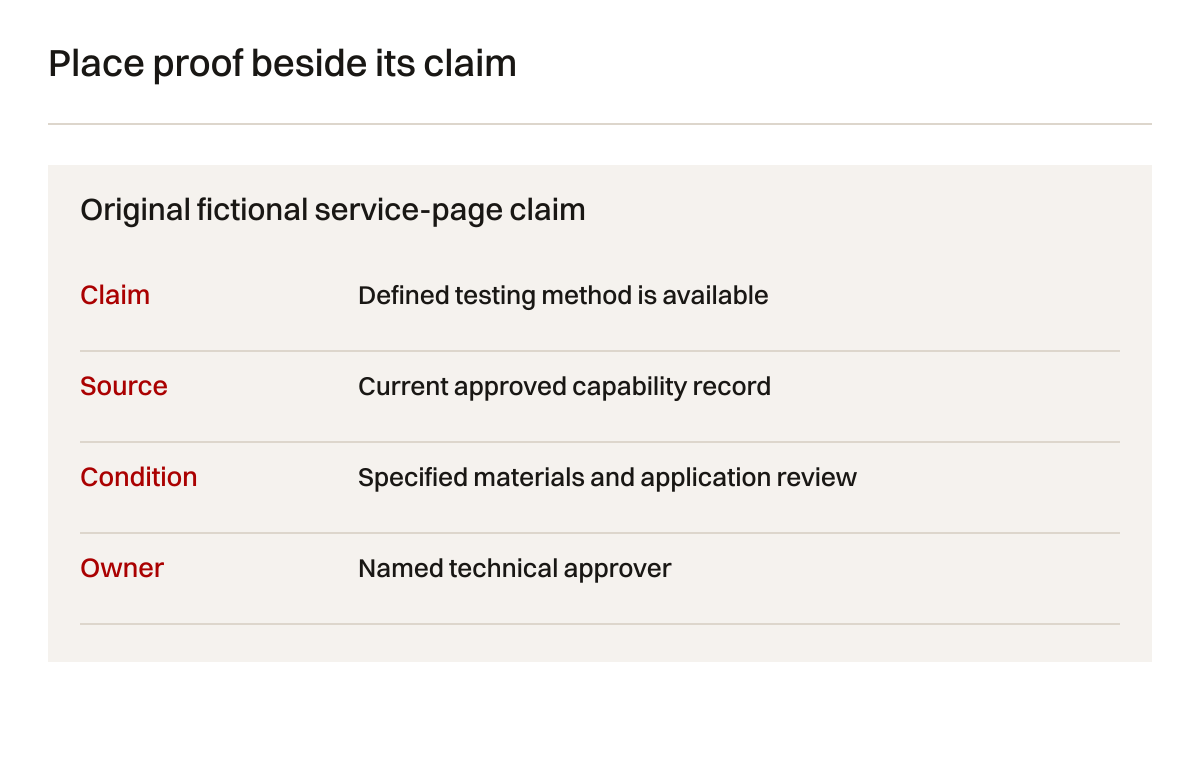
Table 3: evidence register. These examples avoid treating an illustration as measured proof.
| Claim type | Suitable source | Public explanation | Limit to retain |
|---|---|---|---|
| Available process | Approved capability record | Name process and relevant conditions | Capability is not every application's suitability |
| Project experience | Approved project record | Explain the actual scope performed | One project is not a universal result |
| Certification | Current authorised certificate | State entity, scope and validity context | Do not extend beyond the certificate |
| Test method | Approved method reference | Explain how it relates to the enquiry | Method reference is not a guarantee of acceptance |
| Equipment photograph | Rights-cleared image and caption | Describe what is visible | Image does not prove current capacity |
| Generated work scene | Image provenance | Label illustrative context | No real project or result is represented |
Remove claims that cannot be approved. If the business wants to publish a measured outcome, retain the method, source and permission. Do not invent a statistic because the page layout expects a number. A plain account of the work can be more useful than a precise-looking figure with no defensible origin.
Use worked examples with declared boundaries
A teaching example can show how the service applies to a buyer decision without pretending to be client evidence. Label it clearly. State the assumed application, input and question. Explain the decision route rather than inventing a successful commercial result.
For the fictional industrial service, a buyer has a component that needs an evaluation under specified conditions. The page asks for material, relevant dimensions, application and required report context. It explains that the technical team must review the request before confirming suitability. The example shows the information gap, not a guaranteed acceptance.

Use alternative scenarios where they change the decision. A missing material specification needs clarification. An unsupported method belongs outside the approved scope. A buyer asking only for a supplier category needs a clear service description. These are different page and intake needs, not opportunities to repeat the same sales claim.
Keep real examples separate when the business later supplies them. Verify permission, factual scope and any result before replacing a fictional example. A generated image can remain illustrative, but it should not be placed as though it documents the real project. The caption and surrounding prose must preserve that distinction.
Write titles and snippets as descriptions
The title should identify the service clearly enough for the intended buyer. A location can matter when the service genuinely depends on it. A technical qualifier can matter when it distinguishes the offer. Do not add every adjacent keyword or unsupported geography simply because the title has room.
Google's title-link guidance explains that search title presentation can draw on several page signals. Align the title, visible heading and actual content. A title promising a capability absent from the page creates a factual and usability problem even before search systems interpret it.
Google's snippet documentation explains how snippets can be generated from content and, sometimes, meta descriptions. Write a concise description of the actual page. Do not treat a character-count rule as a guarantee of the exact search snippet or display length.
In the fictional brief, the title names the testing service and its meaningful application. The description states the scope and enquiry inputs. It avoids guaranteed approval, invented turnaround time and unsupported comparative claims. The buyer should find the promise fulfilled when opening the page.
Link the service to useful context
Internal links should answer a continuing buyer question. A process page can link to relevant materials. A case study can link to the service performed. A service page can link to an approved technical explanation. Keep anchor text descriptive enough to establish the relationship.
Google's crawlable-link guidance describes supported links and useful anchor text. The implementation should expose actual destinations. A button that only triggers a script can behave differently from a normal link. Check how the route works through the public page.
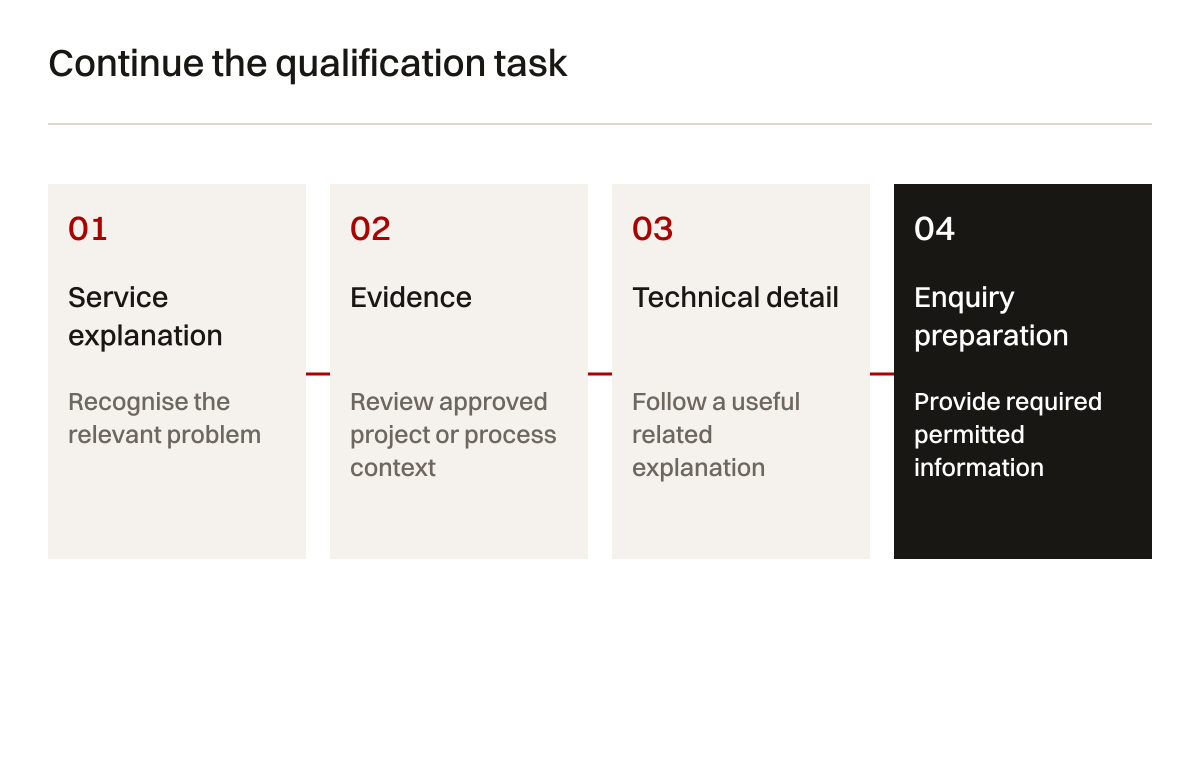
Do not create links solely to distribute a phrase. Ask whether the destination helps the reader. Two services with different scopes should remain distinguishable. A broad parent page can help navigation, while detailed pages answer specific tasks. Avoid duplicating the same content across many thin service variants.
Check downloads and external references. A useful technical PDF needs a current source and owner. An external standard reference should support the claim actually made. Linking a recognised organisation's homepage does not prove a specific service statement. Use the direct relevant source where appropriate and record its review trigger.
Prepare the enquiry before adding fields
The form should collect information required for the next meaningful action. Ask the intake team which fields support triage and which can wait. A long form can deter a buyer who has not yet confirmed relevance. A form with too little context can produce avoidable clarification work. The decision depends on the service.
Separate required from optional inputs. Explain unfamiliar fields in buyer language. If a document upload is offered, confirm permitted file types, size and handling. Do not imply that a public form is an approved route for protected drawings until the actual sharing process has been reviewed.
Table 4: enquiry fields. This fictional intake asks for qualification information rather than unrelated personal data.
| Field | Purpose | Required condition | Handling question |
|---|---|---|---|
| Contact and company | Identify reply route | Needed to continue request | Who receives and stores the record? |
| Required service | Route the enquiry | Buyer can choose or describe need | What happens when the choice is uncertain? |
| Application | Understand relevant context | Needed for technical review | What level of detail is safe initially? |
| Material or process | Check suitability | Required when scope depends on it | Who clarifies an unknown value? |
| Supporting file | Review permitted evidence | Optional or separately agreed | Are access and retention defined? |
| Timing context | Understand buyer constraint | Optional unless needed for triage | Avoid implying a promised delivery date |
Use clear labels and helpful error messages. The W3C form-label guidance explains how labels support accessible controls. A placeholder alone is not a reliable substitute for a proper label. Test keyboard use, small-screen interaction and error correction through the actual form.
Follow the request beyond submission
A success message is one stage. Confirm the request is stored where intended, the notification arrives and the responsible person can find it. A technically accepted form submission can still fail later delivery or commercial routing. Define the complete acceptance route.
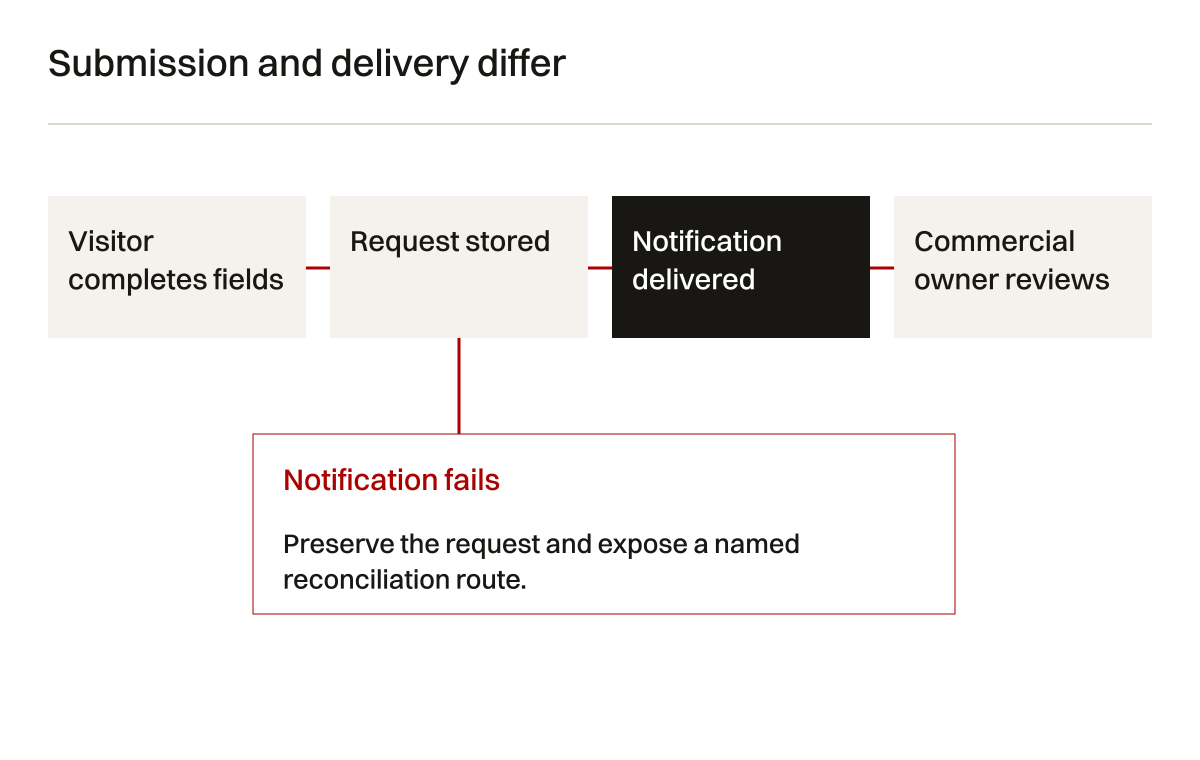
Use a marked fictional test. Record device, route and expected destination. Test a missing required field, a valid submission and a supported attachment where relevant. Verify duplicate handling if the form can be submitted twice. Keep tests clearly separated from real customer requests in the receiving process.

Ask the intake owner what happens next. Does the coordinator clarify the request, assign a technical reviewer or send an acknowledgement? The page should not promise a response time or acceptance that has not been authorised. It can accurately explain the next decision so the buyer understands what submitting the form means.
Test after meaningful changes. A new form plugin, mailbox destination or page template can alter the route even when the copy stays unchanged. The page review register should include operating dependencies, not only proofreading. A useful service page requires both accurate information and a working next step.
Model completeness without inventing conversion targets
The synthetic content model uses ten buyer questions gathered for a fictional brief. Six have approved page answers, three require a technical source and one falls outside the service. Six plus three plus one equals ten. This is a planning inventory, not a recommended page length or conversion benchmark.
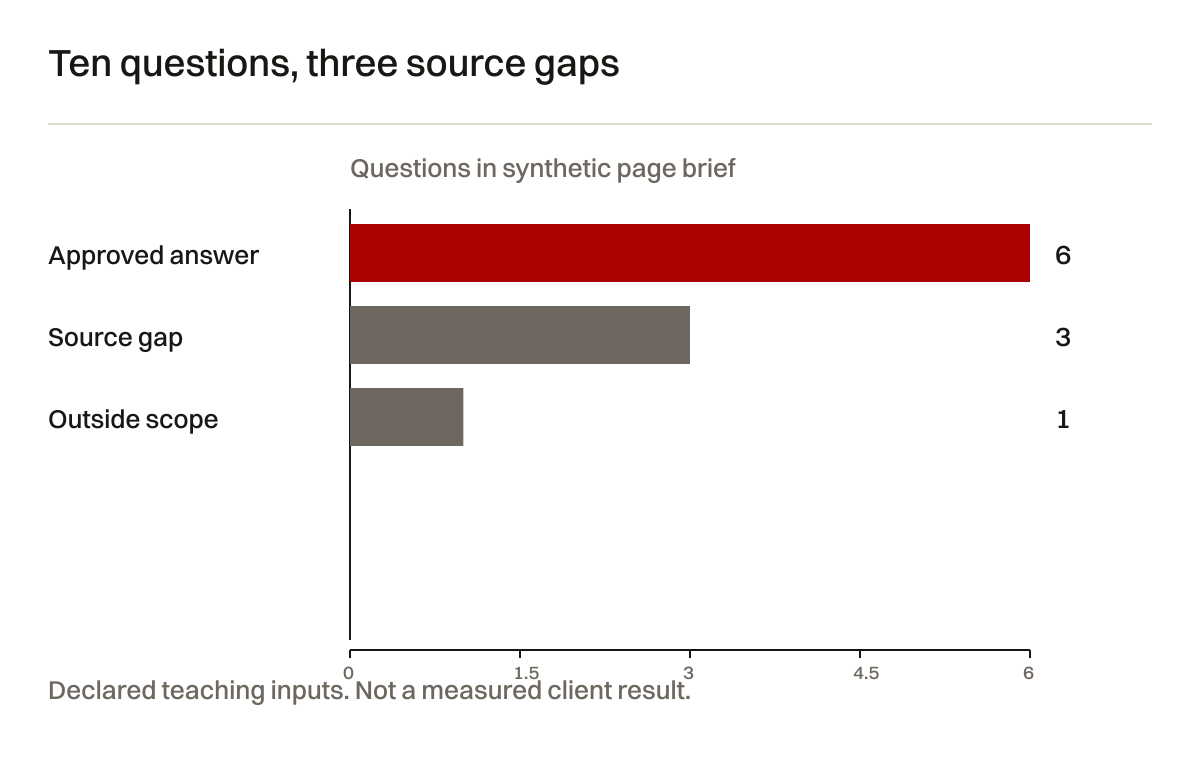
The CSV preserves those assumed inputs. The out-of-scope question still needs a deliberate response, perhaps a clear limitation. It should not be answered with an invented capability merely to produce a completed count. The three source gaps should block unsupported copy until the factual owner provides a decision.
A real page can be short and complete for its task or long and still leave the crucial question unanswered. Count the evidence gaps to manage drafting, then review meaning. Do not interpret more sections, keywords or images as automatic quality. The useful unit is the buyer decision the page can now support.
Where measurement is available, separate page visits, form starts, submissions, received requests and qualified enquiries. A form submission is not automatically a qualified buyer. A small change in totals may be hard to interpret. Define each stage before assigning a numerical target or claiming the page caused a commercial result.
Review search evidence with its limits
Use Search Console to inspect how the page appears in available search observations. Segment relevant pages and query groups where the data supports it. Keep date ranges, exclusions and changes to the page with the review record. Search data can inform a question; it does not approve a technical claim.
If irrelevant queries dominate, investigate what the page says and how it connects to the offer. If useful queries have low visibility, inspect the page's factual completeness, competition and technical condition before choosing a change. Avoid assuming every issue can be fixed by adding a phrase to the title.
Google's AI features guidance explains that its relevant search features use established eligibility and content principles. It does not provide a guaranteed citation method. Keep the service page useful, accessible and supported. Do not add an invented AI-specific checklist that promises inclusion.
The business should ask which observation would change the next decision. A repeated buyer question can justify clearer scope. A confirmed technical restriction can justify repair. A weak statistic without enough context may justify waiting for better evidence. The review process should preserve uncertainty where the data does not resolve it.
Give the page an operating owner
Service pages age when the business changes. Equipment, methods, staff responsibilities, contact routes and project permissions can all change. Assign factual owners and review triggers. A calendar review can help, but a known service change should not wait for the next scheduled proofreading session.
Table 5: review responsibilities. Each owner should know which change creates a task.
| Area | Factual or decision owner | Working owner | Review trigger |
|---|---|---|---|
| Service scope | Commercial and technical leads | Content editor | Offer or operating capability changes |
| Specifications | Technical reviewer | Page and document owners | Method, material or equipment change |
| Project evidence | Project and rights owners | Content editor | Permission, scope or context changes |
| Enquiry route | Commercial operations | Form and delivery administrators | Routing, platform or staffing change |
| Internal links | Website owner | Content maintainer | Related page or file moves |
| Search observations | Commercial decision maker | Search practitioner | New evidence or meaningful release |
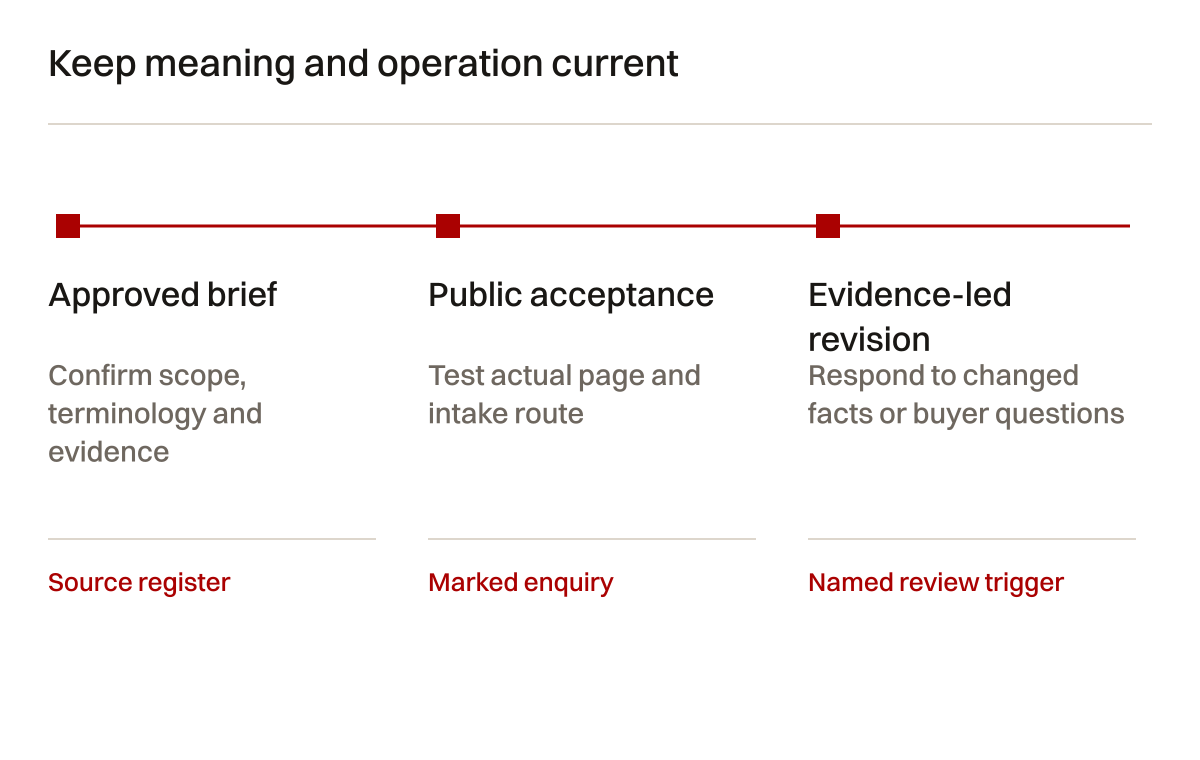
Keep one source record behind repeated facts. If the same capability appears on the homepage, service page and PDF, a change should reach all three. Record the dependent material. Otherwise the page can be accurate while the downloaded document contradicts it. The reader experiences one business, even when several internal teams maintain the material.
Work through a scope misunderstanding
A fictional service page uses the phrase component testing without conditions. Buyers repeatedly ask for an approval that the company does not provide. The technical owner clarifies the actual methods and report scope. The writer adds those facts near the opening explanation and removes an unsupported phrase from the old copy.
The page brief records three application questions that still need sources. They remain unpublished rather than being filled with general claims. An original worked example shows what information a buyer should provide. It makes clear that technical review determines suitability. The enquiry form collects those inputs with accessible labels.
During testing, the form confirms submission but sends notifications to an unattended old mailbox. The operating owner corrects the route and confirms a marked request in the commercial record. The page is now accepted for accurate scope and tested intake. The team still needs later observations to assess how actual buyers use it.
The example distinguishes copy accuracy, source approval and operating delivery. It does not claim a conversion increase. A service page project should report those immediate changes and their evidence before making broader commercial assertions. The remaining question is what real buyer behaviour shows after release.
Test the page with an incomplete enquiry
A service page should help when a buyer does not know the exact technical term. In the fictional test, the visitor describes a component problem but cannot select a method. The page offers a plain explanation of the available review route and the information needed for an initial discussion. It does not require the buyer to impersonate a technical specialist.
The test participant chooses an uncertainty option and supplies the application context. The receiving coordinator can see that uncertainty and route it for clarification. If the form forces a specific method, the buyer may choose an incorrect value simply to submit. The resulting record looks precise while carrying an assumption nobody approved.
Observe whether the page explains the difference between an enquiry and confirmation of suitability. The next action is technical review. The page should not say the service has been booked merely because the form accepted an application description. State meaning belongs in both the interface and the commercial process.
The team also tests a request outside the declared material range. The page explains the actual limit and provides an appropriate next route if one exists. It does not conceal the exclusion in a footer. The coordinator can identify the reason without comparing several contradictory pages. This is useful qualification behaviour even when it leads the buyer to recognise that the service is unsuitable.
Keep the evidence from the exercise as a specific comprehension and intake check. One participant completing the task does not prove a future conversion rate. It can still reveal a concrete wording or field problem that the team can correct before release. The practical result is an enquiry record with meaning the receiving person can interpret.
Check one claim across all its copies
The fictional material condition appears on the service page, a capability PDF and a homepage summary. The technical owner changes the approved condition. Updating only the service page leaves buyers receiving a different statement from the download. The brief should identify those dependent copies before publication.
The content owner records the authoritative statement and each destination. The document owner updates the PDF. The website editor updates the summary. The team opens the actual public download and compares all three. A CMS preview does not establish that the current downloadable file was replaced.
Keep the next review trigger with the source. A capability change should create a task wherever that fact appears. The page's maintenance is therefore a source-and-dependency process, not only a calendar reminder to read it again. That distinction is especially useful when several teams approve different parts of the offer.
Frequently asked questions
How long should a service page be?
Long enough to answer the relevant buyer decisions with accurate scope and evidence. Google does not prescribe a preferred word count for useful content. A fixed length can encourage repetition. Use the brief to find missing information and remove sections that do not help the specific qualification task.
Does every keyword need its own page?
No. Similar wording can describe the same task, while superficially similar phrases can describe different technical work. Decide page boundaries through buyer intent and approved scope. Avoid creating many copies that change only a place name or keyword variation.
Are FAQs useful for service-page SEO?
They are useful when they answer genuine unresolved buyer questions. Put essential scope in the main explanation rather than hiding it only in an FAQ. Do not invent questions to repeat keywords or imply that FAQ markup guarantees a particular search appearance.
Can a generated image serve as proof?
It can illustrate a work context if its provenance is clear. It does not document a real installation, process result or client outcome. Use approved photographs, records and permission for factual evidence. Keep illustrative images distinct from those sources in captions and prose.
What is the first useful measurement?
Check that the actual page is accurate and the enquiry route works. Later, use defined search and intake observations to assess buyer behaviour. A page visit, form submission and qualified request are different measures. Do not collapse them into a single success claim.
Start with the question buyers keep asking
Bring the repeated question, the current page and the approved service scope. The gap between those records usually reveals whether the work is terminology, factual approval, evidence, layout or enquiry handling. Write and test the page around that gap.
Creatif Work can connect search research and review with website design and implementation around a specific service decision. The business retains authority for technical scope and claims. Start with the problem.
Sources and limits
Official sources checked on 4 October 2026. The service, content inventory and worked example are fictional original teaching material.