

What Makes a Website Visible in Google AI Overviews?

There is no switch that places a company in Google AI Overviews. There is also no special AI schema that guarantees inclusion. Google says the foundations remain the same: pages must be crawlable, indexed, eligible for a snippet and useful to the person searching.
That is less exciting than an AI visibility hack. It is also more actionable.
What makes a page eligible for AI Overviews?
Google says a page must be indexed and eligible to appear in Search with a snippet. There are no extra technical requirements for AI Overviews or AI Mode. Useful, original content, clear internal links, accessible text, relevant images, sound technical SEO and a good page experience all support visibility, but inclusion is never guaranteed.
Google's AI features and your website documentation is explicit on those points. Its 2026 generative AI optimization guide also warns against commodity content, unnecessary AI files and pages created for every query variation.
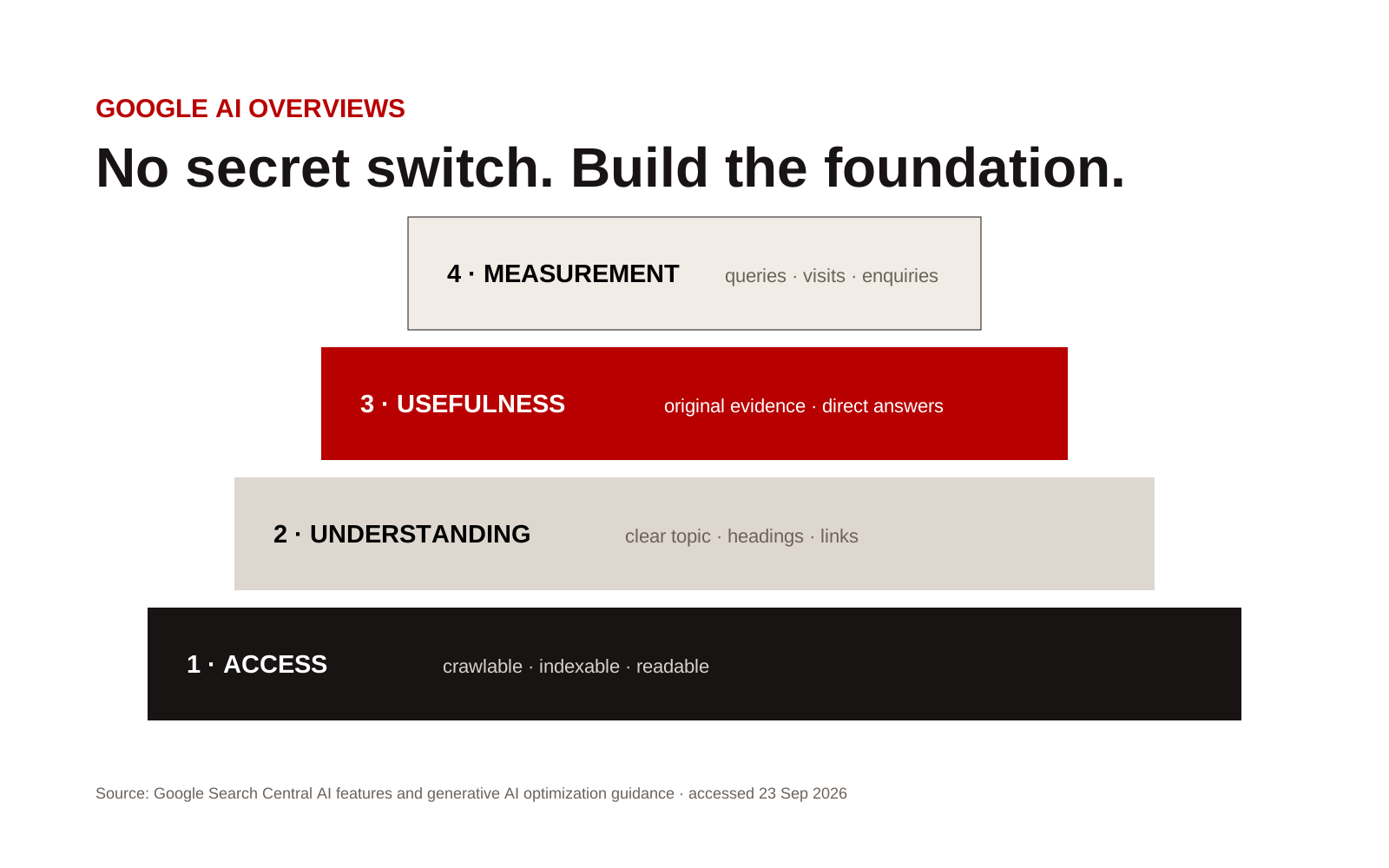
AI search visibility model showing crawlability, useful evidence, clear structure and measurement.
Work on four layers, in order
| Layer | Practical check | Common failure |
|---|---|---|
| Access | Googlebot can crawl the page and important content is in readable HTML | Key copy is blocked or hidden in an inaccessible interface |
| Understanding | Clear title, headings, entities, dates and internal links | A vague page tries to cover several services |
| Usefulness | Original evidence, direct answer, examples and boundaries | The page rewrites what every competitor says |
| Measurement | Search Console, conversions and enquiry quality are reviewed | Success is judged by one manual search |
Do not reverse the order. Adding structured data to an inaccessible or empty page does not solve the real problem.
Publish information only your business can supply
AI search systems can summarise generic advice from many sources. A useful supplier page contains material that is difficult to replace:
- exact service and geographic scope;
- named technical process and responsibility;
- original project evidence with a clear boundary;
- comparison tables based on real decisions;
- current dates, authorship and source links;
- clear answers to buyer questions.
Google describes this as valuable, non-commodity content. A practical test is to remove the company name. If the page could sit unchanged on twenty competitor websites, it probably needs more first-hand substance.
Make the page easy to retrieve and quote accurately
Answer the main question early, then support it. Use descriptive headings instead of clever labels. Keep units, dates and conditions beside the claim they qualify.
Internal links should connect the answer to deeper evidence. A service page can link to a project case study, technical guide and contact route. The case study should link back to the relevant service. This helps users move through the decision and helps search systems discover the relationship.
Images should add meaning. Use descriptive alternative text for diagrams and project visuals. If a chart presents changing data, put the source and date in the visual and the article. Google's guidance notes that relevant images and video can create additional search opportunities.
Structured data helps with clarity, not special access
Use structured data when it accurately represents visible content and is supported by Google for a relevant search feature. Do not create markup for claims that are absent from the page.
There is no special schema for AI Overviews. There is also no need to break every answer into tiny fragments. Google says its systems can understand nuance and that there is no ideal page length. Write enough to resolve the decision.
Our engineering AI search guide shows how this applies to technical suppliers, where model numbers, standards and project boundaries matter more than broad thought leadership.
Measure business value, not just mentions
Search visibility should connect to useful behaviour. Review:
- impressions and clicks in Search Console;
- landing pages receiving qualified visits;
- enquiry type and project fit;
- branded and non-branded query themes;
- pages that attract attention but fail to move readers onward.
Google announced dedicated generative AI performance reporting in Search Console in 2026, but reports and availability can change. Use the current product documentation rather than a fixed screenshot in a strategy deck.
Avoid the pages that look useful only to a crawler
Do not create near-identical pages for every wording of a search. A set of thin location or question pages can make the site harder to maintain and give readers no new evidence. Google specifically warns that high page volume does not make a website more relevant and that scaled content created mainly to manipulate results can violate spam policies.
Create a separate page when the decision, evidence or audience genuinely changes. A service page for marine procurement may deserve different examples and technical fields from a general website page. A page that changes only the city name probably does not.
When two pages answer the same question, decide which one should be primary. Merge useful material, redirect the retired URL where appropriate and update internal links. The aim is a smaller set of strong answers that the business can keep current.
A monthly visibility check
- Confirm important pages are indexable and internally linked.
- Update facts, dates and unavailable offers.
- Add first-hand evidence to thin service pages.
- Merge overlapping pages that answer the same decision.
- Check that structured data matches visible content.
- Review enquiries, not rankings alone.
Creatif Work combines website design with ongoing SEO and AI visibility work. The one-time build creates the technical and editorial foundation. Regular evidence, review and improvement are what keep the site useful as buyers, competitors and search products change.