

What a Useful SEO Audit Should Actually Tell You

A useful SEO audit explains which problems affect suitable buyers, how the findings were verified, what should change first and how the result will be checked. A list of tool warnings is an input. It is not a diagnosis. The final document should let a founder approve a decision and let the implementing team reproduce the evidence.
You receive a long PDF. It reports missing descriptions, duplicate headings and several hundred errors. The score is low. The recommended response is more content and a larger retainer. Yet nobody explains which pages matter to your business or whether the contact form works.
That is the situation this guide addresses. It offers an audit structure you can use before buying work, when reviewing a provider's report or when deciding whether an existing website needs repair. The examples are hypothetical. No client website, search gain or private analytics result is represented.
Download the SEO audit action workbook or the CSV template pack. Its records separate observations, decisions and completed checks. They are blank working tools with clearly labelled sample rows, not invented audit findings.
Begin with the decision, not the crawler
An audit has a purpose. Perhaps a marine service company is getting unsuitable enquiries. Perhaps a construction contractor's recently launched service pages are absent from search. Perhaps a manufacturer is considering an agency change. Each problem needs different inspection work. A generic crawl cannot tell you which one matters.
Write a short audit brief before granting access. Name the relevant services, countries, languages, buyers and commercial concern. Identify what the business can actually deliver. An audit that recommends UK landing pages without checking UK delivery responsibility is solving a keyword opportunity rather than a business problem.
Ask what decision the audit must support. Should the company repair a template, revise service information, improve enquiry delivery or investigate traffic? The eventual answer can differ from the starting hypothesis. The brief should still make the investigation accountable.
Define the exclusions too. A public website review cannot measure qualified leads without authorised enquiry records. A technical inspection cannot prove the quality of every engineering claim. A search specialist can identify missing scope information but needs the service owner to confirm what belongs there.
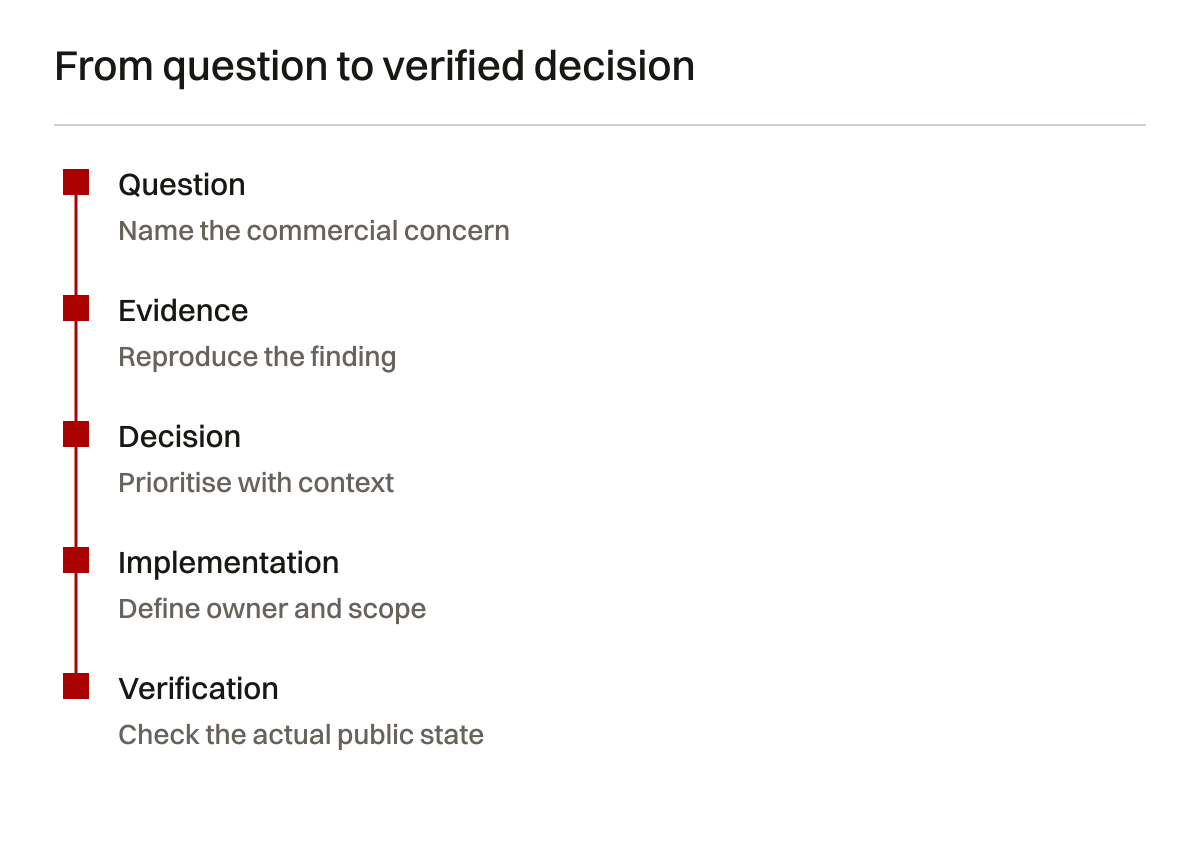
What would change your mind?
A good brief contains competing explanations. Low enquiries might reflect unsuitable traffic, poor page information, a failed receiving mailbox or lower demand. Record what would support each explanation. This prevents the preferred service package from becoming the answer before anyone investigates.
Suppose a construction consultancy wants more enquiries from developers. The audit should not assume every page needs a rewrite. It might find that appointment scope is unclear on one commercially important page while the rest performs its basic task. The useful recommendation could be a specific scope correction and a better enquiry route.
Set a stopping point. Once the evidence establishes a problem well enough to justify a low-risk repair, further research may have little value. Conversely, an expensive rebuild needs more than a crawler score. Match investigation depth to decision risk rather than the number of pages promised in a proposal.
Inventory pages by what they help someone do
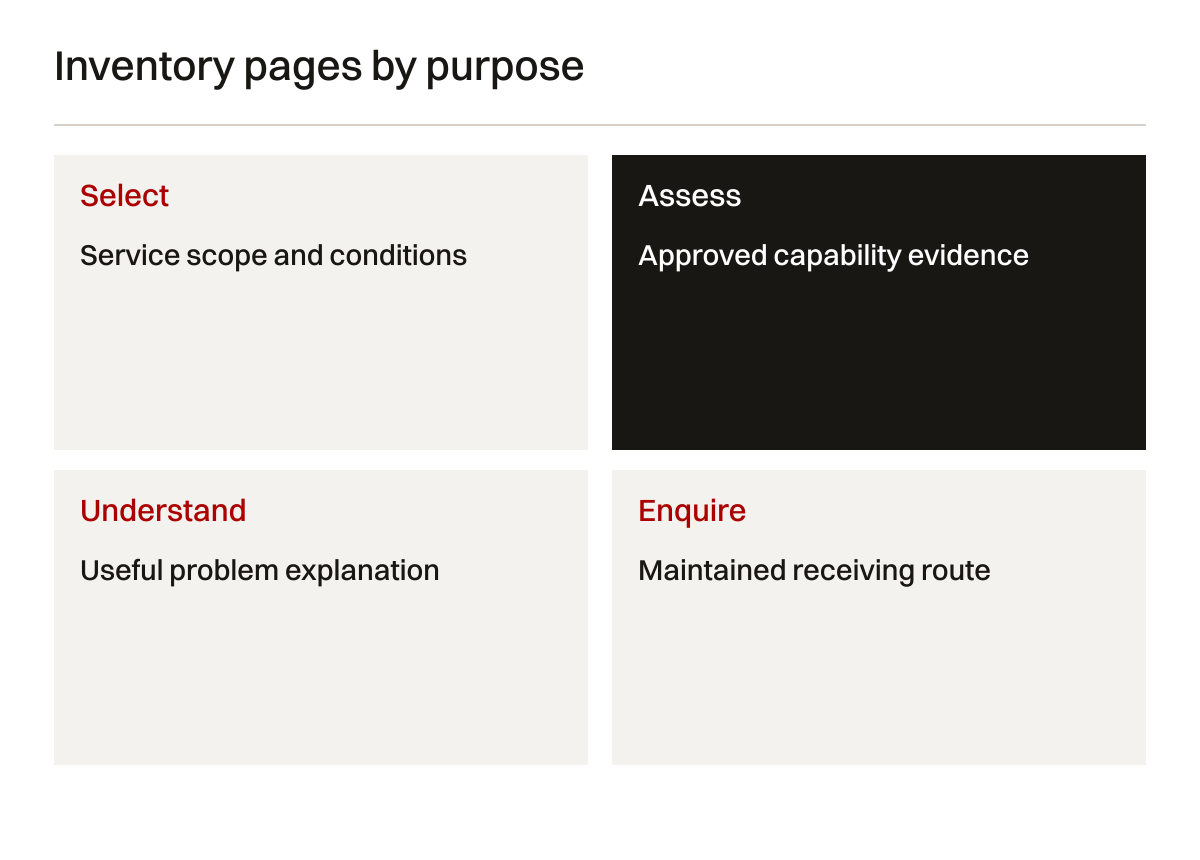
A URL list needs a second layer: purpose. A capability page should help a buyer assess suitability. A project page should provide permissioned evidence. An article should answer a defined question. A contact page should explain what information to send and where it goes.
Mark commercially important paths first. For an engineering firm, that may be a technical service page, an industry application page and a drawing-submission route. For a marine supplier, it may be parts compatibility, operating coverage and a request for availability. Homepage traffic alone cannot stand in for those tasks.
Include documents and alternative paths. A buyer may arrive through a PDF, an old project link or a translated page. The audit should examine the route that exists, not only the latest navigation. A download that promises an obsolete certification can be a more serious issue than a missing blog description.
Separate page findings from template findings
One broken template can affect many pages. One inaccurate service statement may affect only one. Both matter, but they need different repair and verification plans. Group repeated technical findings so the document does not inflate a single cause into hundreds of apparently independent problems.
| Page purpose | Evidence to inspect | Question for the owner | Potential decision |
|---|---|---|---|
| Service selection | Scope, conditions and next step | Is this offer current? | Correct service information |
| Capability checking | Approved technical records | What can be claimed publicly? | Add suitable evidence |
| Project assessment | Permission, dates and responsibility | What did the team actually do? | Repair misleading case-study copy |
| Problem research | Answer, sources and related pages | Does this help a suitable buyer? | Improve, merge or retire content |
| Enquiry submission | Actual delivery and receiving process | Who responds to the request? | Fix the receiving route |
This is a planning framework, not a rating of your pages. An auditor should populate it from inspected URLs and approved business information. “Service page weak” is not an adequate finding. Identify what is missing and why it affects the buyer's decision.
An existing page can need less copy rather than more. If a manufacturer's page mixes three different services, separating their conditions may help. Adding another thousand words can make the same confusion harder to navigate. The audit should recommend the smallest change that resolves the observed problem.
Demand a reproducible finding record
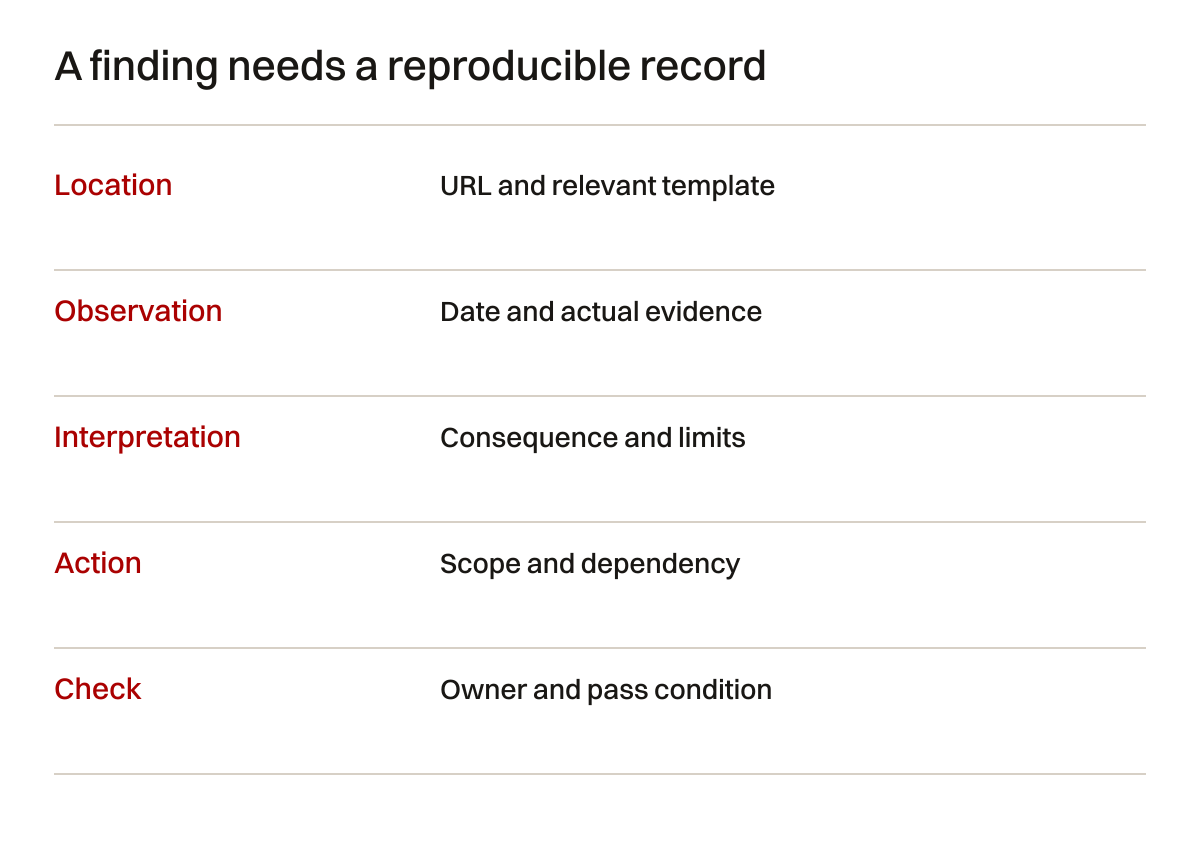
Every material finding needs a location, observation, basis and implication. Record the actual URL, the date, the device or test context, relevant settings and evidence. State whether the finding was observed directly, inferred from a sample or reported by a tool.
The record should also contain a proposed action, dependency, owner and verification method. A screenshot can show what the auditor saw. It cannot explain all of this by itself. The implementation team needs enough detail to reproduce the problem after receiving the report.
Example: a commercially important page is excluded
Consider an illustrative service page intended to be public. Inspection finds an unintended noindex directive. The audit records its URL, response and rendered directive. It confirms with the owner that the service should be discoverable. The action is to correct the directive at its actual source and check other pages using that template.
The verification is not “ranking improved.” It is that the published page no longer carries the unintended exclusion and that the template's expected state is preserved. Later search checks can observe whether indexing changed. They must not claim the correction guarantees appearance. Google's noindex documentation explains the indexing control; it does not promise rankings after removal.
That separation matters. A developer can finish the implementation today. The search engine's later processing is a different state. A report that combines both into “fixed SEO” makes progress difficult to interpret and can lead to a false completion claim.
Example: the service is described inaccurately
Now consider a marine support page that implies a service is available everywhere. The operating owner confirms that some locations depend on partner arrangements. This is a content accuracy issue before it is a search opportunity. The proposed action is to state the actual arrangement and the assessment needed.
The pass condition is approved, accurate scope visible on the actual public page. A keyword ranking is not required to verify that change. Search observations may become useful later, but they do not decide whether a commercial claim is truthful.
Check access, indexing and duplication separately
A visitor can reach a page that a crawler cannot properly inspect. A crawler can fetch a page that is intentionally excluded from indexing. Several URLs can show similar material while their canonical signals disagree. These situations require separate observations and separate fixes.
The audit should inspect the response, important rendered content, crawl rules, indexing directives and intended canonical destination. A single “indexability score” hides which control is responsible. Request examples from the relevant page type rather than a screenshot from one convenient URL.
Google's robots.txt guidance and canonical guidance cover different mechanisms. Treat neither as a substitute for deciding which public address should exist and what the buyer should see there.
The staging question
If the site was recently rebuilt, inspect both intended public paths and any known preview surfaces. Ask whether drafts, duplicate staging pages or outdated launch copies remain accessible. Record the intended state first. Some resources legitimately remain public; others do not.
A repair needs careful scope. Blocking a path broadly may also block useful resources. Changing canonical tags across a template can affect pages outside the audit sample. The recommendation should identify these risks and require a representative before-and-after check.
| Control | What to record | What it cannot prove | Suitable verification |
|---|---|---|---|
| Public response | URL, status and actual content | Indexing or ranking | Fetch the intended destination |
| Crawl access | Applicable rules and resource access | Whether the page is useful | Inspect the relevant controls |
| Indexing directive | Rendered meta and response headers | Future search appearance | Confirm intended directive state |
| Canonical signal | Declared and observed preferred URL | Forced canonical selection | Check consistency across duplicates |
| Sitemap entry | Intended public URL and update state | Guaranteed indexing | Compare sitemap with public inventory |
For discovery records, use the sitemap overview. For an individual Google inspection, use the URL Inspection documentation. An auditor should explain which view was inspected and what its result supports, rather than present a tool badge as universal proof.
Treat performance scores as evidence with a context
A speed report can flag a real visitor problem. It can also become a distraction when its score is presented without the page, device, network or measurement basis. Ask whether the finding concerns field data, a controlled test or both. These answer different questions.
Inspect the actual experience. Does the main content appear late? Does an enquiry button move while someone taps it? Does an essential product image have enough detail to assess the item? A compressed page that removes useful evidence is not automatically an improvement.
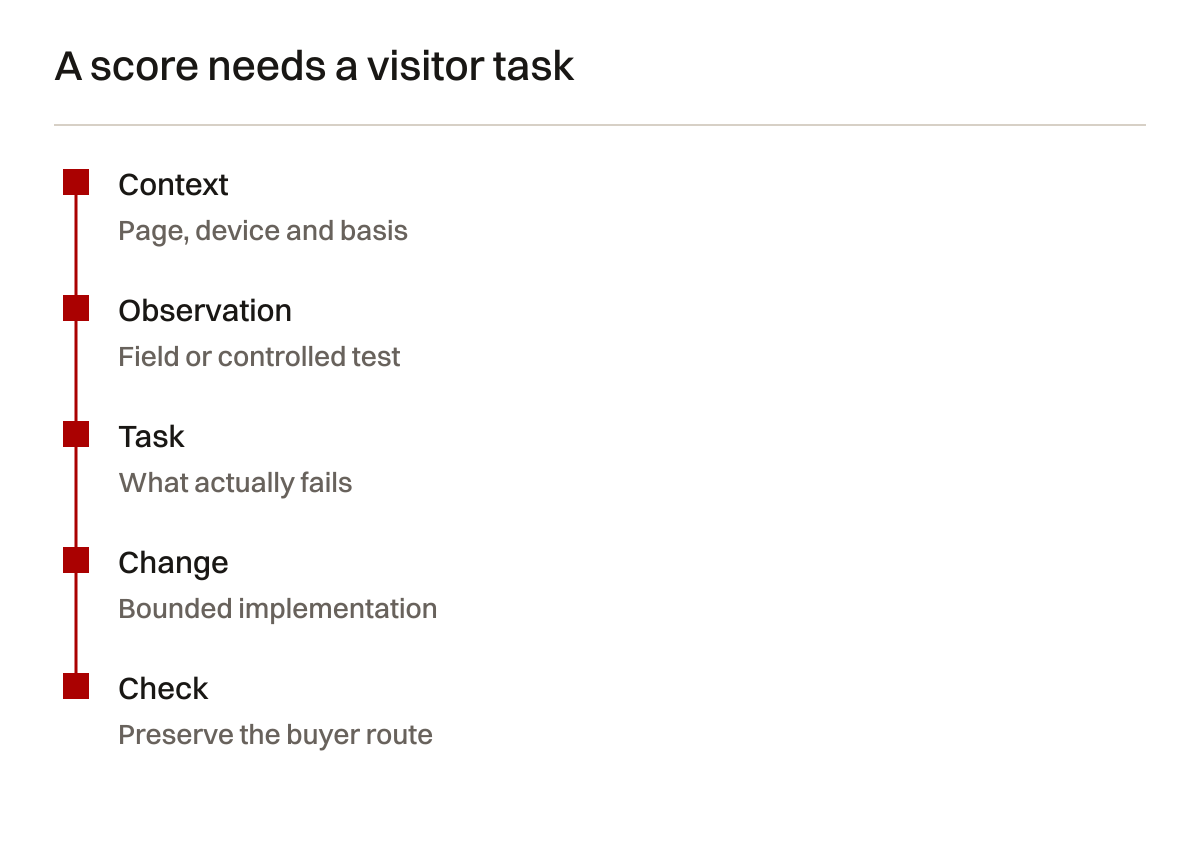
Google's Core Web Vitals guidance is a reference for these metrics, not permission to promise a ranking gain from a perfect score. Record the user problem and the proposed trade-off in plain language.
Test representative templates
A homepage test does not establish the condition of service pages, article pages and enquiry forms. Pick a justified sample. Include a commercially important page, a content-heavy page and a page with an interactive task. Record why each represents the wider site.
When a template change is proposed, check more than the original failing page. Confirm images, text, keyboard operation and contact actions still function on the other page types. A speed improvement that breaks a form introduces a more serious business problem.
Keep the recommendation bounded. “Resize these source images and update their rendered sizes” is inspectable. “Improve user experience” is not. Name the elements, expected state and verification procedure so the team can distinguish completion from intention.
Audit the answer, not the word count
Content inspection should examine accuracy, relevance and usefulness to a decision. An engineering page can be long and still omit material limits. A short page can be enough if it states the required conditions and provides the appropriate next step.
Ask whether the article adds anything beyond paraphrasing public sources. A comparison table, calculation, approved process example or explained inspection method can add value. A dozen generic sections created to meet a word target do not become useful because they have headings.
Google's people-first content guidance supplies questions for evaluating usefulness. The audit still needs its own page-specific judgement. A copied checklist without inspected examples is not that judgement.
Audit claims and sources
Check claims that influence a buyer: certifications, operating territories, quantities, dates, technical compatibility and project responsibility. Each needs an appropriate source or an authorised owner. The audit should not “optimise” an unsupported statement into more confident copy.
Inspect references near the claims they support. A link to an authority's homepage does not substantiate a precise technical statement. Record the exact source, publication date, relevant scope and review trigger. If the source changes, the page needs review rather than another automated rewrite.
Identify unnecessary overlap
Two pages targeting similar phrases may answer the same question. Inspect their purpose and evidence before recommending another page. If they genuinely serve different decisions, explain the distinction. If not, consider whether one maintained answer would be clearer.
Do not recommend deleting every low-traffic page. A capability record used by a small procurement audience can be useful without high visit counts. Equally, high traffic can come from unsuitable readers. Business relevance and observed behaviour must both enter the decision.
Build a priority list that survives a budget meeting
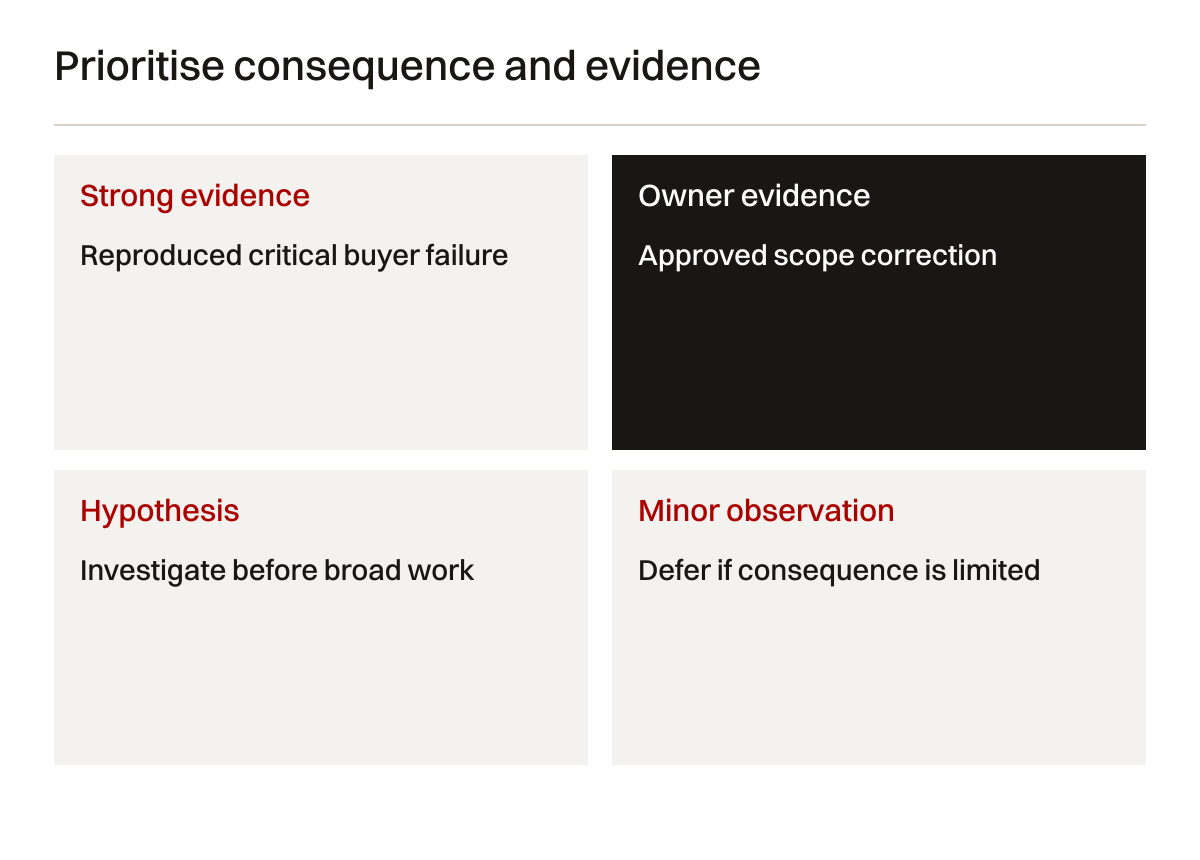
Priority cannot be based on tool severity alone. Consider the affected buyer task, business relevance, evidence strength, scope, dependencies and downside of change. Keep uncertainty visible. A high-impact hypothesis with weak evidence may require investigation before implementation.
A broken enquiry path on an important service deserves attention even if no crawler flags it. A duplicate description on a minor archive may be harmless enough to defer. This is not a universal ranking of technical issues. It is a way to connect each finding to its context.
| Illustrative finding | Evidence strength | Buyer consequence | First decision | Verification owner |
|---|---|---|---|---|
| Enquiry fails delivery test | Direct observation | Suitable buyer cannot reach team | Repair receiving path promptly | Site and receiving owners |
| Service scope is obsolete | Owner-confirmed record | Buyer assesses unavailable work | Correct the public offer | Service owner |
| Important template has unintended noindex | Reproduced inspection | Intended page excluded | Correct directive source | Developer and search owner |
| Article duplicates an existing answer | Editorial judgement | Confusing route and upkeep | Compare purpose before merging | Content owner |
| Low score without reproduced task failure | Tool observation only | Consequence not yet established | Inspect context before broad work | Audit owner |
These examples contain no client results. Their purpose is to show how the same report can distinguish immediate repairs, content decisions and further investigation. Do not turn the table into an automatic scorecard that overrides local facts.
Record dependencies before dates
A content correction may require technical approval. A template fix may require access to the actual deployment repository. A measurement repair may require consent and event decisions. Assign those dependencies explicitly. Otherwise the action plan promises deadlines that nobody can meet.
Do not confuse a blocked task with a failed recommendation. Record what is missing and who can provide it. If the business cannot establish a claim, remove or qualify it. If access is unavailable, report the limitation rather than marking an uninspected area as healthy.
Examine measurement before interpreting performance
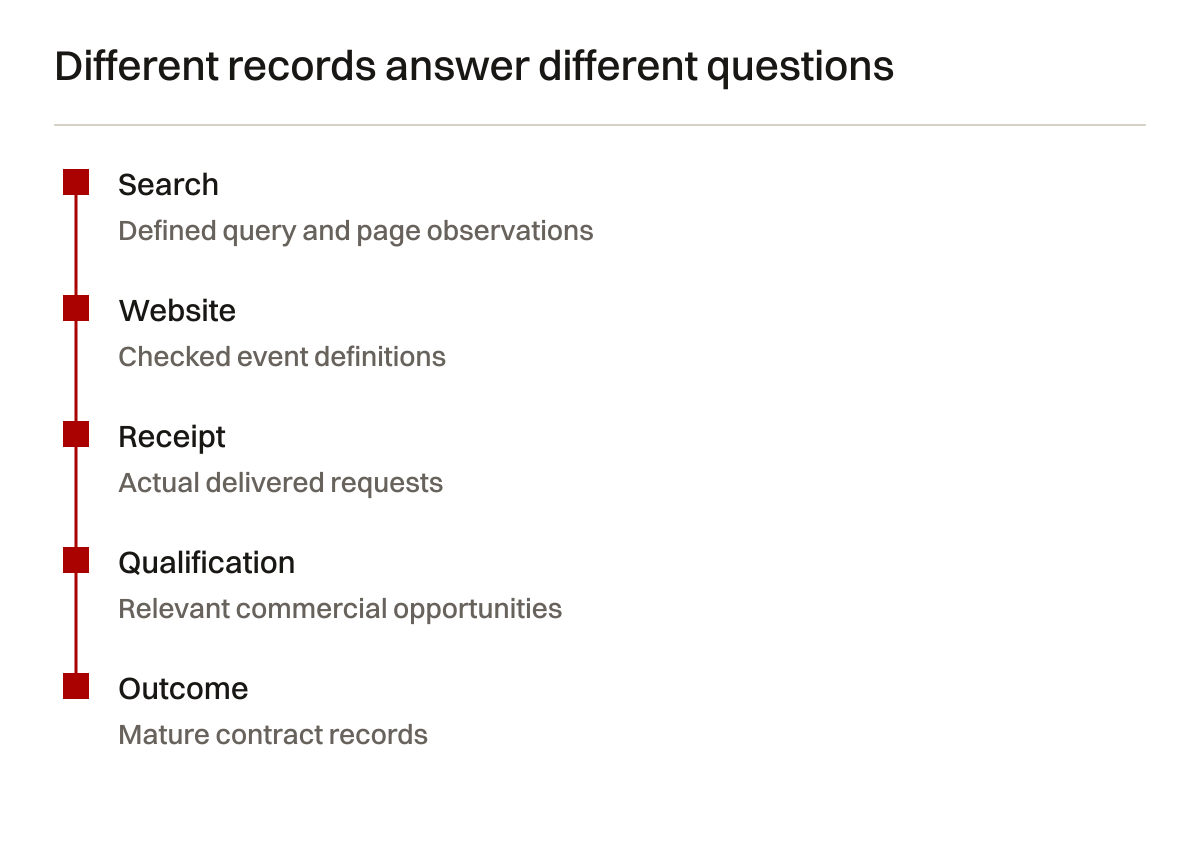
An audit needs to inspect what the data represents. Search impressions, website sessions and received enquiries come from different systems. They are not interchangeable counts. Definitions, filters, consent behaviour and collection faults can all affect the comparison.
Record the property, date range, relevant country and device filters, page selection and event definitions. For enquiries, inspect actual delivery and qualification. A form-button click is not a received commercial request. A generic contact event can contain spam and support questions.
Search appearance is not a sale
An increase in impressions can arise from different queries or pages. Inspect the composition before declaring progress. A construction service page gaining suitable local searches is different from a general article gaining overseas student traffic. Both can produce a rising chart.
For an account with limited authorised data, state what remains unknown. A public audit can evaluate access, content and visitor routes. It cannot infer revenue from rankings. The report should resist pressure to fill those gaps with an AI-written narrative.
Compare like with like
Use a consistent time basis and annotate website changes. If the form event was renamed halfway through the period, the apparent decline may reflect measurement rather than fewer requests. If a campaign raised branded demand, do not credit all branded visits to unrelated article work.
Where the business has a long sales cycle, compare mature enquiry cohorts. Recent opportunities may still be open. A report that labels them all unsuccessful understates progress; one that counts pipeline as revenue overstates it. The audit should help establish the record needed for future analysis.
Do not let AI convert warnings into certainty
AI can help classify crawl exports, summarise a source register and draft a finding record. It cannot decide the business priority merely because the prompt requests one. A model does not know which marine service is deliverable next month unless that information is supplied and verified.
The audit owner must check the underlying record. If an AI explanation says a traffic decline was caused by an update, ask for the timeline, page groups, demand context and alternative explanations. Fluent prose is not a test of causality.
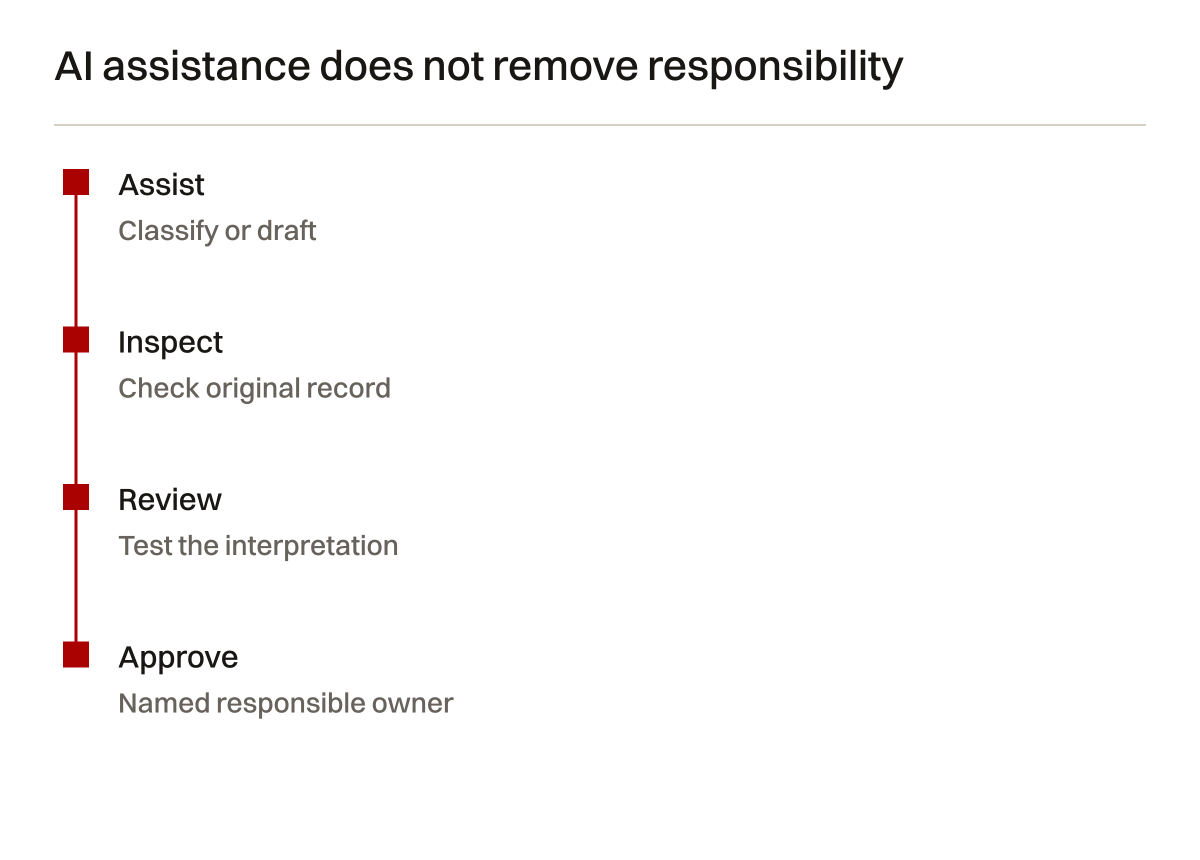
An audit should declare material automation and the review applied to it. This is not about shaming the tool. It is about retaining responsibility for the recommendations. A reviewer who cannot explain a finding without rereading generated text has not completed the analysis.
Distinguish a rule from a recommendation
An official platform requirement, an auditor's hypothesis and a preference are different kinds of statements. Google documents the requirements for its own AI search features. A proposed answer format is an editorial recommendation, not a secret requirement for every AI platform.
Likewise, a tool warning about headline length should not be represented as a guaranteed ranking penalty. Ask for the actual source and consequence. Some recommendations are sensible without being algorithm rules. They should be sold on their practical merit rather than invented certainty.
| Statement in a report | Evidence required | Acceptable wording | Wording to reject |
|---|---|---|---|
| Intended page carries noindex | Actual directive inspection | Observed exclusion, correction required | Google hates this website |
| Scope is unclear | Page and owner review | Missing condition affects assessment | More words guarantee more leads |
| Content overlap may cause confusion | Purpose comparison | Investigate merge or clearer distinction | Every similar keyword needs a page |
| AI answer cites a URL | Dated recorded answer | Citation observed in this sample | We control AI recommendations |
| Traffic change followed an edit | Consistent period and change record | Association requiring investigation | This edit caused all the growth |
Google's spam policies provide the relevant reference when assessing manipulative publishing. Do not replace policy review with “AI content is always spam.” The audit should inspect the purpose and value of the material being published.
Require an implementation handover
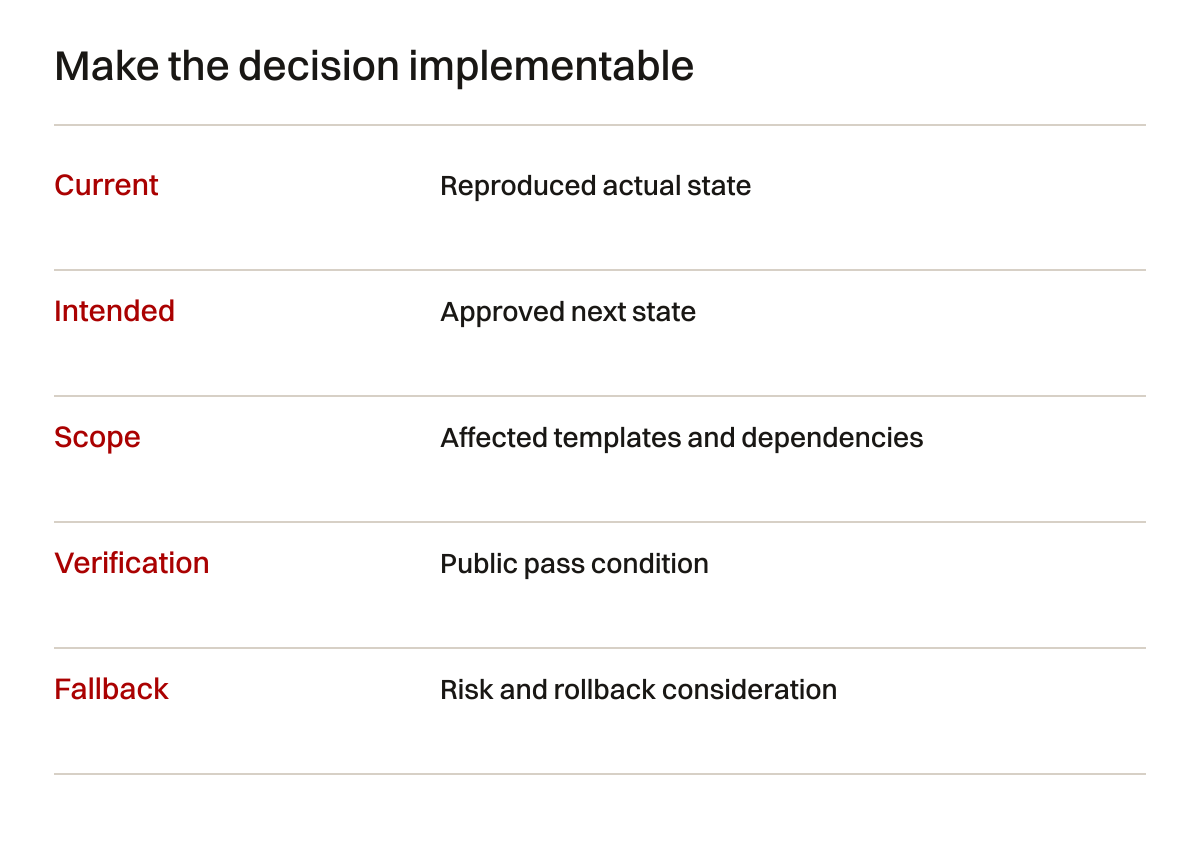
A recommendation becomes useful when someone can act on it. The handover needs the current state, intended state, affected templates, dependencies, risk and check. Include a rollback consideration for changes that can affect a wider page group.
For content, provide the approved facts and the decision rather than an instruction to “improve copy.” For technical work, show the control's source and the affected URLs where access allows. For measurement, specify the actual event and what occurrence it represents.
A completion label needs evidence
Use clear states: recommended, approved, implemented locally, deployed and verified publicly. “Done” should not cover all five. A staging screenshot is not proof that a visitor sees the change. A passing build does not establish form delivery.
Record the public check after publication. If a page directive was changed, inspect the deployed page. If a form was repaired, verify receipt through an agreed test that respects the team's process. If content was corrected, obtain the owner's acceptance of the published statement.
Keep residual uncertainty in the record. Search processing can happen later. Commercial outcomes need subsequent observation. The handover should say exactly what was completed and what remains to be measured, without turning every unknown into a reason for indefinite work.
What the final audit document should contain
The executive summary should name the problem, strongest findings and first decisions. The evidence register should allow reproduction. The action plan should identify owners and dependencies. The verification section should explain how completion will be established.
Appendices can hold crawl exports and detailed screenshots. They should not dominate the opening discussion. A founder needs the decision first, while the implementing team needs inspectable detail behind it. A useful audit serves both without pretending they need identical views.
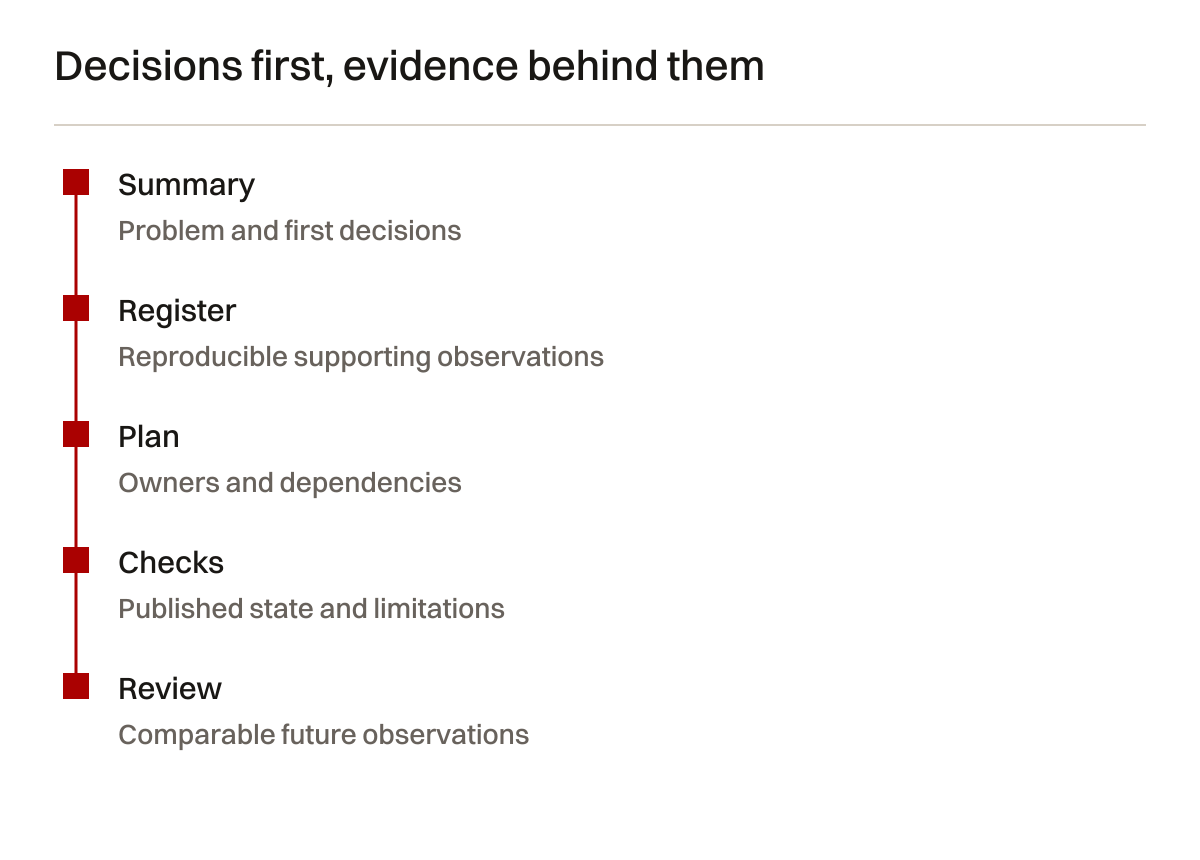
| Document component | Reader's question | Minimum useful content | Weak substitute |
|---|---|---|---|
| Executive summary | What needs deciding? | Problem, priority and uncertainty | A generic score |
| Evidence register | How do we know? | Reproducible observations | Unlabelled screenshots |
| Action plan | Who does what? | Scope, dependencies and owners | More content recommended |
| Verification plan | What counts as complete? | Public checks and pass conditions | Provider says finished |
| Follow-up review | Did the decision help? | Comparable observations and next action | Repeated activity totals |
Questions to ask at the presentation
Ask the auditor to walk through one important finding from original evidence to recommended action. Ask what could make the interpretation wrong. Ask which recommendation they would defer if the business could approve only one task this month.
Then ask what access and input the implementation requires. A credible answer may include a limitation or an unresolved question. That is more useful than confidence unsupported by inspection. You are purchasing a better decision, not an assurance that nothing is uncertain.
A practical first review
Stress-test a recommendation before approving it
Take a proposed action and ask what happens if it succeeds technically but fails commercially. A page might become faster while losing the diagram needed to assess capability. A contact form might become shorter while removing the field that lets the receiving team route urgent marine requests. Those are not reasons to avoid change. They are reasons to define the task properly.
For an engineering business, ask whether the revised page preserves material conditions and tolerances approved for publication. For a construction consultancy, check that the appointment description still distinguishes responsibility from supporting work. For a general professional service, check whether a buyer can tell who should enquire and what the first assessment needs. The implementation should not quietly broaden the offer.
Consider the operational consequence too. More enquiries can create a receiving problem if nobody is assigned to assess them. An audit cannot solve staffing through page edits, but it should identify the dependency. Otherwise a marketing team may report progress while the sales team accumulates unanswered requests.
Finally, ask whether the recommendation can be tested on a limited scope. Correct one important page or representative template where appropriate. Review the actual result before expanding a broad content rewrite. This reduces the chance of copying an inaccurate claim or broken layout across the site. It also creates a record of what the change actually involved rather than a vague retrospective account.
Keep a disagreement record
The service owner may disagree with an editorial recommendation. The developer may identify a dependency the auditor missed. The commercial team may say that a seemingly minor page answers a repeated procurement question. Record those objections. They are information about the decision, not resistance to be removed from the report.
Resolve disagreements through evidence and responsibility. If technical capability is disputed, the qualified owner decides what can be claimed. If the issue is a measured visitor failure, reproduce it. If the disagreement is about priorities, show the buyer consequence and the cost of delay. A good audit does not require every stakeholder to agree with the first interpretation.
When uncertainty remains, write the next investigation rather than forcing consensus. “Review five recent qualified enquiries to confirm the missing information” is a concrete task. “Stakeholders need alignment” is not. The former produces evidence that can change a decision. The latter can produce another meeting without narrowing the question.
Use the action workbook to retain these decisions. Record the rejected option and why it was rejected where that helps future maintenance. The next person should not have to repeat the same debate because the original report preserved only the final instruction.
Start with five records rather than another broad tool run. Select one important service page, its related evidence page, the public enquiry route, the applicable template and the measurement definition. These are a suggested starting sample, not a sufficient audit of every website.
Check what the buyer needs, what the page says and what the business can confirm. Inspect the public response and controls. Follow the enquiry route using an agreed test. Record what each observation supports. Only then decide whether the sample reveals a wider template or process issue.
If the first inspection finds a serious receiving failure, do not bury it beneath a content calendar. If it finds no such failure, resist claiming the entire site is healthy. Expand the sample according to the open question, and preserve the reason for every added check.
Method and limitations
The framework, diagrams and sample rows are original editorial tools. They are not a proprietary ranking model. Platform references were reviewed on 3 October 2026 and should be rechecked when a technical recommendation depends on them. No private account data was accessed for these examples.
The examples demonstrate how to structure an investigation. They do not establish how common each fault is. A real audit needs authorised access, appropriate sampling and approved business information. It should also respect confidentiality when screenshots or records are retained.
Start with the problem
If your current audit contains warnings but no defensible priorities, more warnings will not resolve that gap. Bring the report and the commercial question to Creatif Work. Our SEO service starts with identifying what needs investigation before recommending the next work.
We can discuss which evidence is available, what the website currently helps buyers do and what remains unclear. We do not need to claim a guaranteed ranking to explain a sound next decision. Use the diagnostic route and tell us what the existing report has not answered.