

Rebranding Your Business Without Losing Website and Search Visibility

Rebranding requires a coordinated change record for the business name, offer, public material and website addresses. Preserve useful buyer routes, approve factual changes and test the new experience. A new identity does not guarantee stable search visibility or better rankings, so plan continuity and observation as separate work.
The new logo is approved. The website still names an old service. A downloadable profile uses last year's identity. Customers search the former name, while quotations and business profiles use different variants. The problem is a rollout that lacks a shared record of what is changing, who approves it and where the old information persists.
This guide covers implementation and continuity after the strategic decision to rebrand. It does not revisit whether the business should change its positioning. Its worked example follows a fictional engineering supplier changing its trading identity while preserving its existing service scope. No example is a client result, ranking forecast or claim about a real organisation.
Download the brand, website and search rollout workbook or editable CSV pack. Five captioned web tables explain the registers. Generated photographs illustrate design and administration work. Original mockups and the continuity model are teaching material with declared assumptions.
State exactly what is changing
A visual identity refresh, trading-name change, legal-entity change, service change and domain move have different consequences. A project can include several, but the rollout needs to name them separately. Otherwise a designer may assume the service description stays the same while sales expects an entirely new market position.
Write a change statement approved by the business. It should identify the old and new public names, the unchanged relationships and any changed scope. Legal or contractual descriptions need the appropriate business review. A website writer should not infer those facts from a logo file or an internal presentation.
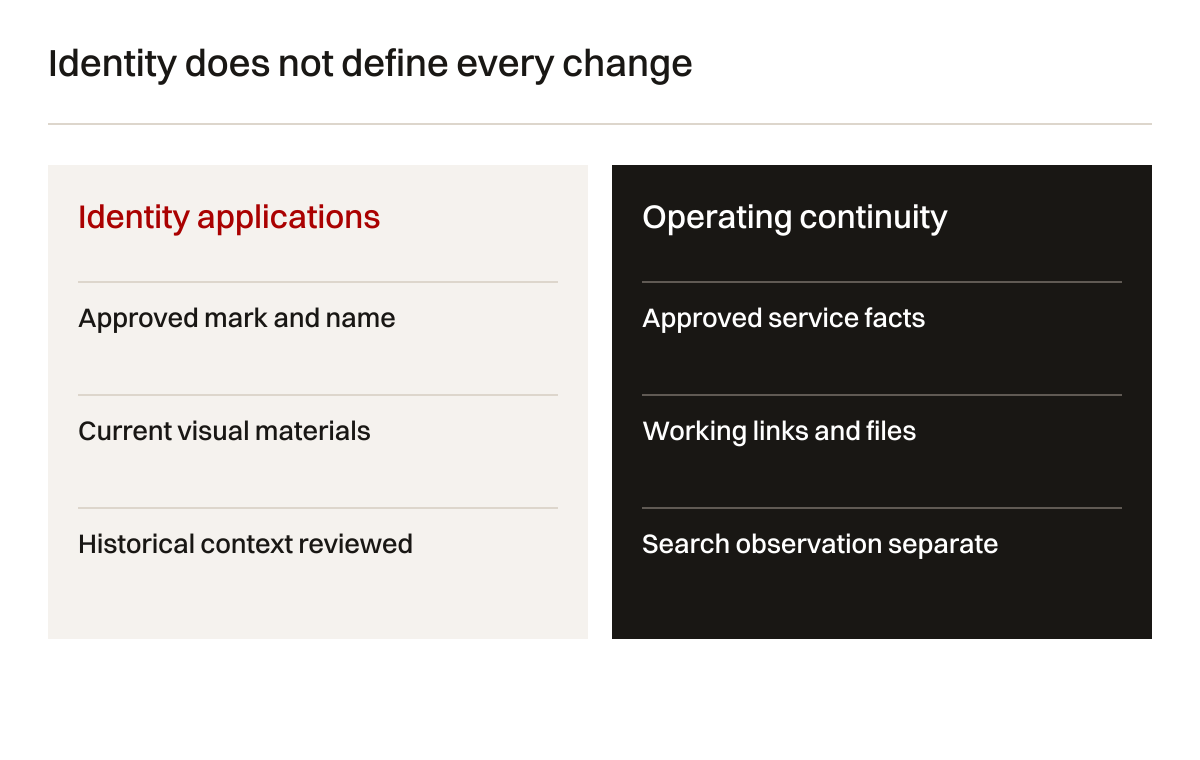
Table 1: changes and consequences. These distinctions identify review work; they do not predict an outcome.
| Change | Business decision | Website consequence | Continuity question |
|---|---|---|---|
| Visual identity | Approved identity applications | Replace selected visual assets | Can visitors still recognise the company? |
| Trading name | Approved public wording | Update names and transition explanation | What happens to old-name enquiries? |
| Service scope | Technical and commercial approval | Revise pages and linked documents | Are old claims still valid? |
| Domain | Authorised address decision | Map and redirect relevant URLs | Do old links reach equivalent content? |
| Page architecture | Approved buyer routes | Update navigation and internal links | Is important evidence still reachable? |
| Entity information | Approved legal facts | Update relevant notices and records | Do documents identify the right entity? |
Keep the statement short enough to use during approval. It is the reference for deciding whether a page needs a visual change, a factual change or both. A clear statement prevents the rollout from becoming a general website rewrite whose new claims nobody has approved.
Inspect how people use the old identity
Search demand for the former name can reflect existing customer relationships, old documents, referral instructions and directory entries. Identify those routes before removing every old-name mention. The purpose is to help people who already know the business find the right continuation, not to preserve obsolete language forever.
Use the company's available search and enquiry evidence. Separate observed old-name queries from assumptions about what customers search. Search Console data has limits and may omit some queries. Keep the date range and property scope with the observation. Google's Search Console starting guidance explains the tool's role in monitoring site performance.
Ask sales what customers call the company. Ask staff which documents they send most often. Review linked profiles and directory records the business is authorised to change. A useful transition explanation may be a short factual sentence describing the former trading name. It should not imply an acquisition, entity change or legal continuity that has not been confirmed.
The fictional supplier discovers three important routes: old-name searches, a frequently shared capability PDF and links from two approved supplier directories. It records each route with an owner. The guide does not invent traffic volumes. The decision is to preserve access and explain the change where those users arrive.
Approve positioning before page copy
New identity applications do not answer what the company now promises. Approve the offer, intended buyer, scope and evidence before rewriting service pages. If the service has not changed, say so where that helps customers. If the service has changed, remove or qualify unsupported old claims rather than carrying them into the new design.
Make a source register for technical statements. Include the approved service description, certification details, locations, contact routes and project permissions. An old website is evidence of what was published, not necessarily the authority for what should be published now. Rebranding is a good moment to resolve discrepancies, but that review needs a factual owner.
Use buyer language that the business can stand behind. A new slogan should not replace a plain explanation of the service. A purchasing manager still needs to know what work the company performs and under what conditions. Search continuity depends partly on preserving useful information, not merely retaining old keywords in hidden metadata.
Google's title-link documentation describes several sources used for search title presentation. Align the page title, visible heading and approved identity where appropriate. Search systems may still choose a different title. Treat this as content consistency work rather than a promise that a particular title will always appear.
Inventory assets by working use
List the material that actually carries the identity. The website is only one part. Capability PDFs, quotation templates, email signatures, presentation files, technical attachments, forms and profile records may all contain the old name. Prioritise according to use and consequence rather than file count.
An active quotation template deserves a different priority from an archived presentation. A technical PDF with current service claims may need immediate review. A historical project file may need to retain its original identity rather than be rewritten. Decide which material should change, remain historical or be withdrawn.

Table 2: asset owners. This inventory distinguishes current working material from historical records.
| Asset | Working owner | Required approval | Release evidence |
|---|---|---|---|
| Website service pages | Content editor | Commercial and technical owners | Public text matches approved scope |
| Capability PDF | Document owner | Technical and identity reviewers | Correct version downloads from current links |
| Quotation template | Commercial operations | Business approver | New quotation uses approved details |
| Email signature | Business administrator | Identity and contact owners | Staff sample shows correct links and details |
| Business profile | Authorised profile manager | Business representative | Fields follow provider policy and facts |
| Historical project record | Records owner | Relevant owner if changed | Retention decision and explanation recorded |
Store the approved identity source files and practical application instructions in a known location. Staff should not reconstruct a logo from a website screenshot. Keep old assets out of the active template folder once they are retired, while retaining historical material where required by the business's record process.
Apply identity where the material needs it
A website header, a small email signature and a technical report cover have different physical and digital constraints. Test the identity at actual size and in context. Check whether the mark remains identifiable, whether text remains readable and whether production formats fit the intended application.
The original teaching mockup for this guide contrasts two applications of the same fictional identity. The first preserves a readable company name and current contact route. The second places the mark prominently but leaves an obsolete URL in the footer. The second looks updated while preserving a broken customer route. That is the practical failure the rollout register should catch.
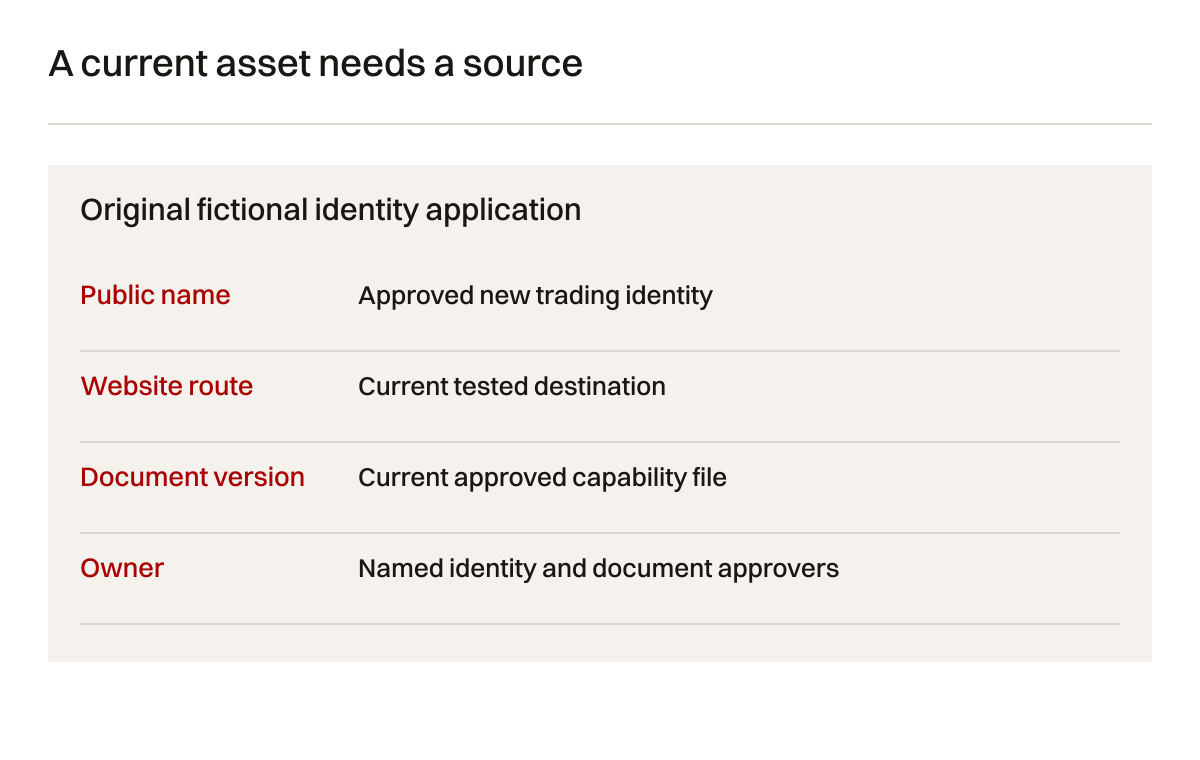
Do not redraw every historical image to create visual consistency. A photograph of an older installation may legitimately show the former mark. Decide whether its date and caption provide enough context. A factual historical record can remain useful when the surrounding page clearly identifies the current business.
Test shared document formats as actual outputs. A PDF can crop differently from its editable source. An email signature can change across clients. A website logo can become unreadable at a narrow viewport. Acceptance should follow where the asset is used, not just whether the source file opens in the designer's tool.
Decide whether URLs need to change
A rebrand does not automatically require new page addresses. A domain can stay if it remains suitable and controlled by the business. Existing service URLs can stay if they still describe the offer. Changing them simply to match a visual refresh adds migration work without necessarily helping a buyer.
If the domain or paths change, prepare a mapping before release. Google's site-move guidance distinguishes URL-changing moves from other changes. It advises planning, testing, mapping and monitoring. It also explains that significant moves can cause temporary search fluctuations. A rollout plan should state that uncertainty plainly.
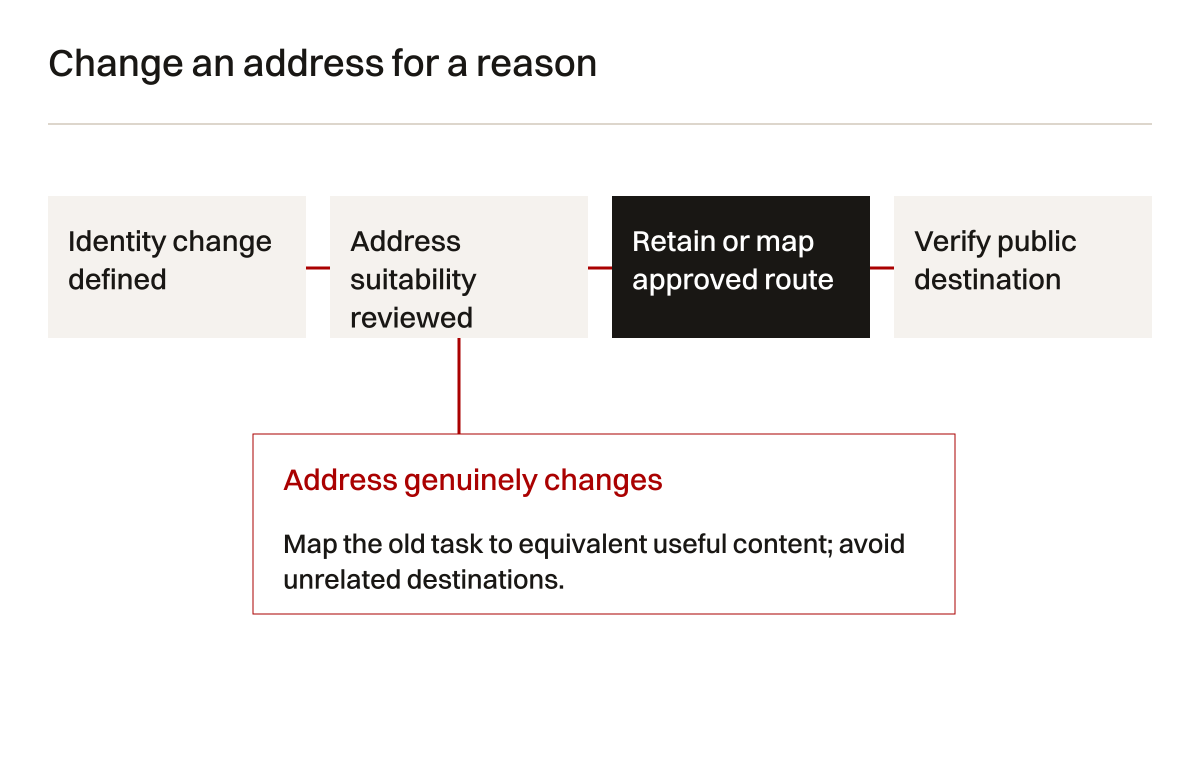
The fictional supplier changes its domain because the old address contains the former name. Its service paths remain equivalent. The mapping pairs each important old page and download with its relevant new destination. It does not send every address to the homepage. Removed content receives a deliberate decision based on whether a genuine replacement exists.
For permanent moves, inspect the implemented redirect against Google's redirect guidance. Test the initial response, destination and resulting content. An address that eventually loads after several unrelated redirects deserves investigation. The purpose is a relevant working route, not a box marked redirect installed.
Keep identity work separate from search tasks
An identity change can improve recognition without altering search performance. A technical URL repair can preserve a visitor route without improving the visual identity. Keep these acceptance questions separate so the report does not present one as evidence of the other.
Canonical signals also need review after a domain move. Google's canonical documentation explains preferred URL signals for duplicate or similar content. A new page should not accidentally continue declaring an obsolete destination because the old CMS template was copied. Check the page's actual output.
Table 3: identity and search tasks. Immediate acceptance and later observation are different kinds of evidence.
| Task | Immediate acceptance | Later observation | Claim to avoid |
|---|---|---|---|
| Replace visual identity | Approved application at actual size | Buyer recognition questions | New logo caused ranking growth |
| Update name wording | Approved name and transition explanation | Old-name enquiry patterns | Every searcher understands the change |
| Change URL | Relevant destination and tested redirect | Recrawl and indexing observations | Rankings cannot fluctuate |
| Update canonical | Intended preferred URL in output | Search-selected canonical where available | A declaration forces indexing |
| Replace capability PDF | Current file and working links | Questions from actual users | A download proves commercial interest |
| Update profile | Accurate permitted fields | Profile observations with limits | Website work guarantees map visibility |
Use a current sitemap to describe intended public URLs. A sitemap helps discovery; it is not proof of indexing or a substitute for internal links. Update navigation, document links and templates that still point to the old domain. Redirects support older routes while current material should use approved current addresses.
Update business profiles under their own rules
Business profiles are separate accounts with their own eligibility and naming rules. Use the real-world business name and current approved information. Google's business representation guidelines describe its policy requirements. A website rebrand does not give permission to invent an office, service area or keyword-filled name.
Identify the authorised account manager before launch. Check which fields can change and whether the update may require additional review. Keep evidence of the old and new approved facts. Do not promise that every platform will accept the change immediately or display it at the same time as the website.
Website site-name presentation is another distinct mechanism. Google's site-name documentation explains how the preferred site name can be communicated and what scope that feature supports. Keep the homepage identity consistent with the business. Search presentation remains determined by the search system.
Record other profiles the company actually uses. Supplier portals, association listings and tender registration systems may have practical importance beyond search. Some hold entity information that should not change just because the trading mark changes. Obtain the responsible owner's decision and follow the platform's required process.
Preserve downloads and working links
A company profile or technical document can receive direct visits from saved emails and external links. Inventory those addresses. If a document stays current, preserve or map its route. If it becomes obsolete, decide whether the visitor needs an updated equivalent, a clear explanation or a genuine removal response.
Test the actual downloaded file. The website link may use the new name while delivering the old PDF. A PDF may contain outdated contact details or links to removed pages. Inspect both the outer address and the file's content. Assign technical facts and identity application to their appropriate reviewers.

If an attachment is sent from a quotation system, update that system's source too. Replacing the website copy does not change files stored in a CRM template. Likewise, a new email signature does not replace an attachment already shared with customers. The rollout should identify where current working copies originate.
Keep version identifiers useful. A name-only filename can make old and new material difficult to distinguish. An approved version record should identify the current file, release decision and owner. The public reader does not need the internal approval history, but staff need enough information to send the intended document.
Sequence launch around dependencies
List the changes that must exist before another action can happen. The new website needs an approved identity and factual copy. A domain move needs DNS and TLS configuration. Updated signatures need working links. Profile updates need approved business information and authorised access. Sequence decisions around those dependencies.
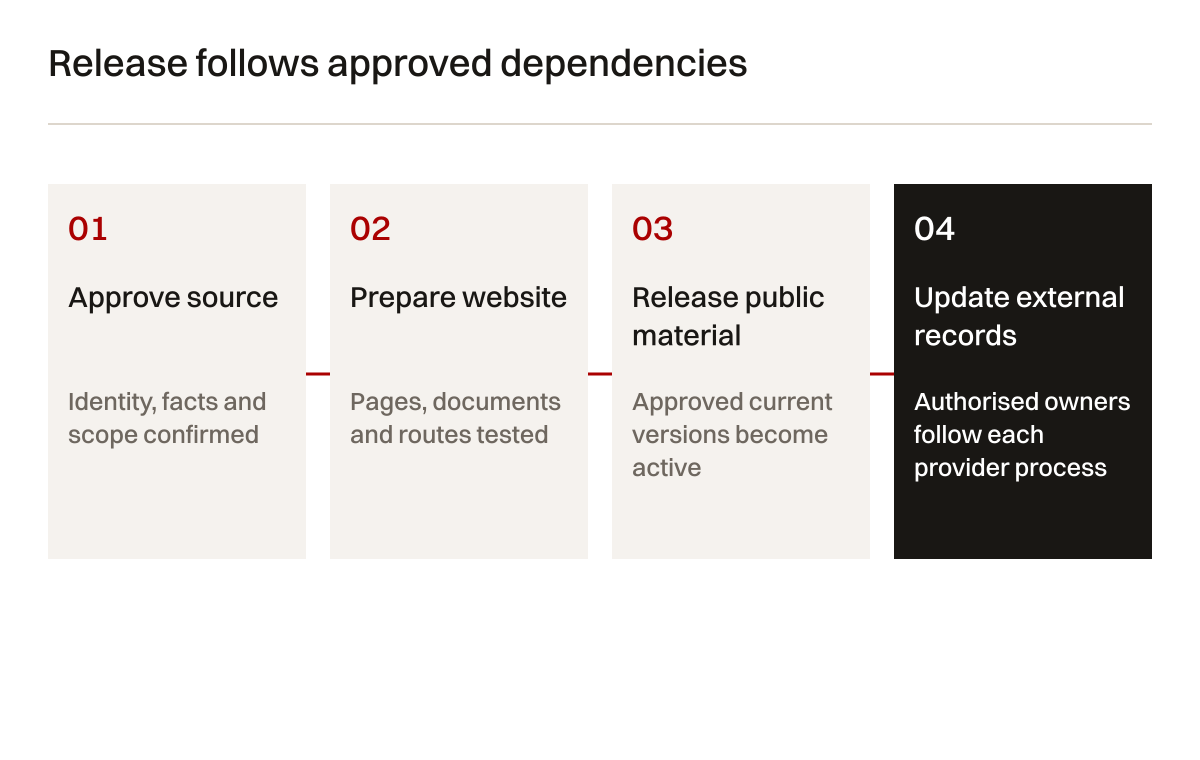
Avoid changing several difficult systems at once when they can reasonably be separated. Google recommends changing one major aspect at a time in its site-move guidance. The business may still have a coordinated launch requirement. If so, record the combined risk and make rollback and acceptance specific to each component.
Choose an approver and working owner for launch. The approver decides whether known conditions are acceptable. The working owner performs the release and checks. Staff should know where to report discrepancies and which old assets must no longer be used. A launch announcement is not a substitute for those operating instructions.
Table 4: launch checks. Record the actual result and any accepted exception.
| Area | Check | Evidence | Decision owner |
|---|---|---|---|
| Identity | Current mark and name used in active applications | Actual page, PDF and template samples | Identity approver |
| Facts | Scope, contacts and entity information agree | Approved source comparison | Business and technical owners |
| Addresses | Old important routes reach relevant content | Dated redirect and destination tests | Website owner |
| Search signals | Canonicals and sitemap reflect intended URLs | Public output and tool checks | Search and development owners |
| Enquiry | Visitor can submit and responsible staff receive it | Marked end-to-end test | Commercial operations |
| Profiles | Permitted fields updated through authorised accounts | Platform record and exceptions | Profile manager |
Retain the release reference and old configuration where recovery requires it. A reversal may need more than restoring a logo. If the domain has moved and staff are using new templates, the operating consequences must be explained. A rollback decision should preserve records created after launch wherever the chosen method allows.
Model continuity as checks, not traffic promises
The teaching model uses a fictional inventory of twenty important routes. Twelve are website pages, five are downloads and three are authorised profile links. Eighteen pass their immediate continuity checks. Two require correction. Eighteen plus two equals twenty. This measures an assumed test inventory, not search traffic or commercial impact.
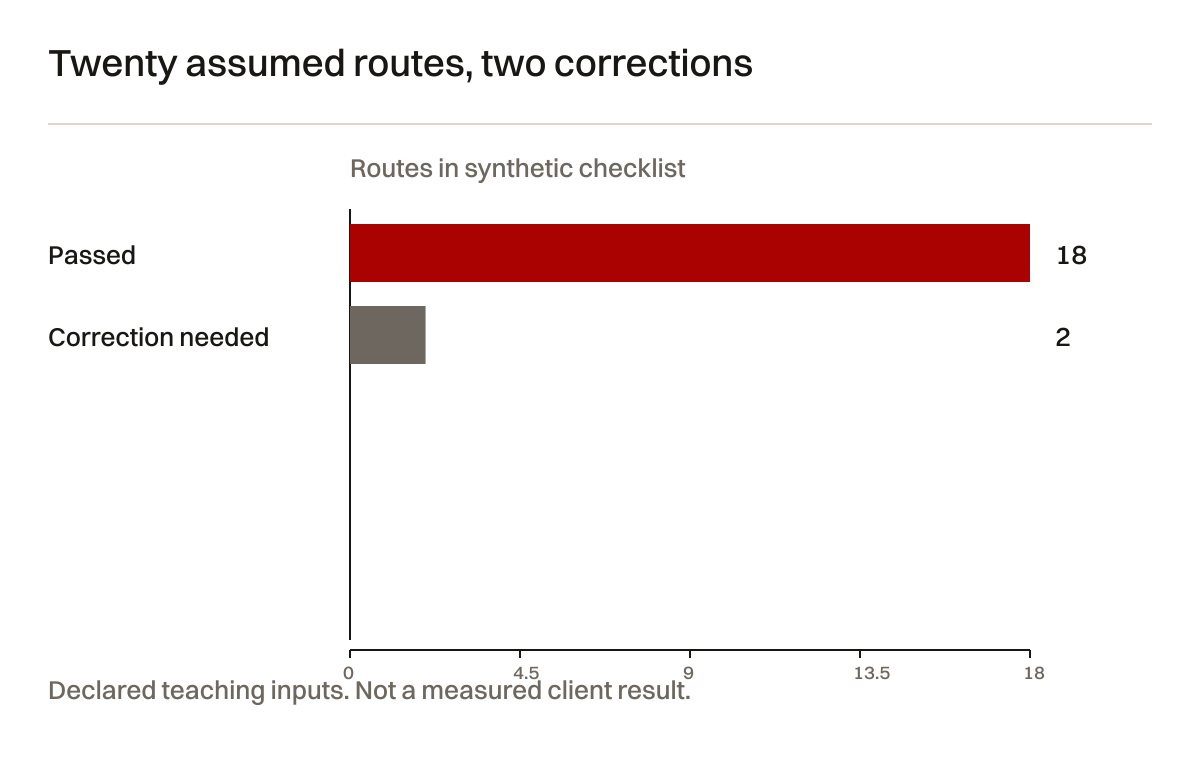
The underlying CSV includes the assumed totals. Do not generalise the pass proportion as a benchmark. A single failed route can matter more than several passed low-use pages. The model is useful because it makes unresolved work visible and keeps the arithmetic inspectable.
For production monitoring, use actual observations with the correct units. Search clicks, indexed URLs, enquiry records and document requests describe different behaviour. They should not be merged into a single success score without an explicit reason. A rebrand's commercial effect may take longer to interpret than a technical route check.
If observations change, inspect competing explanations. Seasonality, service changes, a tracking revision and a domain move can affect different measures. The rollout record should help distinguish them. Avoid attributing every change to the new identity merely because both happened during the same period.
Monitor questions the team can answer
Set observation windows that fit available data and the business's decision needs. Record the release date, property changes and tracking definitions. Keep old and new address observations distinguishable where possible. A blended chart can conceal whether the old property continues receiving visits while the new property grows.
Table 5: monitoring questions. These questions guide investigation without declaring a universal review interval.
| Question | Evidence to inspect | Responsible owner | Interpretation limit |
|---|---|---|---|
| Do old routes still work? | Redirect and download tests | Website maintainer | Sample checks cover specified routes |
| Can buyers find the current business? | Name-query and enquiry observations | Commercial and search owners | Query data may be incomplete |
| Are current pages discoverable? | Crawl and indexing observations | Search practitioner | Indexing is not guaranteed |
| Are enquiries delivered? | Stored records and marked tests | Commercial operations | Delivery differs from qualification |
| Are old templates still active? | Actual staff outputs | Document owner | Inspection does not recall past copies |
| Did profile updates complete? | Provider records and review state | Profile manager | Platforms have separate processes |
Give exceptions a route. An obsolete supplier listing may need a request to the directory owner. A stale company PDF may need a controlled replacement. A broken old URL may need a mapping correction. The action should follow the observed problem rather than a general instruction to do more SEO.
Work through a bounded rebrand
The fictional supplier adopts a new trading identity. Its manufacturing scope remains unchanged. The business approves a factual transition sentence and confirms that entity details should remain as previously approved. The website moves to a new domain, while equivalent service paths are retained.
The team inventories important pages, downloads, current templates and authorised profiles. It prepares mappings and checks new canonical output. It replaces the public capability PDF after technical review. During testing, an old quotation template still links to the former PDF address. The team updates the template and verifies the file actually sent from the commercial system.
After release, one directory retains the old business name. The company records the discrepancy and follows that platform's process. It does not claim the website launch has completed every external update. Search observations are kept separate from route acceptance because the immediate checks cannot establish stable rankings.
The final handover identifies current sources, retired assets and remaining exceptions. This is a completed rollout record under defined conditions. It is not a claim that every old mention has disappeared or that rebranding caused growth. The useful result is that staff know the current material and how to investigate continuity problems.
Separate active material from historical evidence
Historical records can create an apparent inconsistency that is actually correct. A project delivered under the old identity may need to retain its original report. A current quotation template should use the new approved identity. A website page linking both needs to describe them accurately. The register should classify use before ordering replacement.
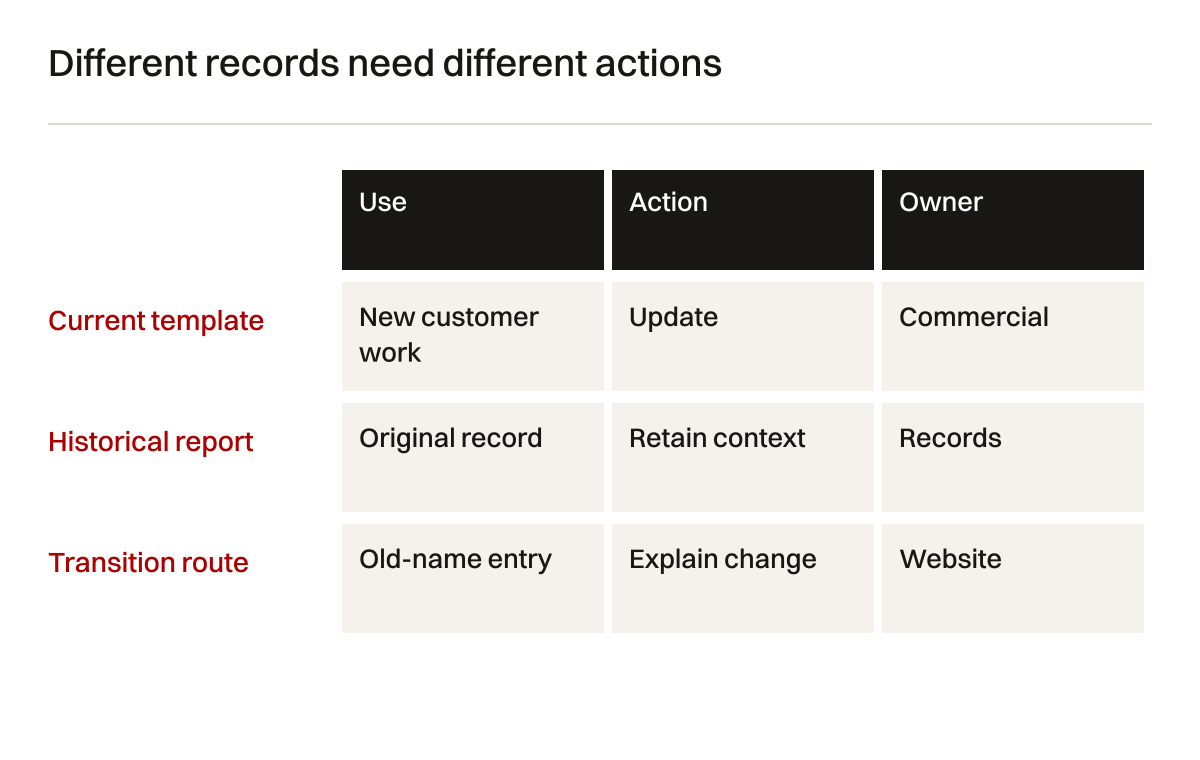
In the fictional supplier, the records owner reviews a report attached to a completed project. The report's facts remain valid, and the business decides to keep its original identity. The public project page provides approved context about the current trading name. The active quotation template changes immediately because staff will create new customer material from it. A transition explanation remains where known old-name routes enter the website.
These decisions are deliberately different. Replacing a historical report's identity could obscure what was originally issued. Keeping an old active template could confuse a current buyer. The designer's preference for visual consistency cannot settle either question. The business owner decides the record's role, and the implementer follows that decision.
Inspect links in retained historical material. A report can stay historically intact while an old website address continues redirecting to relevant current information. Decide whether the file itself needs an accompanying note rather than silently editing its contents. Preserve the approved source and the reason for any change so later staff do not repeat the review without context.
Rehearse a partial launch failure
A coordinated rebrand should include a scenario where one external change does not complete. In the example, the website and active PDF use the approved new name, but an authorised supplier portal still shows the old one. The company can operate because the relationship and contact route are clear. The portal discrepancy remains an assigned task with its own provider process.
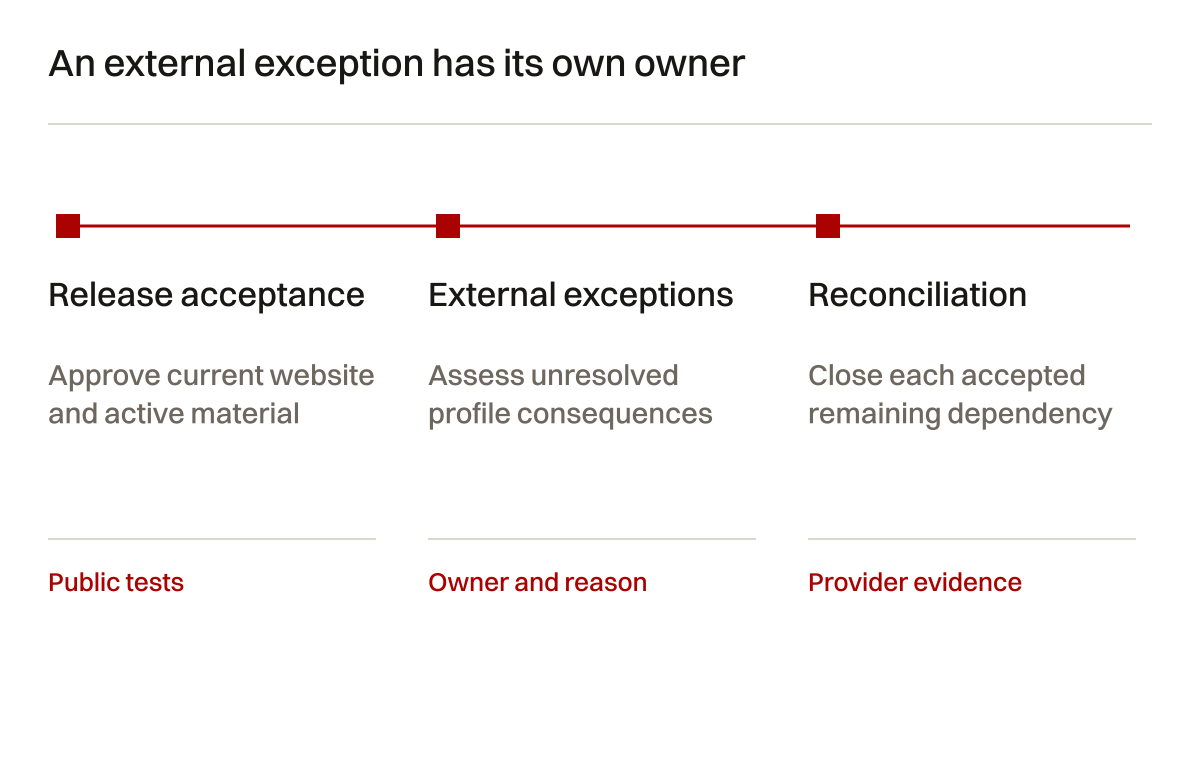
The launch approver decides whether that exception blocks release. The answer depends on consequence. If the portal controls an active tender submission and the name mismatch prevents access, it may be critical. If it is an informational listing with a working transition route, it may be accepted temporarily. Record the actual reason rather than applying one rule to every external profile.
A second rehearsal assumes the new domain works but an important old service route fails. The team checks whether a mapping correction can resolve it safely. It does not reverse every identity asset automatically. If the failure affects a broader configuration pattern, the technical maintainer explains the available repair or rollback and the records each option preserves.
The rehearsal exposes decision authority before launch pressure arrives. Staff know who can approve a temporary exception and where they can find the current source. It also limits exaggerated completion claims. The business can say the defined release was accepted while named external updates remain open, without implying that the entire public web changed at once.
Retain a dated sample of the accepted current material. It gives staff a concrete reference when another old template appears. The sample should identify its source and owner so it can be updated deliberately. A folder labelled new is not enough when several versions continue to circulate through quotations, shared drives and saved email attachments.
Frequently asked questions
Must a rebrand include a new domain?
No. Keep the existing domain when it remains suitable and controlled. A change should have a business reason that justifies the migration work. If the domain changes, map relevant routes, configure the approved move and monitor both old and new observations. A visual refresh alone does not require address changes.
Should every mention of the old name disappear?
Not automatically. Historical records and existing customer routes may need factual context. Decide where the old name helps a person understand continuity and where it is simply obsolete. Approved wording must reflect the actual business change rather than imply unverified legal or commercial relationships.
Will the new identity improve rankings?
The identity's visual acceptance does not demonstrate a search improvement. Content, technical routes and discovery signals have their own checks. Significant URL moves can produce fluctuations. Observe actual data with its limits and avoid presenting a rebrand as a guaranteed ranking intervention.
Can old PDFs stay available?
Sometimes, if they remain valid or are clearly historical. If the facts are obsolete, decide on a current equivalent or an appropriate explanation. Test saved links and the actual file content. The document owner should approve whether an old file remains publicly useful.
Who should approve the rollout?
The business owns identity, facts and operating decisions. Technical owners approve claims in their scope. The implementer verifies website behaviour and records exceptions. A single launch approver can coordinate those decisions, but should not silently replace the required specialist approvals.
Start with the inconsistent customer route
Bring the page, document or profile that contradicts the new identity. Trace its source and the people who use it. That reveals whether the next task is factual approval, asset replacement, address migration or operating handover. The scope can then follow a visible gap.
Creatif Work can coordinate brand identity, website work and search work around the approved change. The business remains the authority for what has changed and what must remain factual. Start with the problem.
Sources and limits
Official sources checked on 4 October 2026. Rollout registers, mockups and numeric inputs are original illustrative planning material.