

Should a Technical Company Show Prices on Its Website?

Technical companies often avoid website pricing because the work varies. Buyers then receive no help deciding whether the supplier fits the project. The choice is not simply “show a fixed price” or “show nothing”.
A company can publish a range, unit basis, minimum engagement, pricing drivers or a worked example, provided the information is accurate and maintained.
When should a technical company show prices?
Show a fixed price when scope, inputs and delivery are standard. Show a range or unit basis when variation is bounded. Show pricing drivers and a representative example when engineering choices materially change cost. Use quote-only when disclosure would mislead, but explain what information is needed and what the quotation covers.
The objective is qualification. Pricing content should help a suitable buyer understand the commercial shape of the decision without creating a promise that ignores technical scope.
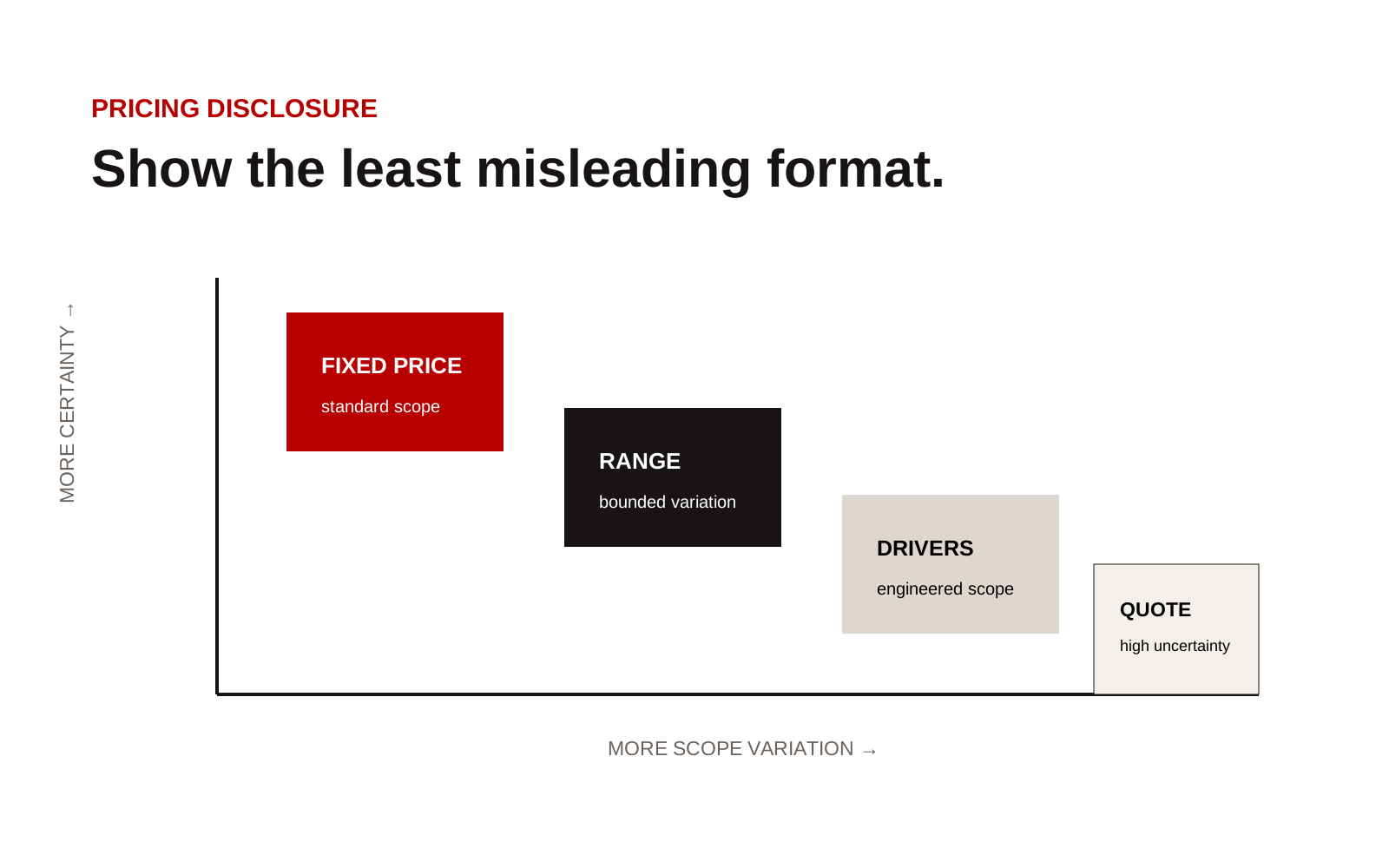
Pricing disclosure decision matrix comparing fixed price, range, drivers and quote-only approaches.
Choose the least misleading format
| Format | Best when | Must include |
|---|---|---|
| Fixed price | Deliverable and inputs are standard | Inclusions, exclusions, tax, validity and change terms |
| Range | Scope varies within known limits | Drivers, example boundary and date |
| Unit rate or basis | Quantity is the main variable | Unit definition, minimum and assumptions |
| Starting price | A genuine base configuration exists | Exact base scope and common additions |
| Pricing drivers | Engineering decisions dominate | Required inputs and a worked example |
| Quote-only | Risk cannot be bounded publicly | Qualification questions and response process |
Do not use “contact us for pricing” as the only information if five known variables explain most of the variation.
Publish the boundary beside the number
Every public number needs a currency, date and scope. State whether delivery, installation, testing, travel, support, tax or third-party costs are included.
Where a price is offered to consumers in the United Kingdom, check the current CMA price transparency guidance and obtain appropriate advice. Its rules are not a universal template for every B2B technical quotation, but they reinforce the need to keep mandatory charges and conditions clear.
For a range, explain what moves the result. A technical project may vary with duty, material, certification, hazardous-area requirement, integration, site access, documentation, testing and programme.
If prices are market-sensitive, use a review date and owner. Remove a number quickly when it no longer represents the business. A stale price attracts the wrong enquiry and weakens trust before the technical conversation begins.
Use examples without inventing certainty
A worked example can be more useful than a broad range. Define a representative configuration, list included work and show the commercial basis. Make it clear that the example is not a quote.
For services, show the stages and what the buyer receives at each stage. For equipment, show the base configuration and important options. Avoid a calculator unless the inputs genuinely produce a reliable result and the business can support it.
Our guide to reading a web design quote demonstrates how scope, ownership and support can be compared without reducing the decision to one headline figure.
Consider the commercial effect
Publishing pricing may:
- filter out projects below the minimum;
- shorten early conversations;
- give buyers a budgeting reference;
- expose positioning to competitors;
- create anchoring before scope is understood;
- require faster maintenance and internal discipline.
These are trade-offs, not universal reasons to publish or hide. Review actual enquiry data. If buyers repeatedly ask the same budget question, the page is missing useful guidance.
Make the quote process visible
When a quote is needed, explain the path:
- buyer submits the minimum technical inputs;
- supplier confirms fit and missing information;
- assumptions and exclusions are agreed;
- proposal identifies scope, outputs, programme and commercial basis;
- changes follow a defined route.
State who the enquiry suits and what should not be uploaded publicly. Sensitive drawings and specifications need an appropriate exchange.
Keep pricing claims aligned across the site
Compare the pricing page, service pages, campaign pages, proposals and sales scripts. A “fixed package” on one page cannot become undefined custom work on another.
Review the most common reasons quoted work differs from the website example. If the same missing condition appears repeatedly, add it to the public boundary.
Track qualification rather than raw form volume. A lower number of better-fit enquiries can be a positive result.
Test the decision with real enquiries
Before changing the site, review a sample of won, lost and poor-fit enquiries. Record when price first appeared, which scope variable changed the figure and whether earlier guidance would have saved time.
Then test one controlled change for 60 to 90 days. This might be a minimum engagement, an example range or a pricing-driver table. Measure fit, sales time, objection type and conversion, not just clicks.
Ask the delivery team whether the public guidance matches the work they actually scope. Sales may prefer a simple number while operations sees exceptions that make it unsafe. Resolve the gap before publication.
If competitors can see the same information, decide whether that creates real harm. Buyers already compare suppliers. Hiding all commercial shape may protect little while adding friction for every suitable prospect.
A decision checklist
- Can the scope be defined in public language?
- Is the range narrow enough to help?
- Are inclusions and exclusions understandable?
- Can the business maintain the figure?
- Does disclosure improve qualification?
- Is a worked example safer than a headline number?
- Who approves and reviews the page?
Creatif Work builds service websites around the information buyers need to decide. We can design a pricing section that reflects real scope and qualification, whether the right answer is a fixed package, a range, transparent drivers or a clearer quote route.