

Technical SEO for B2B Websites: From Diagnosis to Fix

Technical SEO repair starts with a reproducible fault on a useful public page. Record the symptom, test conditions and competing explanations. Choose a change that addresses the confirmed cause, then verify the deployed output. A passed technical test does not guarantee indexing, rankings or enquiries.
A crawler report contains hundreds of warnings. The manager wants to know which one matters. A developer asks for a specific failing route. The commercial team says buyers cannot find a technical service. These statements may describe one problem or several. The next useful step is a test that connects the warning to actual page behaviour.
This guide concerns diagnosis and implementation, rather than the contents of an SEO audit package. It uses owned fictional failures and original repair examples. No third-party website is accused of a fault. Photographs are generated illustrative scenes. The priority chart uses declared synthetic values and does not score actual client websites.
Download the technical repair log workbook or editable CSV pack. Five captioned tables provide a web-readable equivalent. If the fault occurs during a planned move, use the earlier migration launch guide for the wider release inventory.
Turn a warning into a testable finding
A finding should identify the page, observed behaviour and why the business cares. Required service page returns a noindex instruction is useful. Site has technical problems is not. The first statement leads to a test and a repair decision. The second could justify almost any activity without showing what changed.
Record whether the evidence came from a public request, a browser, a crawler or a search tool. Each observes different things. A browser may execute scripts that a simple crawler does not. Search Console may report an earlier indexed state while the public page has changed. Keep the observation date and method with the finding.
Table 1: findings register. These are fictional faults with bounded next tests.
| Finding | Business consequence | Evidence needed | Next test |
|---|---|---|---|
| Required service has noindex | Intended page may be excluded | Public page and response instructions | Check live output and configuration source |
| Specification text missing | Buyer and crawler may see incomplete content | Original and rendered content | Compare requests and rendered page |
| Canonical points elsewhere | Preferred destination is inconsistent | Canonical, links and content relationship | Inspect declared and observed signals |
| Old route loops | Saved link cannot reach useful page | Response chain | Follow exact route through every hop |
| PDF link fails | Technical evidence is unavailable | Actual file request | Check destination and storage rule |
| Slow interaction | Buyer task is delayed | Defined device and measurement | Isolate the affected interaction |
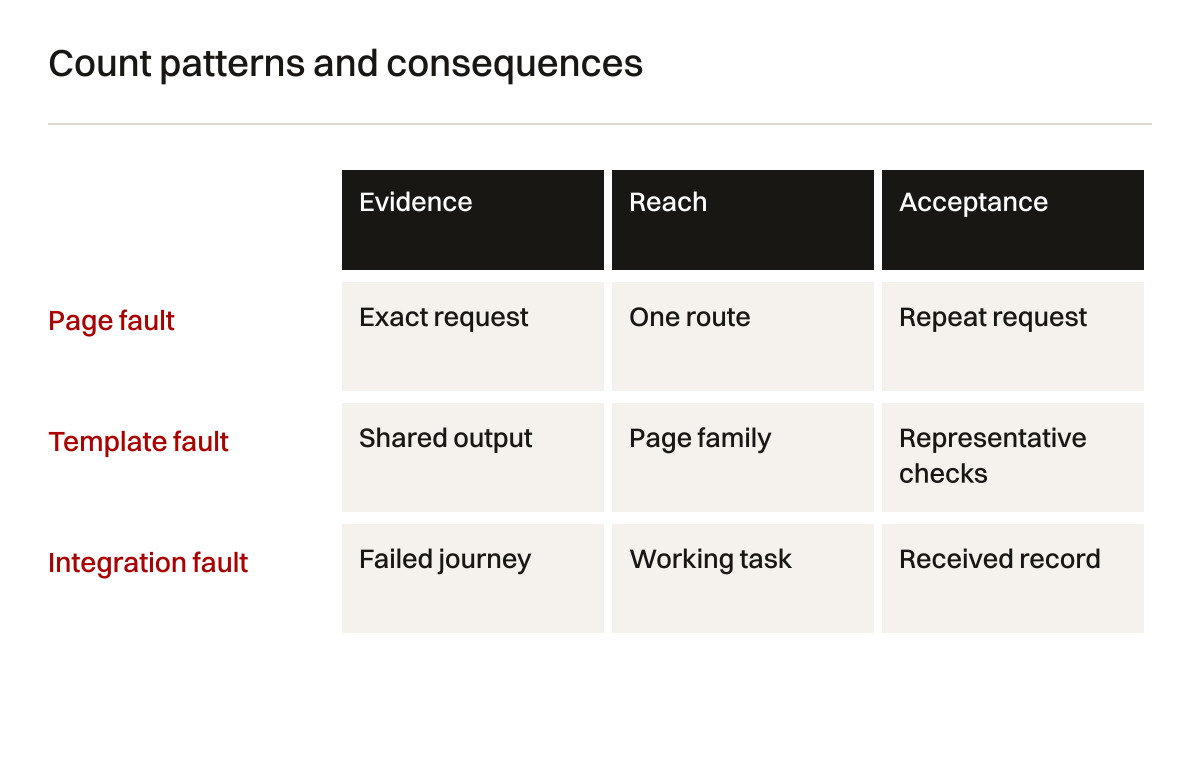
Do not treat tool severity as business priority without inspection. A warning affecting a rarely used decorative resource may be less urgent than one failed enquiry route. Conversely, a fault shared by every service template may have wider consequence than one page's report implies. Scope the affected pattern before estimating the repair.
Follow the response-to-discovery path
A useful public page needs to be reachable, return appropriate content and present consistent discovery signals. Search systems can then decide whether and how to index it. Technical implementation can remove obstacles in that path. It cannot force the search system to select the page or rank it for a chosen query.
Start with the exact URL. Inspect its response, redirects and final output. Then inspect crawl permissions, indexing instructions, canonical signals and links. Finally compare the relevant search observation. Skipping the public response can lead the team to diagnose a ranking issue when the page is simply inaccessible.
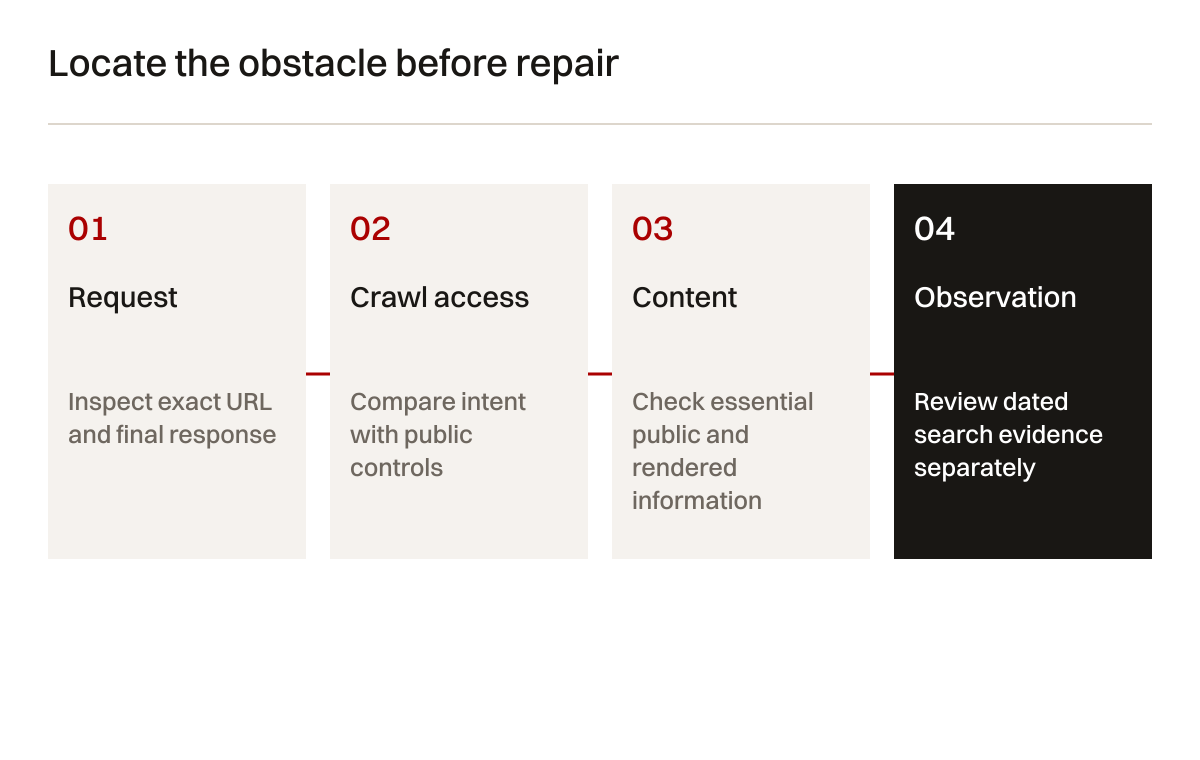
Keep an intended state beside the observed state. The business may deliberately keep a draft unindexed. A tool warning about that draft is not a defect. A public service page accidentally treated like a draft is a defect if the approved intent is discovery. The diagnosis depends on the intended role, not the presence of a particular instruction alone.
The same principle applies to customer portals. Private operational records should not become public search pages to satisfy a crawler report. Access control and discovery controls have separate purposes. Confirm the page's classification before changing any restriction.
Distinguish crawling from indexing
Robots rules govern crawler access in their defined context. Google's robots.txt introduction explains that blocking a URL from crawling does not necessarily prevent the URL from appearing in search. A robots file is also not a confidentiality mechanism. Private material needs actual access controls.
A noindex instruction addresses indexing when the crawler can encounter it. Google's noindex documentation describes supported methods and the crawl-access requirement. If a page is blocked from crawling, the search system may not see its noindex instruction. Changing one control without understanding the other can produce an unintended result.
Use a controlled failure example. A public service template includes a noindex meta tag copied from staging. The page returns ordinary content and works in the browser. The repair removes the unintended instruction from the correct template. The acceptance check inspects the public page and response header after deployment, then records later search processing separately.
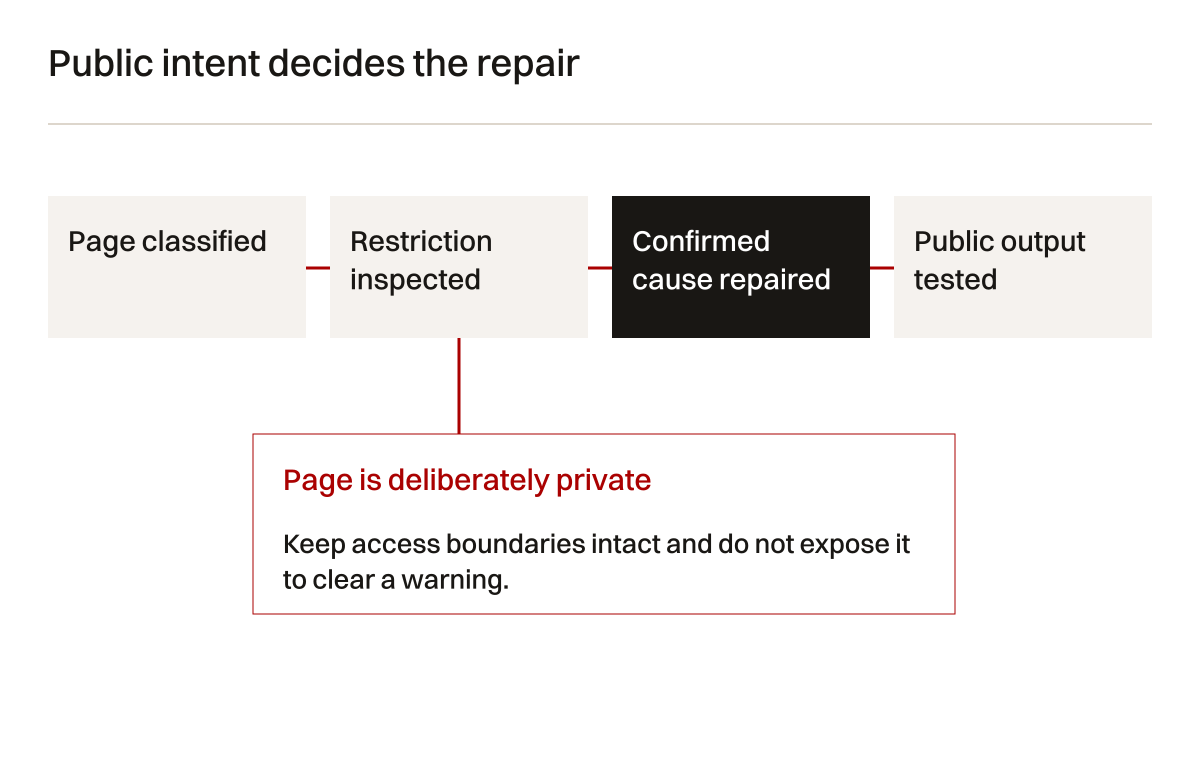
Do not submit a page for indexing repeatedly as a substitute for fixing its output. First establish that the intended public page is accessible and consistent. Search tools can support observation after the repair. They do not override a faulty template or provide a universal indexing deadline.
Compare source and rendered content
JavaScript can affect when and how page content becomes available. Inspect the initial response and the rendered result for important buyer information. A browser showing a service description does not establish that every crawler or tool receives the same content at the same stage.
Google's JavaScript SEO documentation describes crawling, rendering and indexing considerations. Use it to inspect the actual implementation. Do not turn it into a rule that all JavaScript is bad or that one rendering strategy guarantees visibility. The question is whether critical content and links are available through the intended public route.
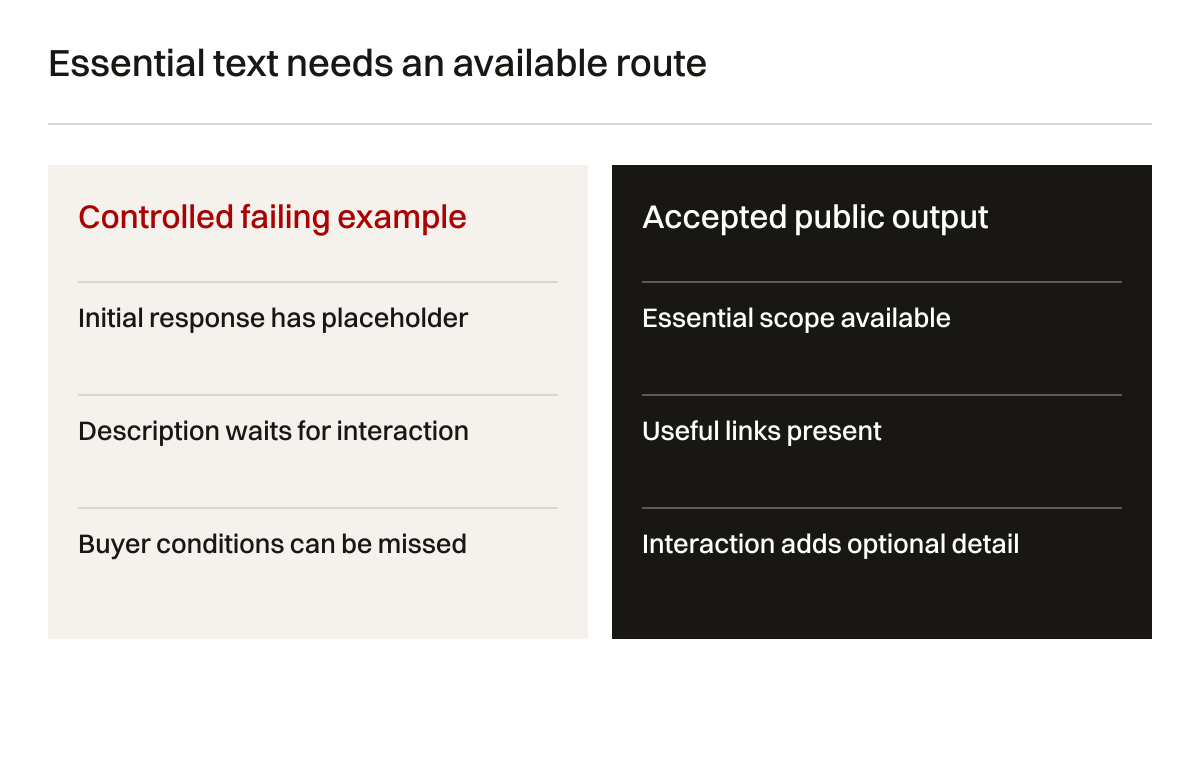
In the fictional failure, specifications appear only after a browser-only interaction that the page assumes every visitor will perform. The repair makes essential text available in the normal public page output. The interactive feature can still support deeper exploration. Critical facts should not depend on a hidden action merely because the design prefers a compact initial screen.
Inspect blocked resources and runtime errors. A missing script can affect navigation, form submission or content. A screenshot alone may show the static shell while the useful behaviour is broken. Record which resource failed and which user task depends on it. Then choose a repair that targets that dependency.
Resolve canonical conflicts by content relationship
A canonical annotation identifies a preferred URL for duplicate or similar content. It is not a way to declare that every page should rank as the homepage. Google's canonical guidance describes supported signals and their interaction. The search system evaluates them alongside other information.
Inspect why two addresses exist. They may be duplicates created by parameters, genuine regional variants or different service pages. A repair should follow that relationship. If a service page has distinct useful content, pointing it to an unrelated page can conflict with the business's intent. If two routes truly duplicate one page, consistent signals may be appropriate.
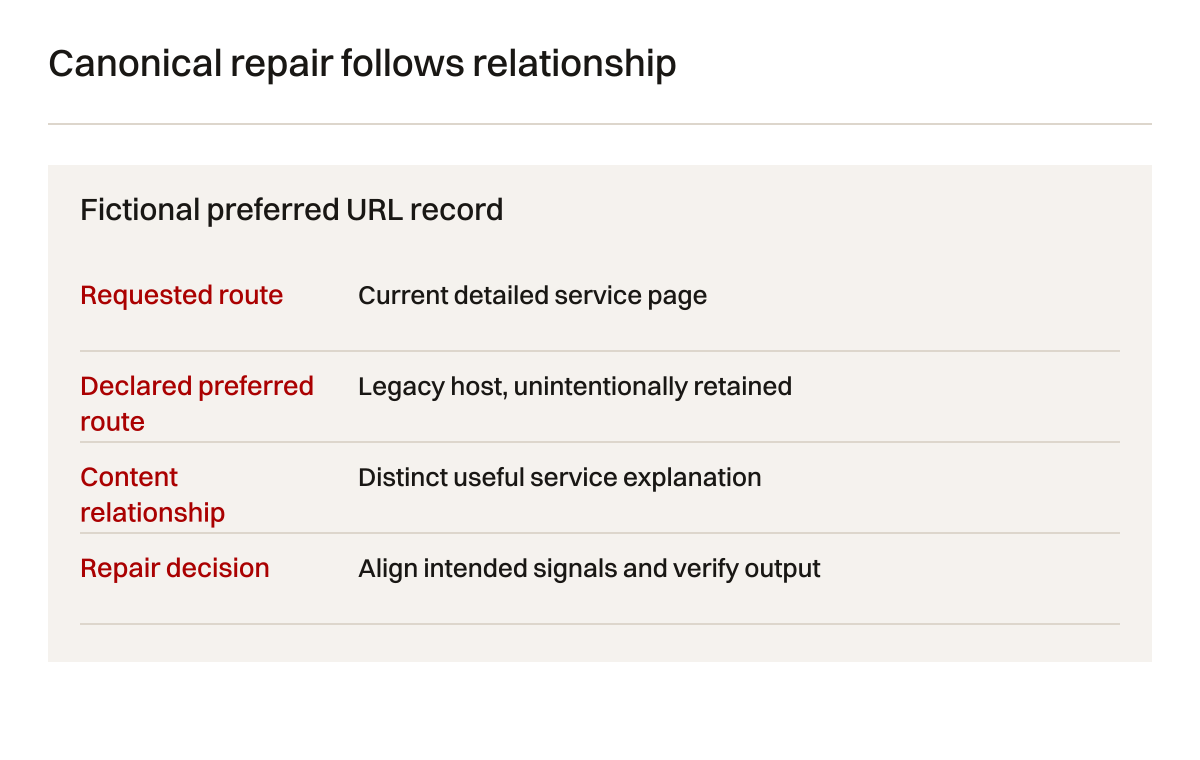
Check the actual deployed canonical, not only the CMS field. Templates, proxies or legacy plugins can insert conflicting output. Compare internal links and sitemap entries too. A canonical pointing to one URL while navigation and redirects imply another deserves investigation rather than a one-field correction made without context.
Record the distinction between declared and search-selected canonical when the tool exposes it. The live page can confirm the repair is deployed. Search-selected information may reflect earlier processing. Both are useful, but they answer different questions at different times. Do not call the repair ineffective solely because the historical observation has not changed immediately.
Inspect crawl paths and sitemap consistency
A public page can exist but have no useful internal route. Ask whether an interested buyer can find it from relevant service, category or evidence pages. Internal navigation should connect related tasks. The technical review should inspect actual links rather than assume every CMS record appears in navigation.
Google's sitemap overview describes sitemaps as discovery aids. A sitemap should reflect intended public destinations. It does not make an inaccessible or weak page useful. An important orphan page needs an architecture decision, not only another sitemap submission.
Check whether the sitemap includes redirects, errors or unintended test URLs. Compare a sample against public responses. A generated file can be syntactically valid while containing stale addresses. Record the generation source and release condition so the repair remains correct after future CMS changes.
The fictional crawl graph has a service overview linked to two detailed services and one evidence page. A third service exists only in the CMS. The repair adds an appropriate link where the buyer's task leads to it. It does not add every page to every footer. Relevance still matters when the technical goal is discoverability.
Repair redirects and broken resources
Follow an old link through its complete route. A permanent move should use the appropriate supported mechanism. Google's redirect documentation distinguishes methods and intended meanings. Inspect whether the implementation actually matches the move rather than relying on a plugin label.
A loop can occur when one layer adds a slash and another removes it. A chain can occur when old host, protocol and path rules are applied separately. A wrong destination can be technically reachable but irrelevant. Record each hop and the final content so the repair can be evaluated clearly.
For files, check the direct request. A technical PDF may use a storage route outside the main application. An image can be referenced in HTML while failing from its CDN. A page repair that only changes the visible link may not address the resource's access or missing source.

Preserve the content decision. If a retired service has no equivalent, the appropriate response may be removal rather than a broad redirect. Technical reports often treat errors as universally bad. Business intent can make a specific removal correct. The repair log should explain that distinction so the same address is not repeatedly reclassified as a defect.
Measure page experience in context
Page experience involves how visitors use the page, not just a score. Inspect the affected journey on the relevant device and connection conditions. A slow first view, shifting content and delayed interaction can have different causes. A buyer reading a specification table may encounter a problem that a homepage speed test misses.
The Web Vitals guidance describes Core Web Vitals and the distinction between field and laboratory measurement. Use the appropriate evidence for the question. Laboratory tests can help isolate a change. Field data describes observed experiences across its actual scope. Neither should be presented as a universal result for every visitor.
Identify the resource or interaction behind the symptom. An oversized photograph might delay important content. A script might block interaction. A layout shift might occur when a file preview appears. The repair should address the relevant cause while preserving information the buyer needs.
Do not remove useful technical content simply to produce a better synthetic score. A specification table and approved evidence can matter to qualification. Optimise delivery and interaction while checking that the task remains usable. Record any trade-off so the business can assess what changed.
Make test conditions explicit
A repeatable test names the route, environment, method, device and expected state. Without that record, two people can report different results without knowing why. A cached response may differ from a fresh origin response. An authenticated editor may see a draft that an ordinary visitor cannot.
Table 2: test conditions. Choose conditions relevant to the finding rather than collecting every possible device.
| Condition | Record | Why it matters | Limit |
|---|---|---|---|
| Exact route | Full tested URL and relevant variation | Routing rules can differ | Does not cover untested variations |
| Environment | Public deployment and release reference | Local output may differ | Provider layers can still vary |
| User state | Ordinary visitor or specified role | Permissions affect output | Other roles need separate checks |
| Rendering method | Initial response or rendered browser | Scripts affect available content | Tools have different capabilities |
| Cache condition | Observed headers and refresh method | Stale output can hide repair | One location is not every visitor |
| Performance setup | Device, connection and measurement type | Results depend on conditions | Synthetic run is not a field population |
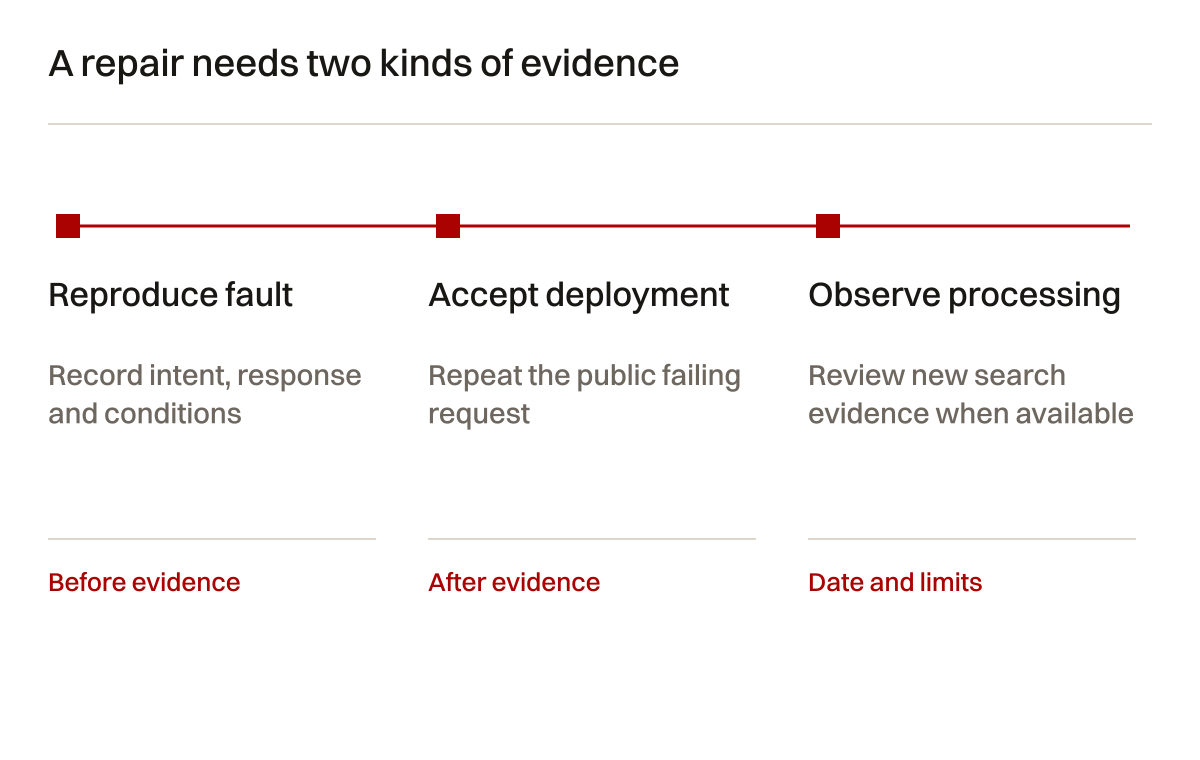
Retain before and after evidence for material changes. A repair log should show what the original fault was and which acceptance check now passes. That is more useful than a report of how many warnings disappeared. Tool totals can change because the crawl scope changed rather than because the website improved.
Prioritise consequence, confidence and change risk
Start with a confirmed fault on an important task. Consider the breadth of the affected pattern and the risk of the repair. A shared template restriction can justify prompt attention because it affects many intended public pages. A speculative warning may need another test before implementation.
Do not create a universal priority score from arbitrary numbers. The guide's synthetic chart counts affected routes under declared assumptions. Fault A affects six intended service pages, fault B affects two document routes and fault C affects one optional archive. Six plus two plus one equals nine affected routes. These counts do not establish commercial impact.
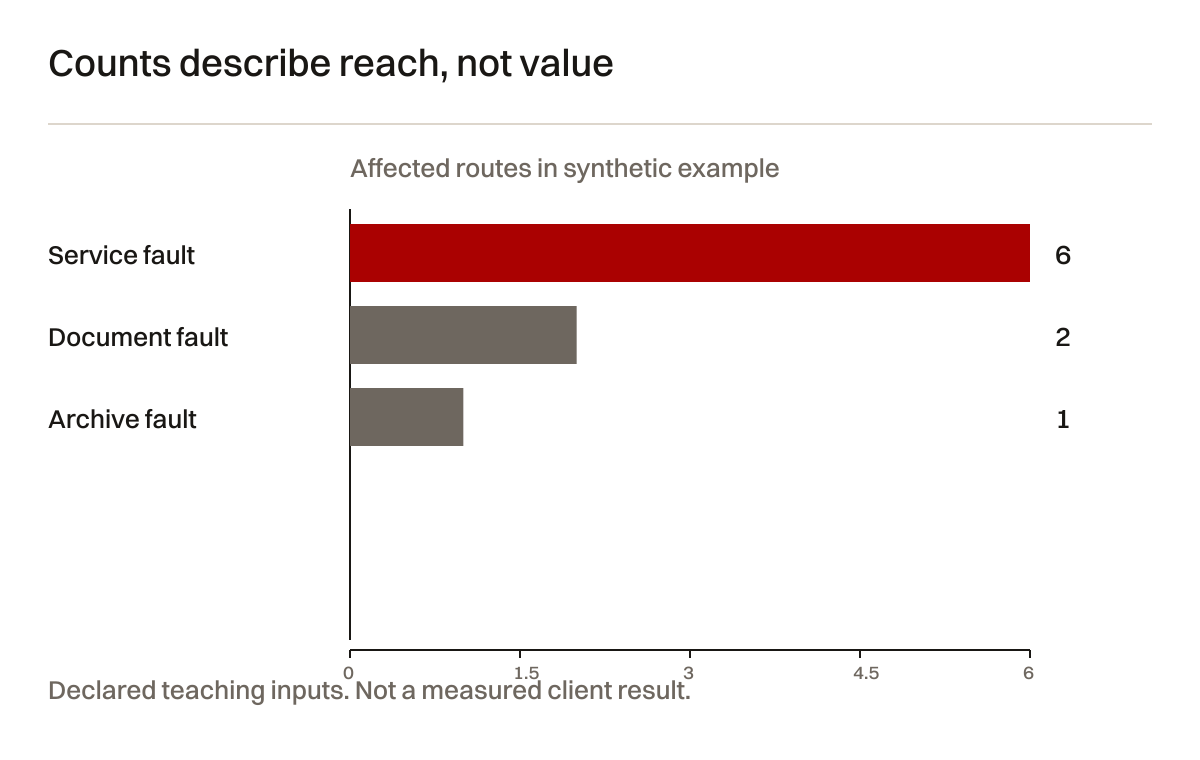
Table 3: repair decisions. Confidence and consequence guide the next action; counts alone do not choose it.
| Situation | Confirmed cause | Proposed action | Risk to review |
|---|---|---|---|
| Shared service noindex | Unintended template instruction | Correct template and verify affected sample | Deliberately restricted pages sharing template |
| Missing specifications | Browser-only content dependency | Provide essential public content normally | Duplicated or inconsistent content paths |
| Canonical conflict | Legacy host in output | Align intended page signals | Genuine duplicate or locale relationships |
| Redirect loop | Conflicting normalisation rules | Resolve relevant rule interaction | Other routes using the same rules |
| Slow task | Identified resource or interaction | Change delivery with task checks | Removed meaning or new interface fault |
The CSV keeps the scope assumptions visible. Use real production evidence for actual decisions. A one-route fault can still be urgent if it blocks the only enquiry path. A broad warning can be less urgent if the affected routes are deliberately retired. The repair log should contain the reason rather than conceal judgement behind a number.
Implement one explainable repair
Describe the intended change before editing. Identify its dependencies and acceptance tests. A developer should know whether the task is to remove an unintended restriction, change a route or alter how content is delivered. Avoid bundling unrelated improvements into the same release if that makes cause and rollback difficult to understand.
Use a controlled environment where appropriate. Test the affected pattern and important nearby behaviour. A template change can affect every page using it. A redirect change can affect files and protocol variants. The test depth should follow the change's reach, not the apparent simplicity of its code.

Keep recovery boundaries clear. Reverting a configuration change may be straightforward. Reversing a content import or URL restructuring may require more work. Record which records can change after release and what a rollback would preserve. Ask the responsible owner to approve material trade-offs before the public change.
After deployment, inspect public output. A successful build proves a limited implementation check. It does not prove that cached HTML, response headers, DNS or external resources now reflect the intended state. Repeat the specific failing request through the real visitor route and retain the result.
Separate repair acceptance from later observation
Acceptance confirms the intended output under recorded conditions. Later observation asks how crawlers, search systems and users respond. Google's Search Console guidance explains monitoring tools that can support that review. Keep the observation timestamp and tool scope with the record.
Table 4: acceptance checks. Immediate evidence concerns implementation; subsequent processing remains a separate question.
| Repair | Immediate test | Acceptance evidence | Later observation |
|---|---|---|---|
| Remove unintended noindex | Inspect public page and headers | Restriction absent from required route | Relevant indexing state after processing |
| Fix rendering | Compare essential content | Approved text and links available | Search-rendered or indexed observation where available |
| Align canonical | Inspect output and related signals | Intended consistent destination | Search-selected canonical with date |
| Correct redirect | Follow old route | Appropriate response and relevant final page | Old and new route observations |
| Improve interaction | Repeat task under stated setup | Defined interaction behaves as expected | Field evidence where population exists |
Do not promise a processing deadline the evidence cannot support. A live output check can confirm the fix now. A search-selected state may change later or remain different for reasons that need further investigation. Report both plainly. The absence of an immediate ranking change does not by itself prove that a confirmed technical repair failed.
Choose the next review trigger. It may be a new tool observation, a relevant release or enough actual field data to interpret a change. Avoid repeated unchanged checks that add no evidence. The log should state what new information would justify another action.
Work through an apparently fixed page
A fictional B2B service page is unintentionally excluded from indexing. The team finds a noindex tag in the initial HTML. The developer removes it and deploys the change. A browser screenshot looks correct. The repair is not yet accepted because the response headers have not been checked.
The public request still receives an indexing restriction from a deployment rule. That rule was added for the staging environment and applied too broadly. The team corrects the rule, repeats the public request and confirms the intended instruction is absent. It also checks a deliberately restricted test route to ensure the repair did not expose it.
Search Console still shows the earlier excluded state. The team records that as historical processing evidence while retaining the current live result. It chooses an appropriate later observation rather than repeatedly editing the page. The report says the implementation is repaired under the tested conditions and search processing remains to be observed.
The example separates page output, hosting configuration and search observation. It avoids a claim that the repair guaranteed indexing or generated leads. The business can understand exactly what was changed, what was tested and what remains outside the immediate conclusion.
Keep remaining limits visible
A technical repair does not make unclear service content useful. A well-rendered page can still lack evidence or misstate the offer. A correctly indexed page can still attract irrelevant visits. Technical work removes identified obstacles; buyer relevance and commercial handling have their own questions.
Table 5: remaining limits. These prevent a repair report from implying a broader result than the evidence supports.
| Evidence | Supports | Does not establish | Next owner |
|---|---|---|---|
| Successful response | Tested route is reachable | Page deserves indexing | Content and search owners |
| No unintended restriction | Implemented public intent | Search system will select page | Search observation owner |
| Consistent canonical | Signals align under inspection | Guaranteed chosen canonical | Search practitioner |
| Faster laboratory task | Improvement under stated setup | Every visitor's field experience | Measurement owner |
| Received test enquiry | Tested delivery route works | Buyer qualification or sale | Commercial team |
Hand over the fault record, release reference and review trigger. The receiving maintainer should know which pages share the repaired pattern and what would indicate regression. A record that preserves reasoning makes the next change safer and prevents the same diagnosis being repeated from scratch.
Investigate a disagreement between tools
Two reports can disagree because they inspect different conditions. In the fictional repair review, a crawler reports an empty service description while a browser shows complete content. The team does not choose the preferred result by intuition. It records each request method and compares the content available at the relevant stage.
The initial HTML contains only a placeholder. The browser later loads a description from an API. During the crawler test, that API request is not performed by the selected tool. This explains the discrepancy for that test. It does not establish how every search system processes the page. The next decision is whether essential approved information should be available without that dependency.
The developer changes the public delivery path and repeats both observations. The initial response now contains the essential service explanation, and the browser retains the intended interactive detail. The commercial owner checks that no technical conditions were lost. The report records the repaired dependency and the limits of the methods used.
Another disagreement concerns cache. A fresh origin response contains the correct canonical, while a public edge response still serves the earlier output. The team inspects the relevant deployment and caching rules. It verifies the repaired public route after the approved cache action. A correct local template was necessary but insufficient evidence for the visitor result.
These cases teach an operating habit: compare conditions before declaring a tool wrong. A simple crawler, live browser and historical search observation can each provide useful evidence while describing different moments or capabilities. The repair log should preserve those distinctions so the next practitioner can understand why a check was chosen.
Record a repair that should be deferred
Some warnings require a business decision before implementation. The fictional crawler finds a service page canonicalised to a broader parent. The pages share much of their content, but the technical owner is considering whether the detailed service remains offered. The implementer should not force a separate public page merely to clear the warning.
The log records the current relationship, observed signals and unanswered scope question. The business owner decides whether to retain distinct content, consolidate the useful explanation or retire the old page. Only then can the technical route follow the approved intent. This is a specific dependency, not an indefinite refusal to act.
A separate performance proposal would remove a technical file preview. The preview supports buyer review, so the team first tests alternative delivery rather than deleting it solely for a score. If the proposed change cannot preserve the task, the business needs an explicit trade-off. The implementation should not quietly sacrifice useful meaning to improve one metric.
Deferred work should have a next decision owner and trigger. The record remains open until that question is answered. It is not reported as a completed repair, and it is not repeatedly re-entered as a new finding each month. Good technical work includes knowing which change cannot yet be justified by the available evidence.
Frequently asked questions
Should every crawler warning be fixed?
No. First establish intended behaviour and business consequence. Some warnings describe deliberate removals or restricted pages. Some require another test. Repair confirmed faults with appropriate acceptance evidence, then explain unresolved questions rather than promising a completely warning-free report.
Is noindex the same as robots blocking?
No. They address different discovery stages. Crawlers need to encounter supported noindex instructions for those instructions to be processed. Robots controls do not protect confidential data. Test the actual combination and keep private access as a separate implementation concern.
Does JavaScript stop SEO?
Not universally. Inspect whether important content and links are available through the intended public route and rendering process. Google documents JavaScript considerations. The repair should address a demonstrated dependency or failure, not remove all interaction because a tool prefers static output.
Can one speed score prove a repair?
It can provide evidence under a defined test setup. Field experience and actual buyer tasks need their own interpretation. Keep measurement type, device and conditions visible. Check that the page still conveys useful technical information after performance changes.
When should another repair be made?
When new evidence identifies a remaining cause, a regression or an unmet acceptance condition. Unchanged external processing alone does not justify repeated speculative edits. Record the next observation that could change the decision and investigate before expanding scope.
Start with the failing public task
Bring one route, its intended role and the observation that concerns you. The next step is to reproduce the behaviour and locate its cause. That gives the business a concrete repair decision and gives the implementer a bounded acceptance test.
Creatif Work can connect technical search diagnosis, website implementation and operating support around confirmed faults. Reports should show the changed behaviour and remaining limits. Start with the problem.
Sources and limits
Official references checked on 4 October 2026. All failures and numeric inputs are original controlled teaching examples.