

How Technical Buyers Use AI Search Before They Contact a Supplier

Technical buyers may use AI-assisted search before a supplier ever sees the enquiry. They can explore terminology, compare approaches, identify standards, draft a shortlist and prepare questions.
That does not remove the need for supplier evidence. It raises the cost of vague pages because buyers can compare many sources before making contact.
How do technical buyers use AI search?
They use it to frame an unfamiliar problem, expand a query into subtopics, compare options, identify risks and prepare a supplier brief. They still need source pages for current specifications, compliance, project evidence and contact. Suppliers should publish clear, crawlable facts with dates, boundaries and original evidence that a buyer can verify.
Google explains that AI Overviews and AI Mode can use query fan-out to run related searches across subtopics and sources. Its AI features guidance says the same SEO foundations still apply: accessible content, internal links, useful text, page experience and accurate structured data.
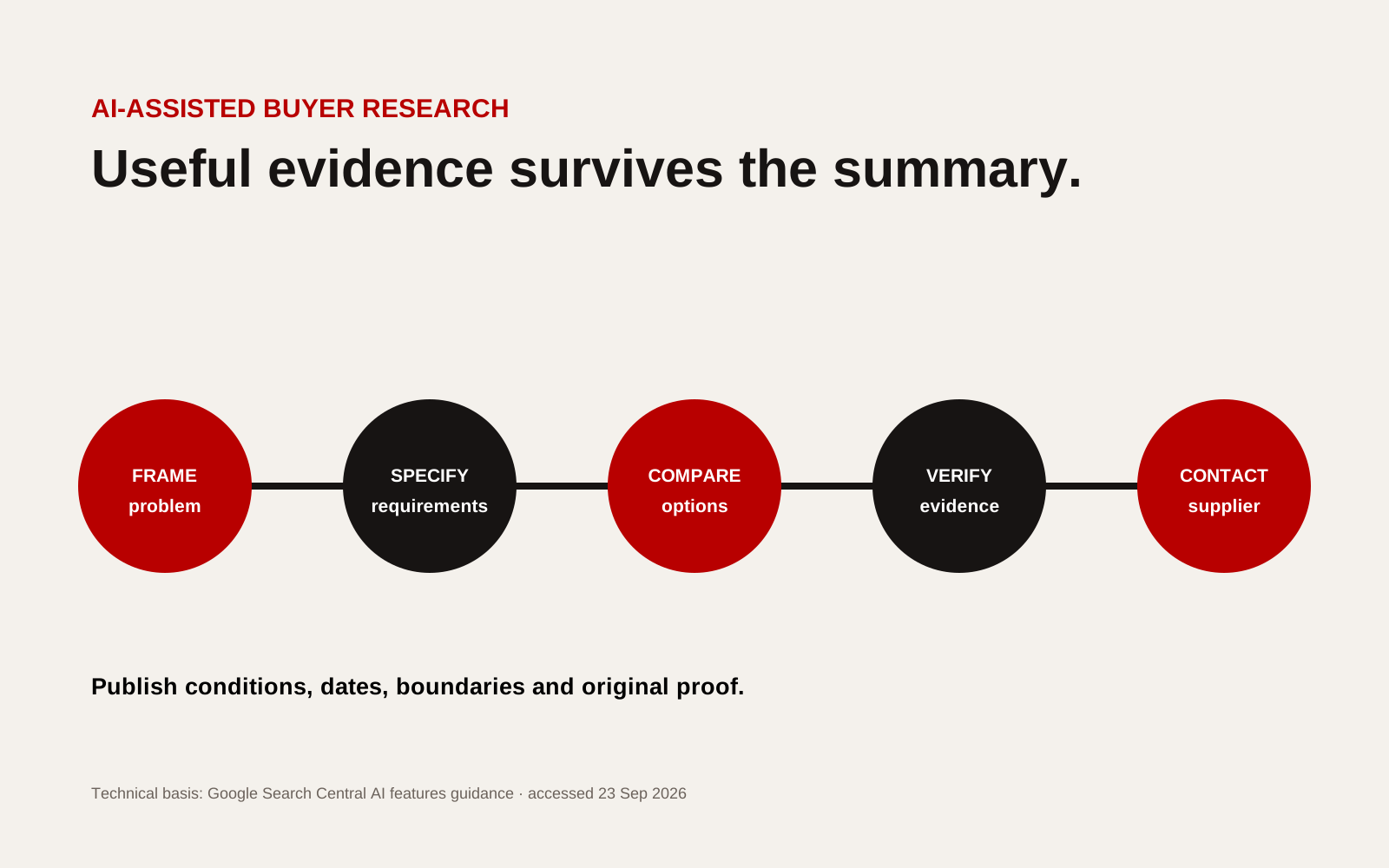
Technical buyer AI search journey from problem framing through evidence comparison to supplier contact.
Follow the buyer's research sequence
| Stage | Example buyer question | Supplier content needed |
|---|---|---|
| Frame | What type of system solves this? | Clear problem and application pages |
| Specify | Which ratings, standards and interfaces matter? | Structured technical data and selection inputs |
| Compare | How do options differ? | Bounded comparison and decision criteria |
| Verify | Has this worked in a similar case? | Project evidence, method and limitations |
| Contact | What information should I provide? | Qualified enquiry and responsible owner |
A homepage slogan rarely supports any of these stages.
Publish facts that survive summarisation
Put the condition beside the number. Put the date beside a changing requirement. Put the responsibility beside the capability claim.
For example, do not publish “30% more efficient” without baseline, duty, test method and date. Do not say “global support” without locations, roles and escalation. These missing qualifiers create an attractive sentence that can be repeated inaccurately.
Use tables where buyers compare fields, diagrams where interfaces matter and checklists where a process must be followed. Add descriptive alt text so the meaning is not locked inside an image.
Answer the main question early
Technical pages often begin with company history before the reader learns whether the product fits. Open with a direct answer, then provide method, evidence, limitations and next step.
Use specific headings such as “Which monitoring methods are supported?” rather than “Innovation without limits”. Clear headings help people scan and give search systems better page structure.
Google's 2026 generative AI optimization guide recommends original, non-commodity content. It also says there is no ideal length and no need to rewrite text only for AI systems.
Build a connected evidence path
A useful path might be:
- industry problem or regulatory guide;
- relevant service or product page;
- technical method or comparison;
- project evidence;
- qualified contact route.
Link in both directions where helpful. A case study should identify the service and product. A service page should point to evidence and useful guidance.
Our guide to Google AI Overview visibility covers the crawl, content and measurement foundations behind this path.
Keep high-risk evidence current
Assign review owners to specifications, regulatory claims, certifications, service coverage and dates. Trigger review when a product, standard, partner or process changes.
Do not create a separate page for every phrasing of the same question. Merge overlapping content and maintain a stronger primary answer. Google's guidance warns against scaled pages created mainly to influence rankings.
Measure what happens after visibility
Review Search Console, landing-page behaviour and enquiries together. Ask:
- Which pages receive non-branded technical searches?
- Which internal links do visitors follow?
- Do enquiries reference the published evidence?
- Which pages attract traffic but fail to reach a next step?
- Are buyers asking questions the site should answer earlier?
AI visibility is not valuable if the page cannot support qualification.
Prepare sales for a better-informed buyer
Buyers may arrive with a comparison table, a summary or a list of risks produced before contact. Sales and engineering should know what the website states and where each claim comes from.
Create a short internal map linking public pages to approved sources, current downloads and subject owners. When a buyer challenges a figure, the team can verify it rather than improvise.
Review repeated questions after calls. If buyers misunderstand the same boundary, improve the page. If they ask for sensitive project evidence, create a controlled follow-up pack rather than putting it all online.
Do not optimise for one generated answer
AI responses vary by query, model, location and time. Chasing a particular wording can lead to unnatural copy and constant reaction.
Build durable source pages that remain useful when no AI summary appears. A buyer should be able to scan the answer, inspect the evidence, compare the option and contact the right person directly.
A supplier readiness check
- Important pages are crawlable and indexable.
- Product facts have units, conditions and dates.
- Compliance claims name the market and scope.
- Case studies show responsibility and limitations.
- Internal links form a useful research path.
- Images and diagrams have descriptive alt text.
- Enquiries capture enough context to route correctly.
- Owners review changing content.
Creatif Work combines website design with SEO and AI visibility work. We build the evidence path once, then review and improve it as buyer questions, products and search interfaces change.