

What Is Included in Professional Website Design?

Professional website design is not one standard package. One proposal may cover visual design only. Another may include research, writing, development, analytics, migration and support.
The useful question is not “does it include a website?” It is “which decisions, deliverables and responsibilities are included from discovery through handover?”
What is usually included?
A complete professional website project usually covers discovery, goals and audience, information architecture, content planning, visual and interaction design, responsive development, accessibility, search foundations, analytics, testing, launch and handover. The proposal should also name exclusions, client inputs, third-party costs, ownership and post-launch support.
Do not assume that logo work, copywriting, photography, hosting, ongoing SEO or maintenance are included. Confirm them in the scope.
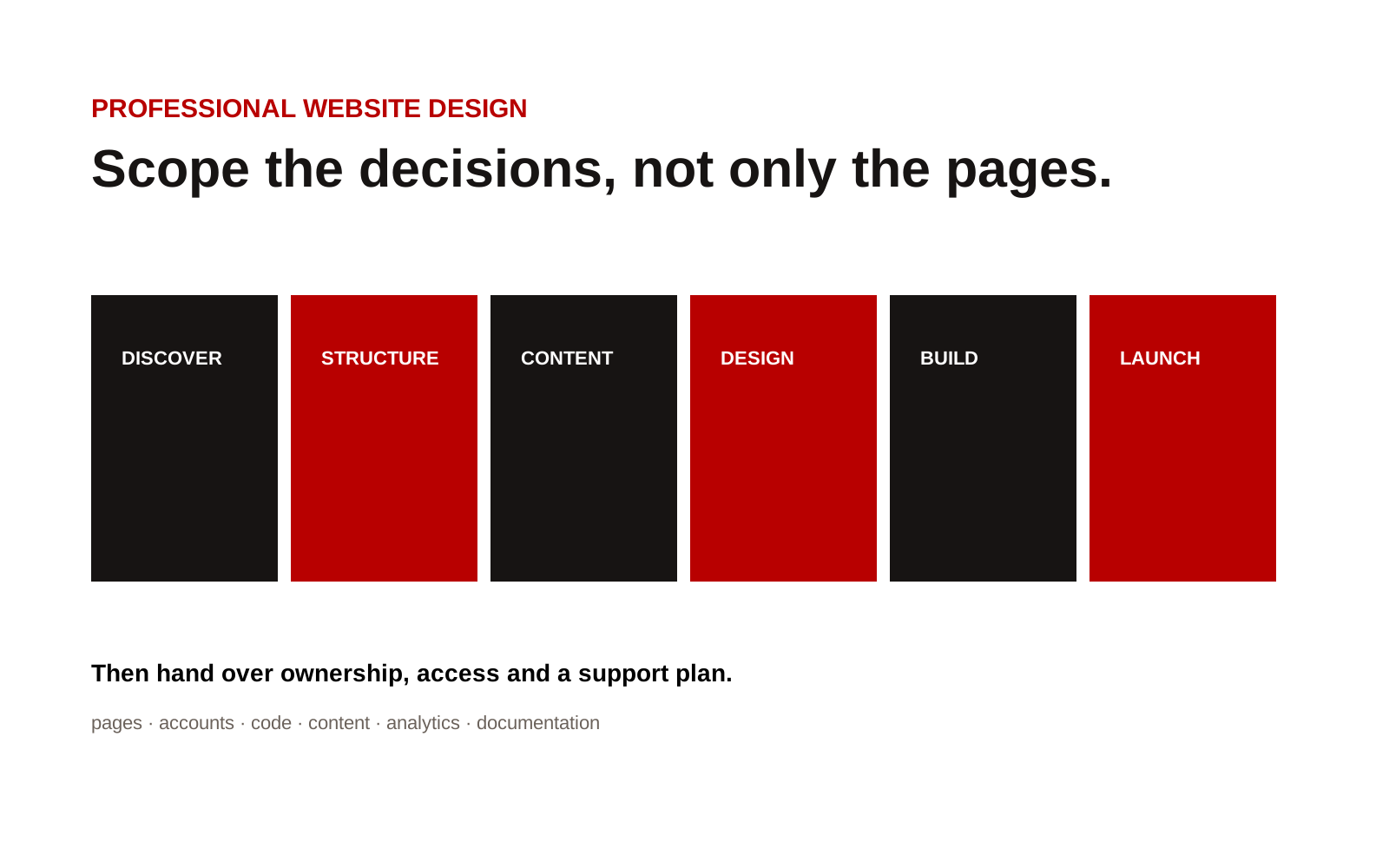
Professional website design scope map covering strategy, content, design, build, launch and support.
Compare work by stage
| Stage | Typical deliverables | Questions to confirm |
|---|---|---|
| Discovery | Goals, audiences, current-site review and requirements | Who participates and what research is included? |
| Structure | Sitemap, user flows and page plan | How many page types and revisions? |
| Content | Briefs, writing, editing and migration | Who writes and approves each page? |
| Design | Direction, page designs, components and responsive states | Are mobile and interaction states shown? |
| Build | Templates, CMS, integrations and forms | What is custom and what depends on third parties? |
| Launch | Testing, redirects, analytics and deployment | Who controls domains, accounts and rollback? |
| Handover | Training, documentation and access | What does the client own and maintain? |
This table helps compare proposals that use different labels.
Discovery and structure
Discovery should identify the business decision the website needs to support. That may be better project enquiries, easier technical screening, recruitment or international growth.
The structure then maps services, products, industries, projects and evidence to buyer tasks. A sitemap is not only a list of pages. It should show why each page exists and how readers move to the next decision.
Confirm whether current analytics, search performance, enquiries and stakeholder interviews are reviewed. If the project skips research, understand which assumptions will replace it.
Content and evidence
Copy may be supplied by the client, written by the designer or developed together. Define who gathers technical facts, approves claims and checks legal or regulatory wording.
Professional content work can include page briefs, interviews, drafts, editing, metadata, internal links, image direction and migration. It should not invent project outcomes or credentials to fill a layout.
Our website content audit checklist lists the questions to answer before old pages are copied into a new design.
Design and development
Design includes more than a homepage picture. Confirm the number of templates, responsive behaviour, navigation, forms, empty and error states, accessibility and motion.
If accessibility conformance is in scope, name the target and testing method. The W3C WCAG overview explains the international Web Content Accessibility Guidelines and their testable success criteria.
Development should define the content system, editing permissions, integrations, performance approach and browser support. Ask which code, themes, plugins or services are third-party and what happens if they change.
Clarify whether the build includes structured data, redirects, sitemap, robots controls, canonical tags, social sharing and basic search metadata. These are foundations, not a promise of rankings.
Testing and launch
Testing should cover content, links, forms, devices, keyboard use, accessibility, performance and analytics. A migration also needs a URL map and redirects for valuable old pages.
Name the launch owner, DNS responsibility, backup and rollback path. Avoid transferring accounts through personal logins when business-owned access can be used.
Ownership and support
Confirm ownership of design files, code, written content, photography, domains, analytics, hosting and third-party licences. Record access at handover.
Post-launch support may cover defect correction, maintenance, content changes, security updates, SEO work or new features. These are different services. Define response, exclusions and how additional work is approved.
Our website ownership and handover guide provides an account and asset checklist.
Search and AI visibility work
A professional build should give search systems access to useful content, but design alone does not guarantee visibility. Confirm whether the project includes keyword and audience research, page titles, descriptions, internal links, structured data, image alt text, Search Console and a measurement plan.
Ongoing SEO is a separate operating service when it includes publishing, evidence updates, search analysis, technical monitoring and content improvement. The launch establishes a sound foundation. It does not create permanent rankings or AI search inclusion.
Ask how success will be reviewed after launch. Enquiry quality, product-page use and target-market visibility may matter more than total visits.
Changes and acceptance
Define how new requests are assessed, priced and approved. A revision to an agreed design is different from a new page type, integration or content stream.
Use acceptance criteria for design, content, functions, performance and browser support. Record unresolved items and the person authorised to accept them. This keeps launch from becoming an argument about unspoken expectations.
Confirm the defect period and the difference between fixing agreed work and requesting a new feature. Put both routes in the handover notes.
Questions before signing
- What exact pages and templates are included?
- Who provides and approves content?
- Which integrations and third-party costs are excluded?
- What accessibility and testing standard applies?
- How are revisions and scope changes handled?
- Who owns every account and asset?
- What happens at launch and handover?
- What support continues afterward?
Creatif Work's website design service is scoped around the real buyer journey, content and evidence, not a page count alone. We make deliverables, ownership and ongoing work visible before the build starts.