

Can AI Do Your SEO? Where Supervision Matters

AI can assist with SEO research, classification, drafting and checks. It cannot validate a recommendation merely because it can explain it confidently. Someone still needs to verify the data, understand the business, inspect the implementation and accept responsibility for what is published. The useful distinction is supervised work versus unchecked output, not human work versus every use of AI.
A founder asks a tool to audit a website. Seconds later, it recommends keywords, articles and technical repairs. The list looks plausible. But the tool has not seen the enquiry records, does not know which services remain available and may not have inspected the actual deployed page.
That does not make the tool useless. It makes the task definition and review important. This guide separates suitable assistance from decisions requiring evidence and qualified responsibility. The examples are hypothetical editorial exercises. They are not private client audits or demonstrations of measured search gains.
Download the supervised SEO workflow workbook or the CSV template pack. Use it to record inputs, checks, approval and limitations rather than treating a generated answer as a completed task.
Begin with the job, not the model
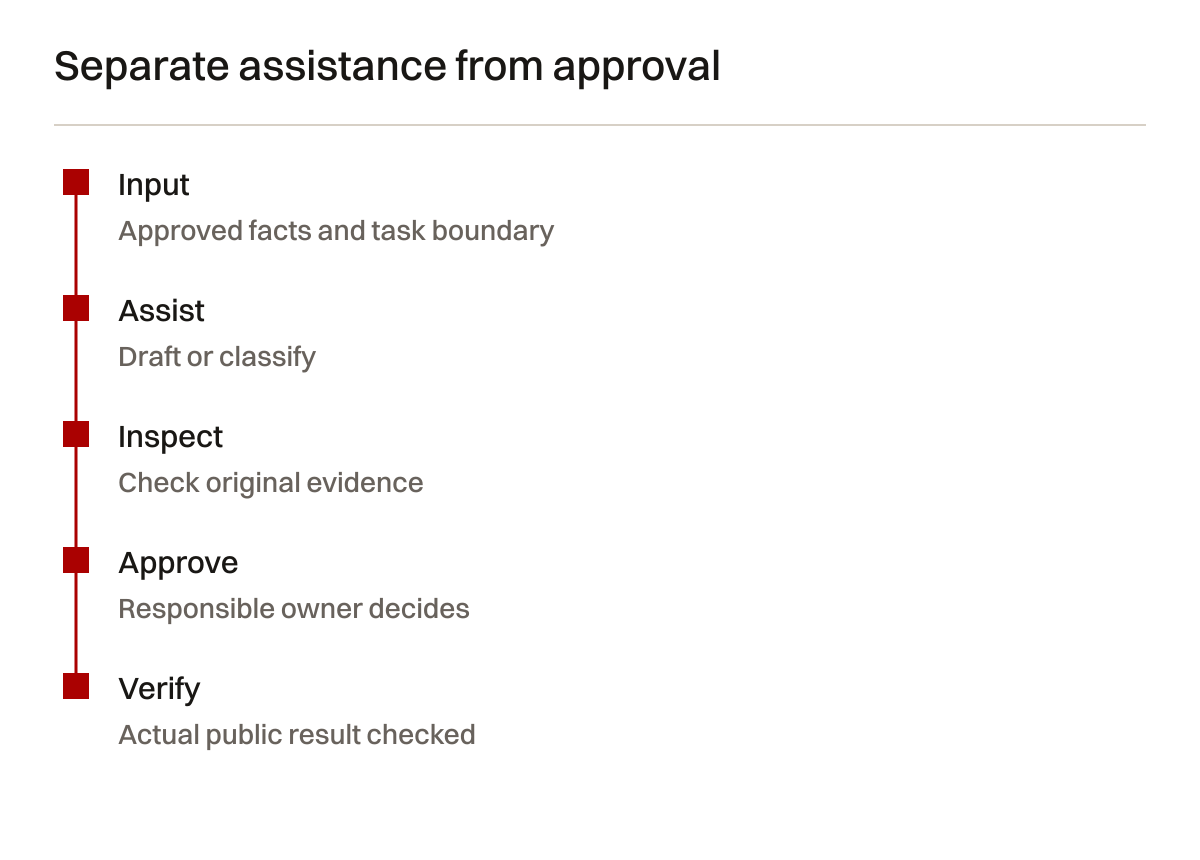
SEO contains different kinds of work. Grouping a known list of queries is not the same as deciding commercial relevance. Drafting a paragraph from approved facts is not the same as verifying those facts. Proposing a technical change is not the same as deploying and checking it.
Name the task in terms of its input and required output. For example: “Group these authorised enquiry questions by the buyer decision, preserving each original identifier.” That is a more inspectable task than “create a strategy for our engineering company.”
Define what the tool is not allowed to assume. It should not invent search volumes, delivery territories, qualifications or project outcomes. Where information is missing, the output should mark the gap. A useful workflow gives the reviewer a chance to resolve it before publication.
Match review effort to consequence
A wrong grouping label can be easy to correct. A false technical capability on a public page can affect procurement and trust. A mistaken site-wide indexing change can affect many pages. The same quick review is not sufficient for every task.
Identify the consequence if the output is wrong and who is qualified to assess it. The content reviewer can check readability and citations. The service owner confirms actual capability. The developer verifies the deployed technical state. The analyst checks the measurement definition and interpretation.
NIST's AI Risk Management Framework is a useful reference for deliberate risk management. The workflow here is our practical editorial interpretation for SEO work, not a claim that completing a checklist certifies compliance or removes every risk.
Where AI can help without pretending to know the business
Tools can assist with organising a defined source set, comparing page inventories, drafting from approved records and proposing alternative wording. They can flag inconsistent terminology or unanswered questions. They can help a reviewer notice that a service claim lacks a source.
The value depends on the input and the check. If the source inventory is incomplete, the tool cannot reliably establish completeness. If the approved facts are old, a fluent draft can reproduce old information. If the instruction asks for impressive numbers, the output may contain numbers without a defensible basis.
| Task | Suitable assistance | Required review | Boundary to retain |
|---|---|---|---|
| Query organisation | Group supplied records with identifiers | Check intent and ambiguous terms | No invented volume or demand |
| Page inventory | Summarise inspected page content | Compare with actual public pages | Summary is not a full audit |
| Drafting | Explain approved facts in readable structure | Source, scope and editorial review | No invented capability or results |
| Data checking | Suggest anomalies and reproduce formulas | Inspect definitions and original values | Calculation is not causal proof |
| Technical proposal | Draft a bounded change plan | Developer review and public verification | Proposed is not deployed |
Keep the original identifiers
When classifying queries or pages, preserve the original row identifier and text. If the model rewrites every query, the reviewer may lose the distinction between what was observed and what was inferred. A classification should add information to a record rather than replace its provenance.
Use an unresolved category for ambiguous records. A query about a construction material might concern procurement, repair or academic research. Forcing it into “high buying intent” does not create evidence. The unresolved rows tell the analyst where further inspection may be worthwhile.
Check a sample from each category and inspect unusual cases. Do not review only the rows that support the desired strategy. If the classification will determine expensive work, expand the review or use an independent second pass. Record what was checked and what remains uncertain.
Keyword research still needs a commercial test
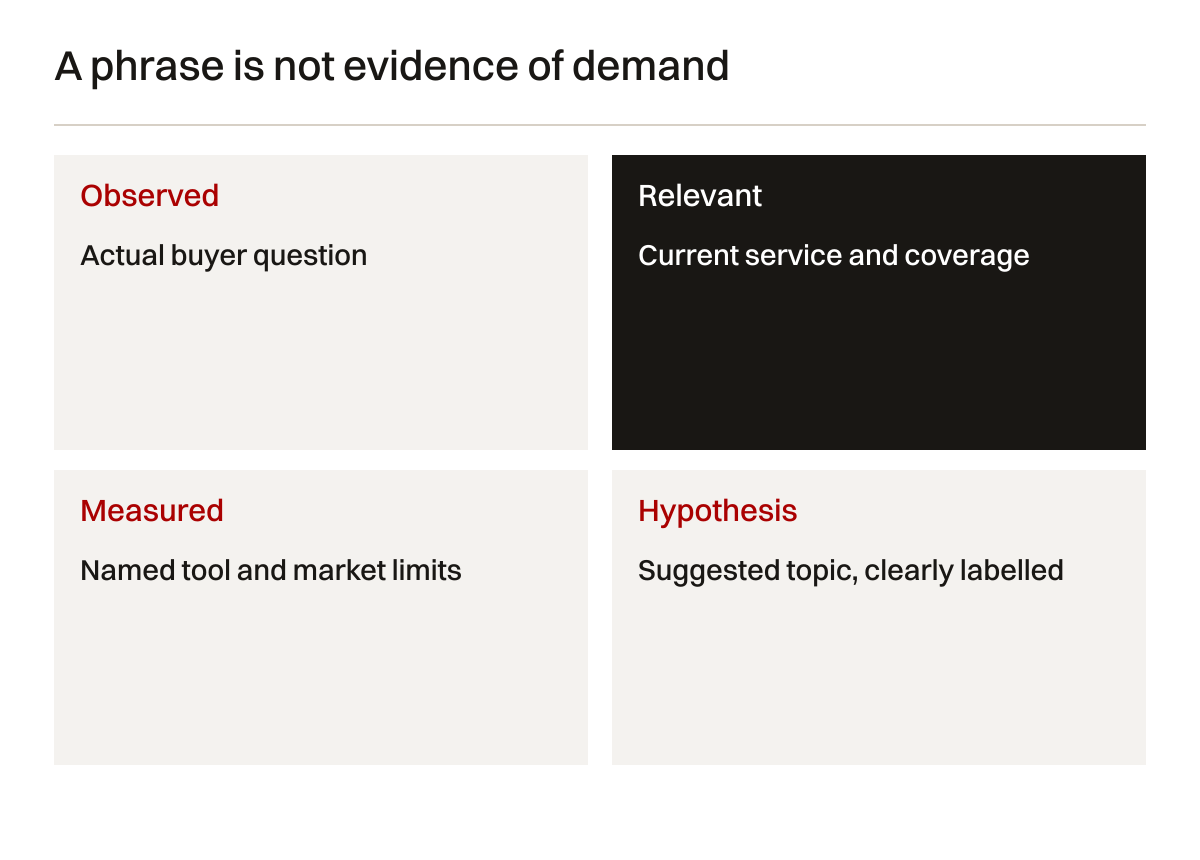
A generated keyword list can contain plausible phrases. It cannot establish demand merely by listing them. It may infer words from your website without checking how suitable buyers ask questions. It can also confuse a technically related topic with a service the company actually offers.
Begin with actual buyer decisions and authorised information. Ask the receiving team which conditions need clarification. Inspect relevant existing pages and the search context where appropriate. If a keyword tool supplies data, record its source, market, date and limitations.
A construction example
Imagine a consultancy that advises on a defined appointment. An AI list suggests broad construction terms and dozens of country pages. The terms may attract attention, but attention is not necessarily suitable demand. The review needs to check appointment responsibility, coverage and the information a buyer must provide.
A more useful topic could explain the boundary between two kinds of responsibility and show what the client team needs to prepare. That decision comes from the actual service and buyer question. It does not require pretending the tool has discovered a large monthly volume where no volume record exists.
For international topics, confirm delivery arrangements before drafting. A company capable of supporting a project remotely should not automatically be described as having a local office. The review should preserve the actual arrangement rather than expand the claim to suit the keyword.
Keep topic hypotheses labelled
A suggested topic is a hypothesis about usefulness and demand. A recorded enquiry question is an observation. A measured tool estimate is another input with its own limits. The plan should distinguish all three rather than present the entire list as established buyer behaviour.
Google's SEO starter guide supplies foundational guidance rather than a secret formula. Your keyword decision still needs the commercial context the documentation cannot provide. The tool can assist with that record; it cannot approve the offer on the business's behalf.
Research assistance is not source verification
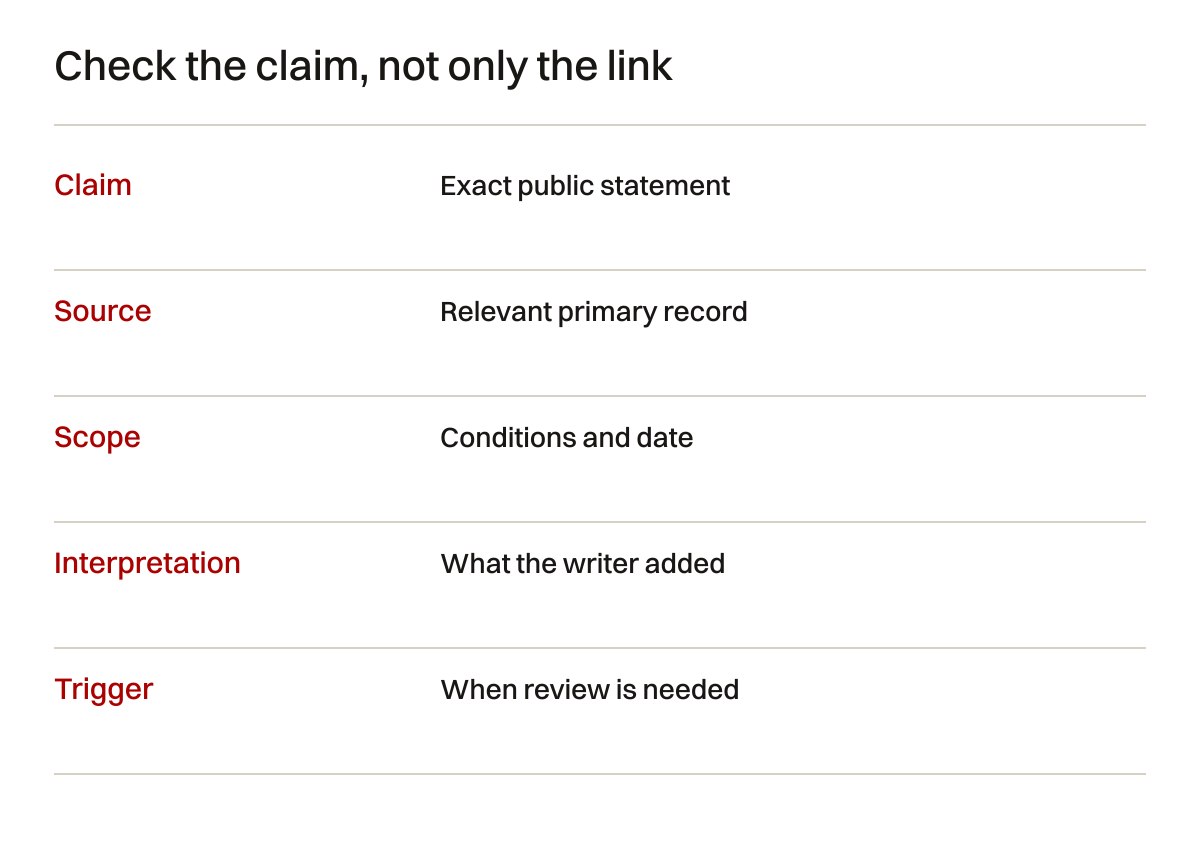
AI can suggest where to look and summarise material supplied to it. The reviewer still needs to open the source, confirm the statement and inspect its scope. A working URL is not enough. The document must support the claim actually made.
Keep a claim register. Record the exact statement, primary source, relevant date, conditions and editorial interpretation. Where a technical or commercial statement comes from the company, name the authorised owner or controlled record. Do not use a competitor's statement as evidence of your own capability.
| Proposed claim | Evidence needed | Appropriate reviewer | Failure to catch |
|---|---|---|---|
| Service supports a specific application | Approved operating or capability record | Service owner | Plausible but unavailable offer |
| A standard requires a condition | Current relevant primary document | Qualified subject reviewer | Outdated or unrelated requirement |
| A project achieved an outcome | Actual permissioned project records | Responsible project owner | Invented client result |
| A platform requires a control | Current official guidance | Technical owner | Universal rule inferred from one platform |
| An observed metric changed | Authorised data with definitions | Analyst | Incompatible periods or missing filters |
Do not invent a source to complete the outline
Sometimes research does not support the desired chart. Use a non-numerical diagram or change the section. If you create a teaching dataset, label it clearly as hypothetical and supply its assumptions. A made-up statistic next to an external link is not sourced merely because the link is reputable.
An article can contribute original reasoning without original market data. A calculation, comparison framework or explained workflow can be useful. The distinction must remain clear. “Here is an illustrative procurement record” is honest. “Our research shows procurement teams behave this way” needs actual research.
Google's helpful-content guidance provides questions for evaluating useful work. The page still needs a specific answer and inspectable reasoning. Copying a generic quality checklist does not produce either.
Drafting needs an approved fact boundary
Give the writing tool the actual service scope, audience, approved claims, relevant sources and house style. Identify what cannot be said. That includes unsupported leadership claims, fabricated testimonials, invented staff credentials and guaranteed search outcomes.
Ask for the missing information to remain visible in the internal draft. The public page should not publish placeholders, but the reviewer needs to know which statements await approval. A smooth draft that quietly invents answers is harder to review than a draft that marks its gaps.
The content should answer a decision. For a marine service, that might mean compatibility, location, timing and the information needed for assessment. For an engineering service, it may mean conditions, inputs and limits. A long definition section does not compensate for missing those facts.
Review meaning, not just grammar
A grammatically correct sentence can broaden a claim. “We support projects involving this material” and “we certify every application of this material” describe different responsibilities. A reviewer must notice the difference, not merely approve the tone.
Check comparative claims too. If a draft says one approach is always better, ask what conditions make the comparison valid. If those conditions are absent, revise the statement. Strong writing often becomes more convincing when it names the boundary rather than pretending there is none.
Google's generative-AI content guidance recognises useful assistance and emphasises accuracy and value. The practical requirement in your workflow is a real review before publication, not a sentence claiming that all AI use is forbidden.
Bulk publishing creates a review capacity problem
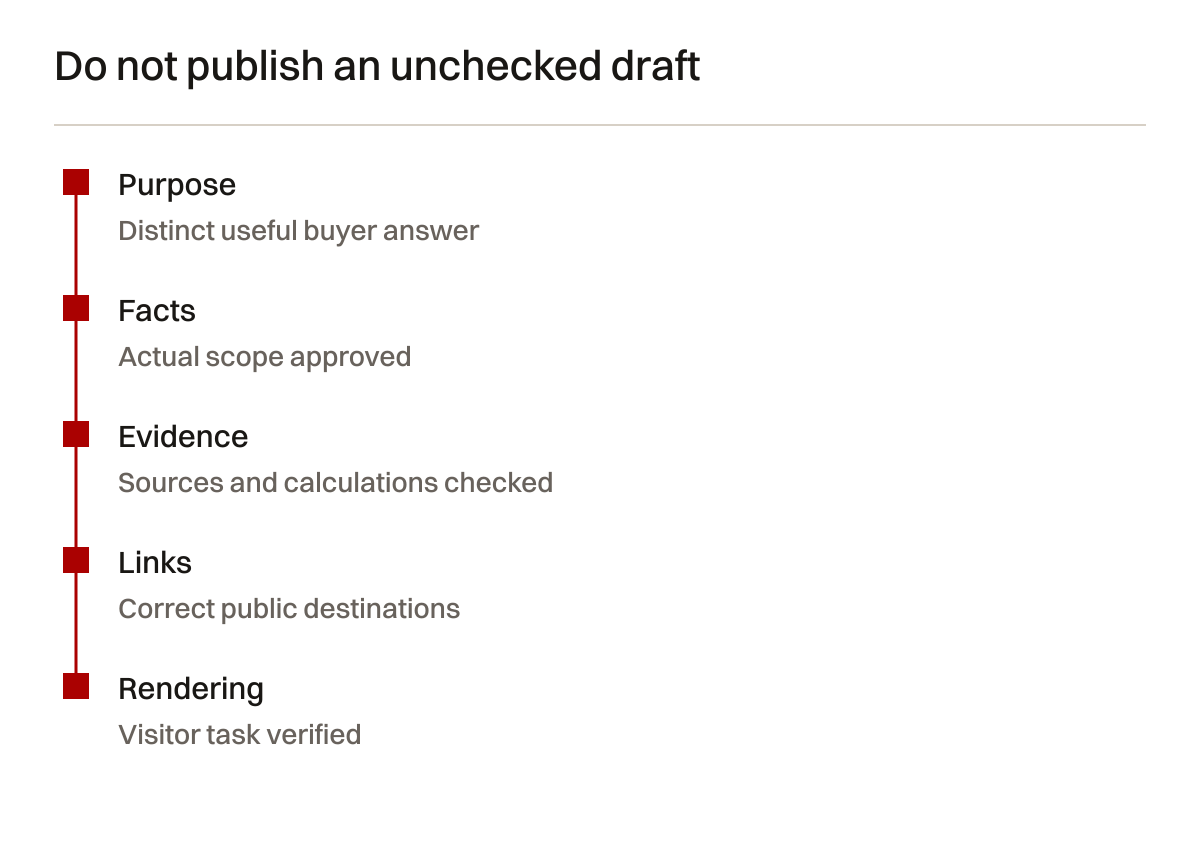
Generating many drafts is easy. Verifying business facts, technical claims, source relevance, internal links and public rendering takes work. A production quota that exceeds review capacity can convert a useful tool into a factory for unmaintained pages.
Count the approval capacity before committing to volume. Who can verify the service details? Who can obtain project-image permission? Who checks formulas and sources? Who maintains the pages when information changes? If those responsibilities are unassigned, more drafts can increase risk rather than value.
Publishing frequency is not the only issue
A business can publish often and still produce useful original work. It can publish infrequently and still produce manipulative pages. The purpose, value and review matter. Google's spam policies are the reference for scaled content abuse, not a simple ban on any particular daily quota.
Review overlap before commissioning another topic. If two proposed articles answer the same decision with the same evidence, perhaps the existing answer needs maintenance. AI can help compare outlines, but a content owner must decide whether a distinct purpose exists.
Keep scheduled material separate from public material until the intended release. Check related cards, sitemaps and downloads as well as the article route. An unpublished page should not be recommended to visitors merely because its source file exists in the content repository.
Technical work requires actual inspection
AI can explain a control from documentation or propose a code change. It should not be treated as having inspected your implementation unless it actually received the relevant evidence. A site-wide recommendation based only on a homepage screenshot is insufficient.
Record the current state and intended state. For an indexing control, identify the actual response and template. For a canonical issue, identify the relevant duplicate URLs and desired public destination. For an internal link, confirm it exists and reaches the correct page.
Google's noindex guidance and canonical documentation cover different mechanisms. The generated recommendation must use the right one for the actual situation.
| Technical work state | Evidence expected | What remains open | Unsafe shortcut |
|---|---|---|---|
| Suggested | Rationale and affected scope | Whether diagnosis is correct | Marking it fixed |
| Reviewed | Current code or controls inspected | Implementation and side effects | Approving from prose alone |
| Implemented locally | Change and proportionate checks | Production publication | Claiming visitors see it |
| Deployed | Confirmed release state | Actual public behaviour | Using a build log as visitor proof |
| Verified publicly | Actual response, rendering and task checks | Later search processing | Promising immediate rankings |
Preserve useful functions while changing a template
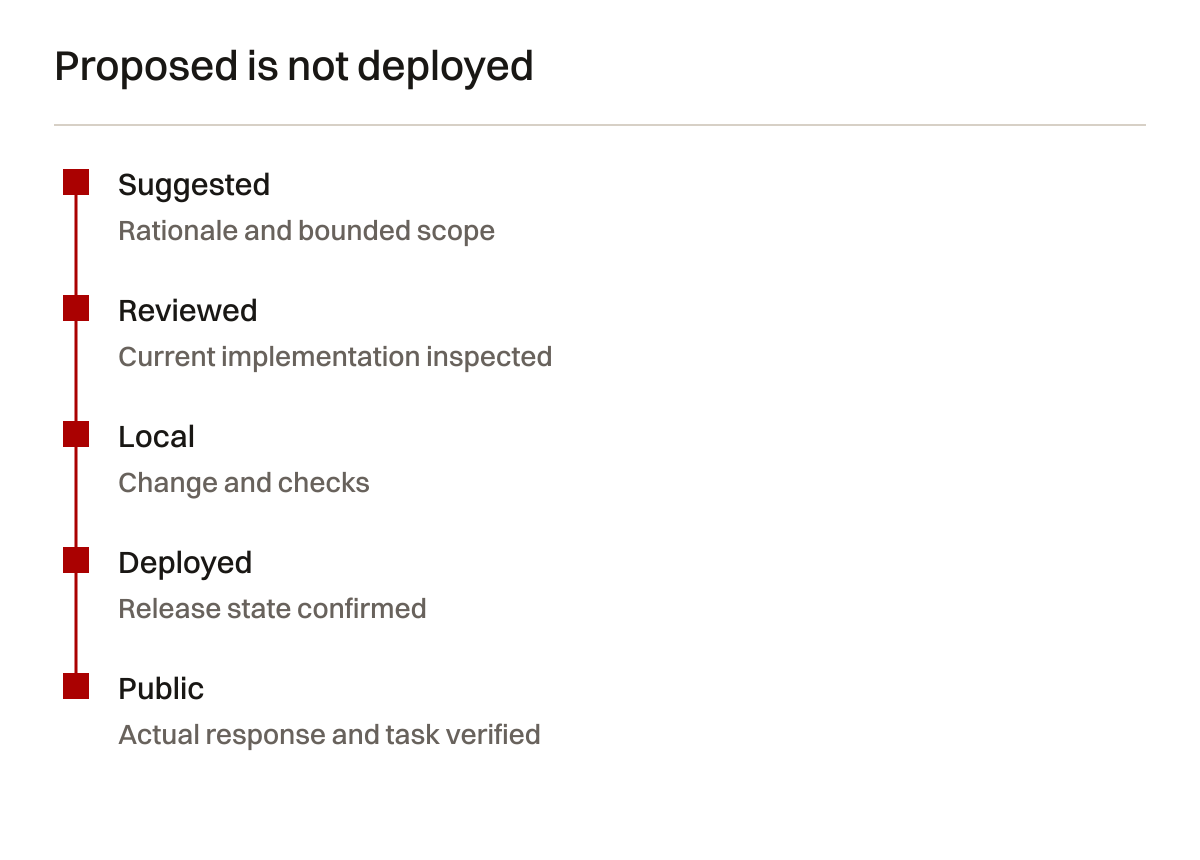
A technical optimisation can affect more than search. Compressing a capability image too aggressively can remove detail needed by a buyer. Simplifying a page can remove approved conditions. Changing a form can disrupt the receiving process. The review should test the actual visitor task after the change.
Choose representative templates and boundary cases. If a shared article component changes, inspect a long table, an image-rich guide and a short article. If a navigation component changes, inspect mobile and keyboard paths. A generated patch does not choose that coverage automatically unless the task specifies it.
Keep a fallback plan for material changes. The implementer should know how to recover the prior state if a task fails. This is ordinary responsible website work, not an argument against AI-generated code. Human-written code needs the same verification.
AI analysis must preserve metric definitions
A model can identify apparent trends and explain calculations. It can also interpret inconsistent data as if it were comparable. The analyst needs to inspect the property, periods, filters, metric definitions and changes in collection before requesting a narrative.
Search observations, sessions, form events, received requests and qualified opportunities belong to different records. A model cannot make them equivalent by calling them conversions. Define the commercial event and verify what the website actually records.
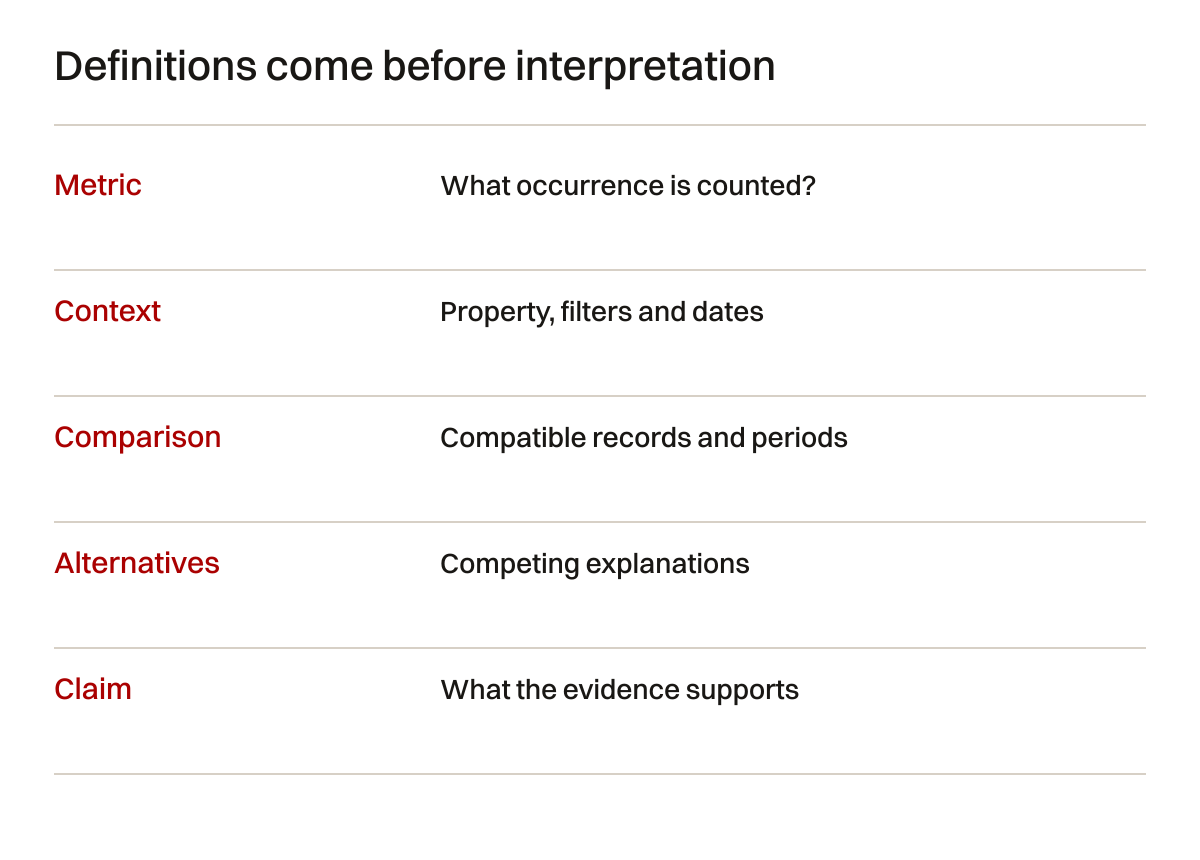
A worked hypothetical reporting error
Imagine a report showing contact events rose from twenty to forty. The generated narrative calls this doubled demand. Inspection finds that the new form fires the event on both button click and successful response. The same request can now create two recorded events.
The correct next step is to inspect and repair the event definition, then reconcile actual received requests where possible. The report cannot claim doubled qualified demand from the event count. The original narrative should be corrected rather than retained because it sounds commercially useful.
Google's key-event documentation explains the analytics designation. Google's data-quality reference explains report indicators. Neither verifies your particular form implementation. That requires the actual site's inspection.
Correlation is not an explanation of cause
If traffic rises after an article is published, several explanations remain possible. Demand may have changed. Existing branded interest may have increased. Other pages may account for the rise. A different query mix may produce more impressions without more suitable visits.
Ask the analyst to preserve competing explanations and identify what would distinguish them. A tool can help organise that investigation. It should not choose the most flattering cause because the prompt asks for a success summary. The source record needs to support the interpretation.
AI search visibility has its own observation limits
An assistant can produce a mention when the tester supplies the brand name. That does not establish broad unbranded discovery. A citation can support a general claim without recommending the company. A repeated prompt panel can vary across dates and contexts.
Define the test before examining answers. Preserve the exact question, platform, available mode, date, language, context and repeats. Retain unfavourable results. Keep a stable comparison panel and distinguish it from exploratory questions.
Google's AI-features documentation does not require special AI schema or new files for its own features. OpenAI's crawler overview describes separate crawler purposes. Recommendations must distinguish platforms rather than present one universal formula.
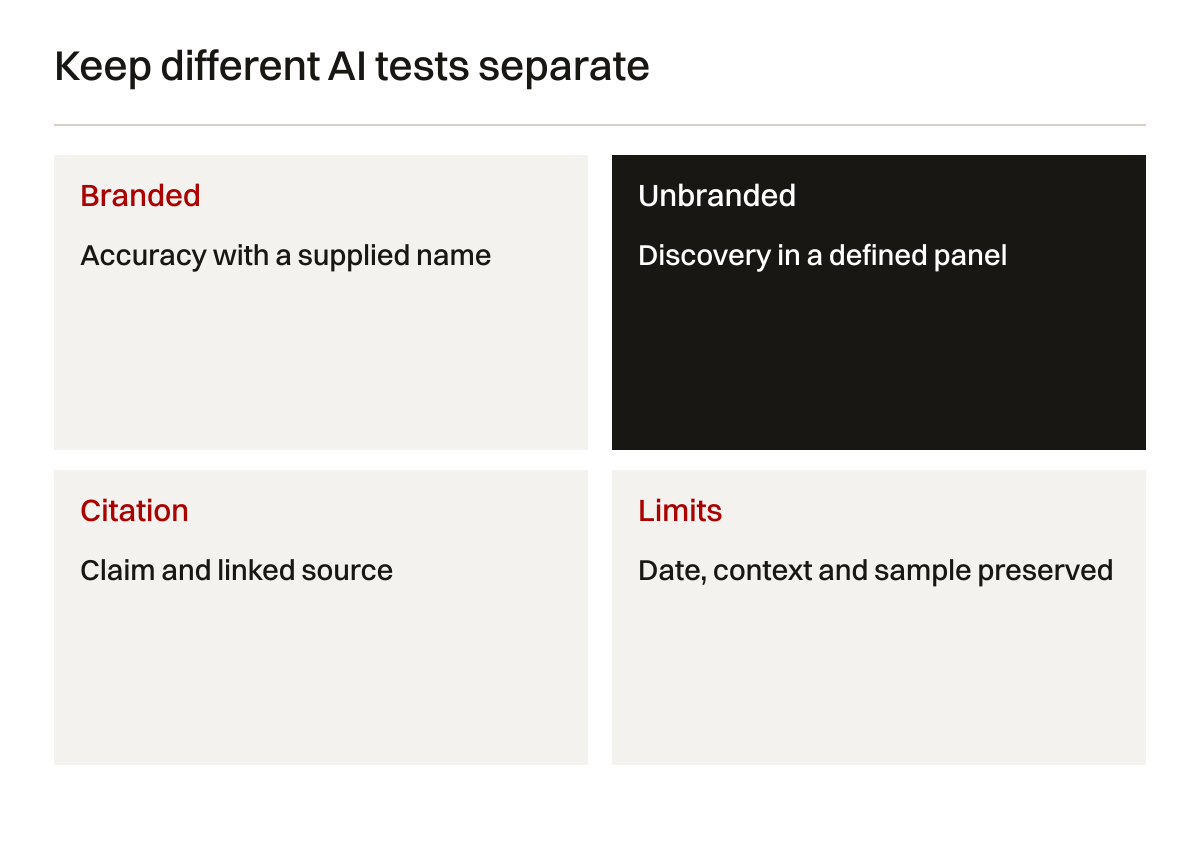
Do not let the tool grade its own output alone
An AI system can help classify a recorded answer. The reviewer should inspect difficult cases and the classification rules. Otherwise the same tool may generate an answer, call it a recommendation and score the programme favourably without independent scrutiny.
Retain the original answer and cited URLs. If a claim is inaccurate, record that even when the brand appears. Visibility without accurate representation can create unsuitable enquiries or damage credibility. The analysis should treat that as a problem rather than an uncomplicated win.
For a detailed buying framework, see questions to ask before buying GEO services. The objective is to understand which evidence supports the claim and what remains unknown. It is not to replace one unexplained score with another.
Write a review protocol people can actually use
Keep the protocol short enough to follow and specific enough to catch meaningful faults. Define required inputs, prohibited assumptions, review checks, approval owners and completion evidence. Add a correction path. A policy that says “humans review everything” without naming what they check is insufficient.
The workflow can vary by risk. A low-consequence internal classification may need a sampled check. A public technical claim needs source verification and an appropriate owner. A site-wide change needs implementation review and representative public checks. Record the chosen level and its rationale.
| Review area | Required check | Responsible role | Record to retain |
|---|---|---|---|
| Business scope | Actual offer, coverage and limits | Service owner | Approved facts and trigger dates |
| Sources | Exact claim supported by relevant evidence | Writer and qualified reviewer | Claim register |
| Calculations | Definitions, units, formulas and assumptions | Analyst | Reproducible input and output |
| Implementation | Actual change and visitor task | Developer and site owner | Public verification record |
| Interpretation | Alternative explanations and claim limits | Responsible review owner | Decision and uncertainty record |
Make disagreement visible
A reviewer may reject a fluent paragraph because the service claim is too broad. An analyst may reject a positive narrative because the periods are incompatible. A developer may reject a patch because it affects unrelated templates. Retain these decisions where useful; they explain what review actually did.
Do not measure the review process only by speed. Time saved on drafting can be worthwhile. Time spent correcting avoidable factual errors can remove that saving. The useful comparison includes preparation, review, correction and maintenance, not only seconds to the first draft.
A founder does not need to inspect every sentence personally. They do need to know that appropriate responsibility exists. The agency should explain who checks which claims and what evidence marks the task complete. That explanation is more useful than a broad assertion of human oversight.
Protect private information and access
Use the minimum information needed for the task and approved tools for its sensitivity. Public page classification does not require an entire customer database. A source review may need an approved excerpt rather than a confidential project folder. Choose the input deliberately.
Check the relevant tool's current data terms and account settings before supplying sensitive material. Do not infer them from a different product or subscription. The SEO provider should explain how it handles access and retained records without publicly disclosing your operational details.
Separate permissions from capability
A tool capable of editing a site should not publish every proposed change automatically. Approval depends on the scope granted and the risk of the action. Drafting an article, changing technical controls and sending an external message are different actions.
For a website task, preserve the actual target repository, branch and deployment destination. A correct change in the wrong website is still a failure. Record the intended target before acting and verify the published result after release. Do not let an impressive interface substitute for that basic discipline.
Keep credentials and confidential records out of public evidence. A screenshot proving a check can expose more than intended. Redact or use an appropriate demonstration record where needed, and label the demonstration honestly. The goal is inspectable work without unnecessary disclosure.
How to evaluate an agency's AI use
Ask for one completed task trail, not a declaration that the team uses the latest model. What was the question? What input was supplied? What did the tool produce? What did the reviewer change or reject? How was the public result checked?
A provider should be able to explain the reasoning without relying on the generated wording. If asked why a page needs a new section, the answer should concern the buyer's missing information and the source basis. It should not be “the AI recommended it.”
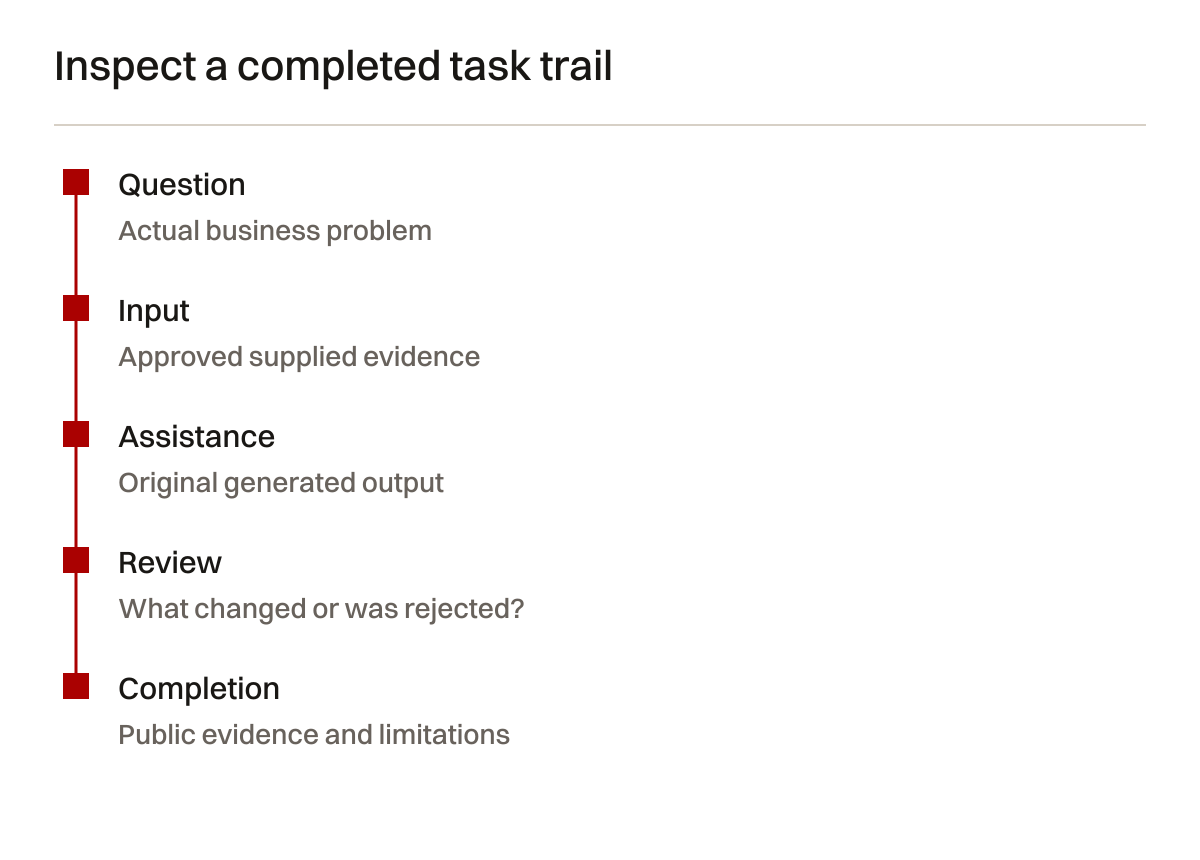
Ask what the team would not automate
The answer should reflect consequence and evidence, not a blanket slogan. They might automate a draft grouping but retain commercial review. They might generate alternative explanations but require original-data checks. They might draft code but restrict deployment to reviewed scope.
Ask how they handle missing information. A good answer may include a narrower claim, a request for the service owner's input or a decision not to publish the section. A team that never admits a gap may be replacing investigation with plausible writing.
Finally, ask how the process changes when mistakes appear. A credible workflow can trace a wrong claim, correct affected material and update its checks. Blaming the model does not remove the provider's responsibility for what it approved.
A hypothetical engineering article review
Suppose a manufacturer wants a guide explaining how buyers prepare a technical enquiry. The writer supplies approved public scope, the current enquiry requirements and relevant primary references. AI assists with the outline and a first explanation. It proposes a broad compatibility claim not present in the source record.
The reviewer removes that claim and asks the service owner which conditions can be stated. The owner confirms that suitability requires assessment. The article explains the information needed for that assessment rather than implying automatic acceptance. A diagram shows the enquiry sequence without inventing a performance statistic.
The analyst checks any calculation used in a worked example and marks the assumptions. The editor checks sources, image descriptions and internal links. The implementer checks the published page on representative devices and verifies that the intended enquiry route works. Each review has a different job.
The value comes from the complete workflow. The first draft may have been faster to produce, but it was not the final evidence of quality. The business still needed source approval, a useful answer and public verification. Calling that human-led AI assistance is accurate only because the review actually happened.
A workable first month
Choose a limited set of tasks. Inventory important pages, organise existing questions and draft one useful answer from approved records. Establish the review protocol before increasing output. The first month should teach the team where assistance is useful and where mistakes are likely.
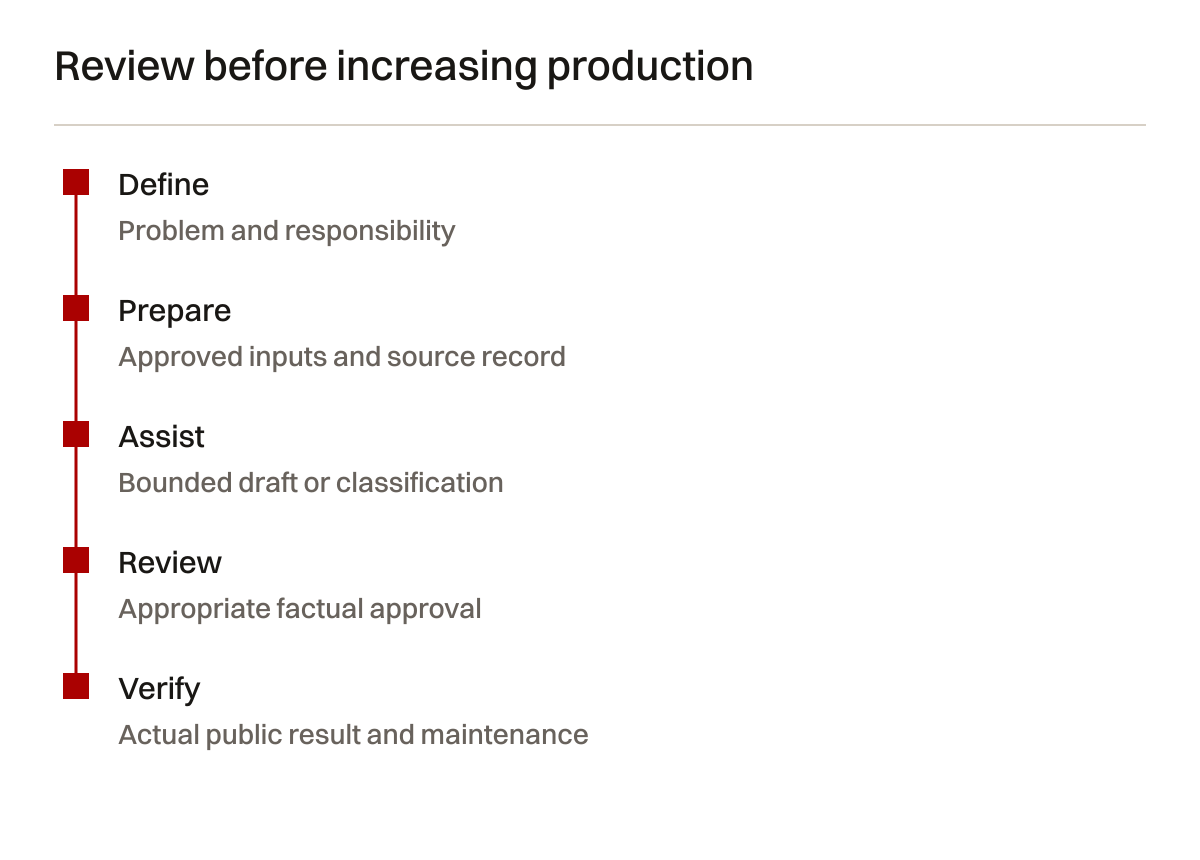
| Stage | Task | Check before moving on | Decision supported |
|---|---|---|---|
| Define | Name problem and information boundary | Offer and audience confirmed | Is the task worth doing? |
| Prepare | Collect approved inputs and sources | Provenance and gaps recorded | Is drafting ready? |
| Assist | Produce a bounded draft or classification | Original identifiers preserved | What needs review? |
| Review | Inspect facts, meaning and interpretation | Appropriate owners approve | What can be published? |
| Verify | Check actual public result | Rendering and task confirmed | What needs maintenance next? |
Test the review with a known error
An internal quality exercise can reveal whether the protocol is being followed. Use a clearly labelled test draft containing an unsupported capability statement or a deliberately inconsistent calculation. Keep it out of the publication workflow. Ask the assigned reviewers to apply the same checks they would use for real work, then discuss which check caught the issue.
The exercise is not a trap for staff. Its purpose is to see whether the review depends on luck, personal memory or a repeatable record. If the false statement is missed, improve the source boundary and approval task. If the calculation passes, inspect whether the analyst reviewed the formula or only the visual presentation.
Keep the result in the internal process record, not a public claim that the team is infallible. One successful exercise does not prove every future error will be caught. It does show that review can be tested rather than merely asserted. Repeat the exercise when responsibilities or tools change materially, and adjust the task coverage according to the consequences that matter to the business.
Increase volume only after learning
If the review finds repeated source errors, improve source preparation before adding more drafts. If it finds repeated scope expansion, change the task instructions and approval check. If implementation repeatedly breaks tables on mobile, fix the template before generating more image-rich guides.
Record what worked as well. A clear input register may reduce repeated questions. A classification can help expose missing buyer information. A source trail can make later updates easier. These practical benefits matter even when no ranking change can yet be attributed to the workflow.
Method and limitations
The examples, workflow diagrams and workbook rows are original editorial tools. They do not establish that a specific model or provider will perform the tasks correctly. Primary references were reviewed on 3 October 2026. Current tool behaviour, controls and terms need verification when the workflow is implemented.
No invented client results or reviewer credentials are included. Numerical results are not used to imply that AI assistance caused search gains. A real programme needs authorised records, appropriate reviewers and a clear boundary between observed evidence and interpretation.
Start with the problem
We do not object to AI assisting the work. We object to unsupported output being sold as analysis. If your provider cannot explain where a recommendation came from, what it changes and how it will be checked, the missing piece is responsibility.
Bring that question to Creatif Work through our SEO service. We can discuss the information gap, appropriate evidence and the next investigation. For a report you already have, use the useful SEO audit guide. For financial claims, read what a founder can and cannot calculate about SEO ROI.