

How to Investigate an Organic Traffic Drop

An organic traffic drop is a symptom, not a diagnosis. First confirm what fell and whether collection changed. Then locate the loss by page, query, country, device and search type. Test technical faults, demand changes and search-result changes separately. Repair confirmed faults before commissioning a site-wide rewrite.
The chart falls on Monday. By Tuesday, someone has blamed an algorithm update. Another person wants fifty new articles. Neither has checked whether analytics stopped collecting on half the pages.
That is an expensive way to investigate. A founder needs a narrower answer: what changed, which commercially important pages were affected, what can be verified now, and which action is safe. A complete explanation may take longer. The first decision should still be clear.
This guide is an investigation method for business websites. It is not an account audit or a promise of traffic recovery. Every numerical example below is synthetic. No client data, observed Google update effect or live competitor trend is claimed.
Use the traffic investigation workbook or CSV template pack to record evidence, comparisons and decisions. Keep private analytics exports and personal enquiry information in controlled systems, not public spreadsheets.
Establish what actually fell
“Organic traffic” might mean Google Search clicks, organic sessions from several engines, a dashboard percentage, or visits to a selected folder. Those measures describe different things. Ask for the exact report, metric, property, filters and period before discussing the cause.
If organic traffic is now a smaller proportion of all visits, check its absolute count. Paid campaigns can increase the denominator while organic visits remain steady. A percentage decline does not necessarily mean lost organic visitors.
Google's Search Console introduction explains the tool's role in monitoring search performance and indexing. It provides one evidence source. It does not replace an investigation of what happened inside your site.
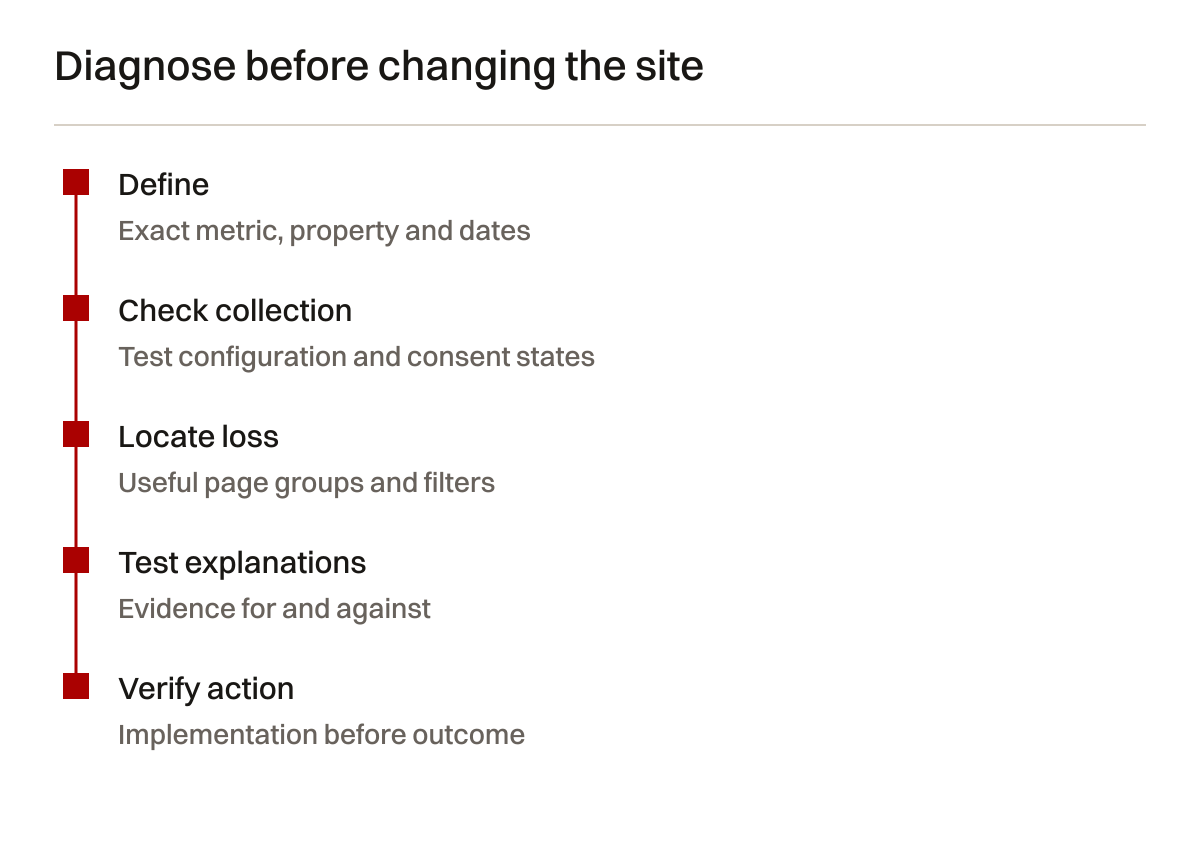
Write a precise incident statement
Replace “SEO crashed” with a statement someone else can reproduce. For example: “In this synthetic example, Google Web clicks to the product folder fell from 600 to 420 across two complete four-week periods. The Singapore filter and page mapping are unchanged.” That statement defines the observation without assigning a cause.
Add the business concern separately. The affected folder may contain important capability pages. Alternatively, a retired careers page may account for most lost clicks. Both deserve accurate reporting. They do not deserve the same urgency or response budget.
Record who owns the investigation. One person should maintain the incident statement and evidence register. Developers, search specialists and sales staff can contribute without each issuing a different public explanation. Keep an explicit unresolved list so uncertainty does not disappear between meetings.
Compare the tools before blaming search
Search Console clicks and analytics sessions are not interchangeable. Collection methods, attribution, canonical handling and time zones can differ. Google's guide to using Search Console and Analytics together explains why discrepancies occur.
Use differences to generate checks. If Search Console clicks are stable while analytics sessions fall sharply, inspect the analytics implementation, consent behaviour and reporting configuration. That pattern does not prove a tracking fault. It gives you a specific place to investigate before altering pages.
| Observation | First question | Evidence to collect | What it does not prove |
|---|---|---|---|
| Analytics sessions fall; Search clicks stable | Did collection change? | Release log, consent state, tag checks | That rankings collapsed |
| Clicks and impressions fall in one folder | Is access or demand different? | URL inspection, queries, page map | That every page is weak |
| Impressions stable; clicks fall | Did the result or query mix change? | Comparable query groups and results | That titles alone caused it |
| Organic share falls; count stable | Did another channel grow? | Absolute channel counts | That organic discovery declined |
| Enquiries fall; visits stable | Did the action or buyer mix change? | Form tests and received requests | That more content is required |
Check measurement without ignoring privacy
Test collection using the consent choices that actual visitors receive. Do not bypass consent to make a dashboard look fuller. A changed banner or tag trigger can explain a measurement discontinuity, but the appropriate response must respect the visitor's decision.
Check multiple templates. A homepage tag can work while product pages fail. A form event may fire when someone opens the form rather than when a request is successfully received. Inspect the intended event definition and actual delivery path. Treat a dashboard correction and an enquiry repair as separate work items.
Preserve the old configuration where possible. Record the release date, changed rule and affected templates. If historical data cannot be reconstructed, say so. Do not blend estimates into observed counts without marking the boundary. A repaired measurement system improves future analysis; it does not retroactively prove what unrecorded visitors did.
Make the comparison fair
A partial week against a complete week creates an avoidable false alarm. Compare equivalent durations and weekday composition. Note public holidays, campaigns, product announcements, tender deadlines and known outages. For a small B2B site, a few working days can materially change the apparent trend.
Use more than one comparison. A recent-period comparison can locate the onset. A year-on-year comparison may help with recurring seasonality. A longer chart can show whether the apparent collapse follows an unusual spike. None is automatically correct. Explain why each comparison is useful for the question.
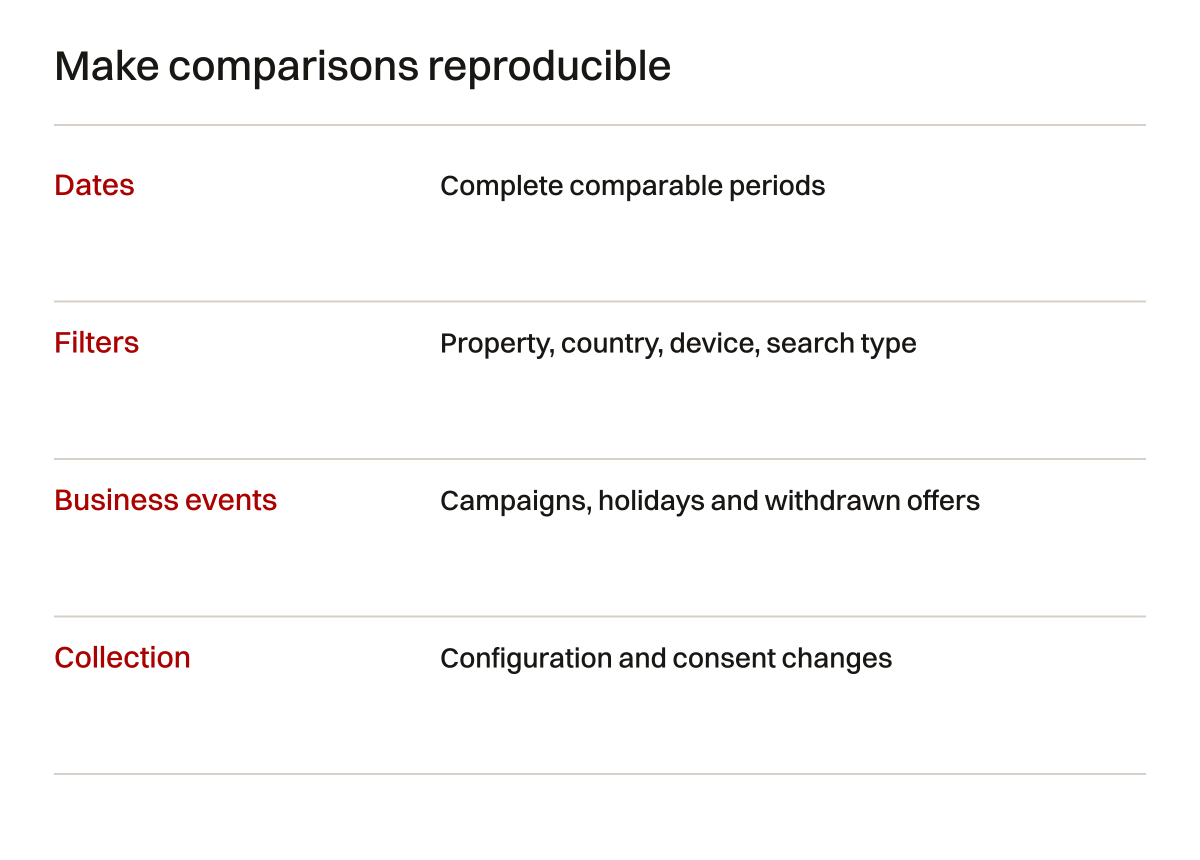
Avoid a convenient baseline
Suppose a trade show temporarily doubled branded searches. The next month returns to its usual level. Calling that return an SEO failure mistakes an event peak for a normal baseline. Keep the peak in the chart, but annotate it and compare with earlier ordinary periods.
Do not choose the weakest old month to make recovery look impressive either. Maintain a consistent baseline policy. State when it changes and why. A business owner should be able to recreate the comparison without trusting an analyst's preferred screenshot.
For international sites, record the reporting time zone and market filters. An Australian working day may cross a different platform's date boundary. Do not silently convert daily figures and then present them as exact matches. Weekly aggregation can sometimes reduce the practical confusion, but it does not remove other collection differences.
Find where the loss sits
Break the site into useful groups: services, products, technical guides, projects, careers and company information. Start with actual page purpose, not whatever folder name happens to exist. Mixed folders need a maintained page map.
Calculate the absolute click change for each group. A small page losing half its clicks may contribute little to the total. A larger page losing a modest proportion may account for most of the observed loss. Report both scale and rate so the team does not chase the loudest percentage.
The table and chart below use invented counts to demonstrate decomposition. They are not a benchmark, a forecast or findings about Creatif Work.
| Synthetic page group | Earlier clicks | Later clicks | Absolute change | Interpretation to test |
|---|---|---|---|---|
| Capability pages | 600 | 420 | -180 | Priority commercial investigation |
| Technical guides | 800 | 760 | -40 | Smaller loss, inspect topic mix |
| Careers | 400 | 100 | -300 | Check vacancy and campaign changes |
| Company pages | 200 | 220 | +20 | Possible branded demand change |
| Total | 2000 | 1500 | -500 | Total decline does not locate cause |
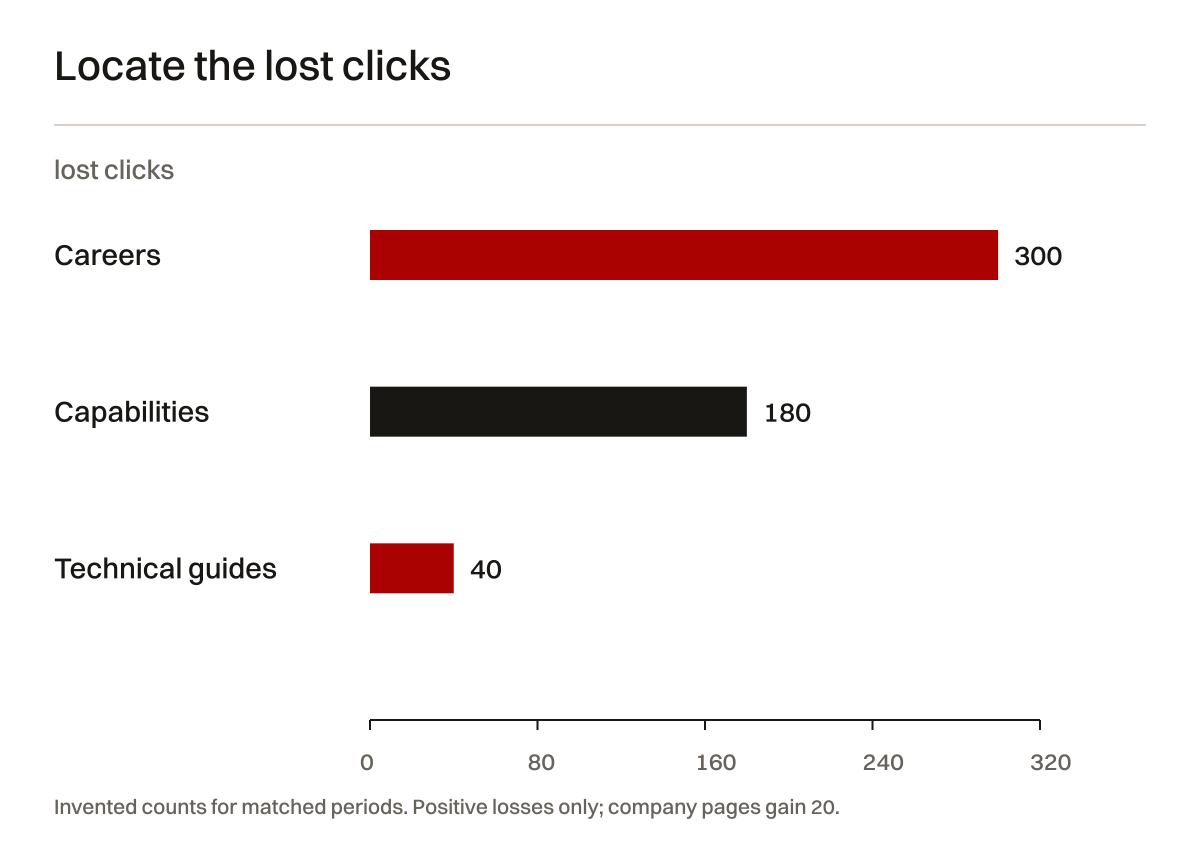
Careers contributes 300 of the 500 net lost clicks. That is 60% of the net change in this invented example. It does not mean the careers loss caused the capability loss. It does mean a site-wide percentage hides two different business questions.
Then inspect dimensions within the affected group
Look at country, device, query families and search type without changing several filters at once. Save each meaningful comparison. A mobile-only pattern can suggest a template or experience issue worth testing. A single-country pattern can suggest market demand, language coverage or result differences.
Check representative affected pages and unaffected controls. An unaffected page using the same template can weaken a template-wide explanation. It cannot rule out a fault that depends on a specific image, script or content field. Choose controls that share relevant conditions, and explain their limits.
Avoid treating query rows as a complete census of all searches. Available reports have collection and disclosure limits. If the visible rows do not sum neatly to an aggregate, record the mismatch instead of inventing “other keywords” to force an exact story.
Inspect public technical behaviour
Open the actual affected addresses as a visitor. Check the response, useful content, access restrictions, indexing directives, canonical preference and important internal links. Do not accept a green build or a CMS preview as proof that the public page works.
Google's HTTP status guidance distinguishes successful responses, errors and server failures. Its noindex documentation describes a separate indexing control. Verify the actual response and directive instead of treating all exclusions as the same problem.
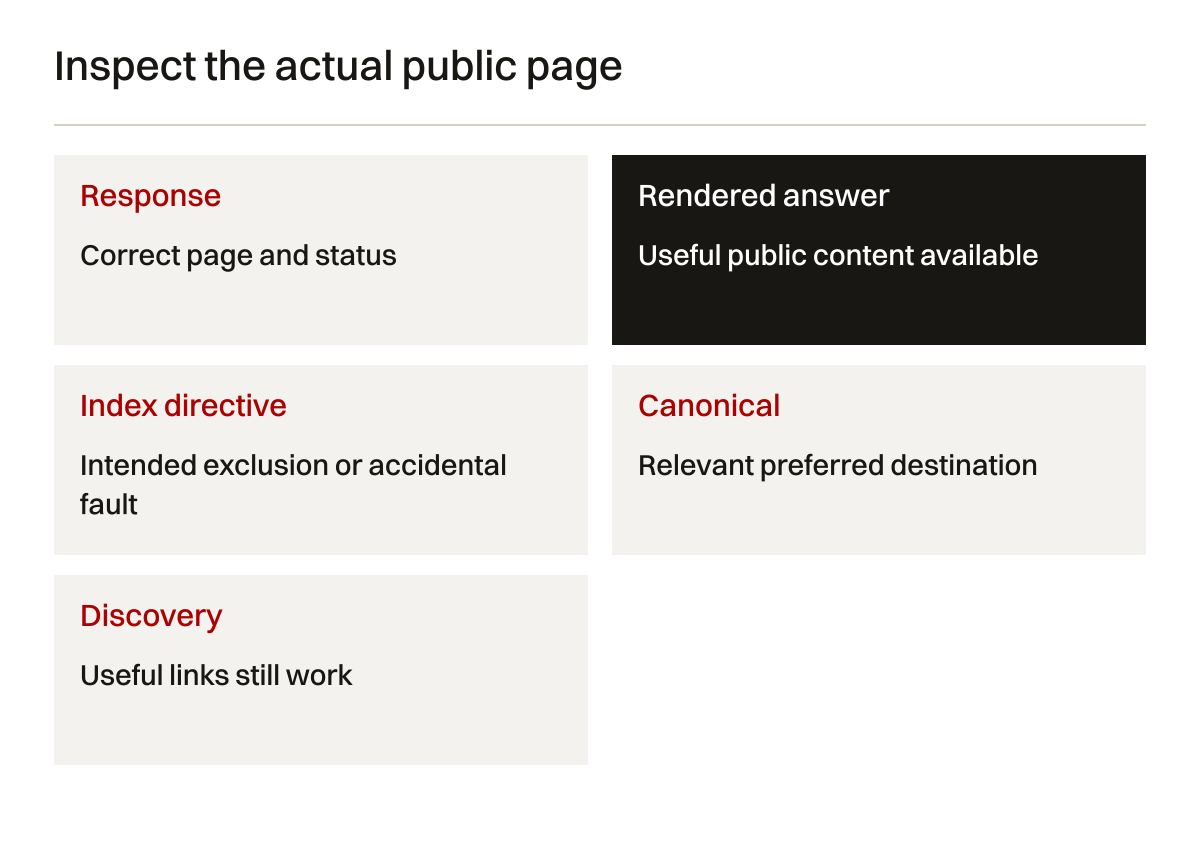
| Check | Actual observation needed | Responsible role | Safe immediate response |
|---|---|---|---|
| Page response | Status and correct content at public URL | Developer | Repair confirmed erroneous response |
| Important content | Main answer visible to visitor and inspection | Developer and editor | Fix failed rendering before rewriting |
| Index directive | Intended versus observed noindex | Developer and search lead | Correct accidental exclusion |
| Canonical preference | Destination and matching content | Search lead and developer | Inspect mapping before changing |
| Internal route | Relevant links still reach the page | Editor and developer | Restore accidentally removed routes |
| Request form | Successful submission reaches owner | Operations owner | Repair delivery and test receipt |
Keep access and indexing decisions separate
A deliberate private document should remain private. Search loss is not a reason to publish confidential material. Confirm which pages the business actually intends to expose before calling an exclusion an error.
Likewise, a removed service may no longer deserve an active sales page. First establish whether the business changed its offer. Then decide the accurate public explanation and destination. Search work should preserve useful access, not freeze an outdated commercial promise.
If the site is compromised or presents a harmful visitor path, involve the technical and security owners promptly. Do not hide a security issue inside a general content task. Keep remediation records controlled. Public incident statements need approval and should contain only information the organisation can substantiate.
Reconstruct the change timeline
Collect releases, redirects, navigation changes, consent changes, content removals, downtime and business events. Ask for exact dates where records exist. “Sometime last month” should remain uncertain rather than becoming a precise date on a chart.
For an address migration, inspect old-to-new mappings and both destinations. Google's site-move guidance is a useful technical reference. The practical investigation still needs your actual changed addresses, redirects and receiving pages.
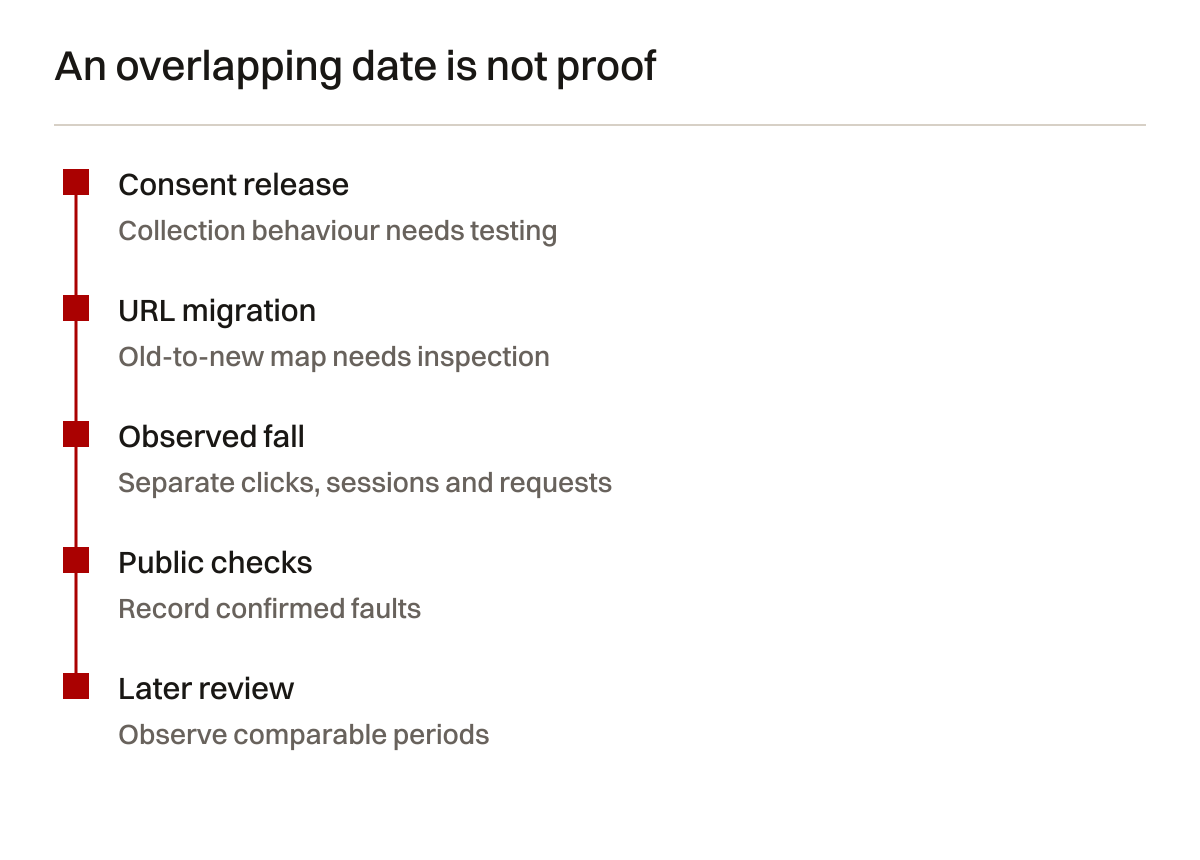
Correlation gives you a lead, not a verdict
An event occurring before the fall makes it worth inspecting. It does not establish causation. Several changes can occur near the same date. Search processing can also lag publication, while a collection fault may affect data immediately.
Use specific predictions. If a redirect mapping is wrong, the old addresses should lead to unsuitable pages or errors. If a consent release suppressed collection, inspect the event behaviour under actual consent states. If only a discontinued topic lost demand, unrelated service queries should behave differently.
Write the prediction before viewing the confirming evidence where practical. This makes it harder to retrofit every observation to a favourite explanation. Ask a second reviewer which fact would contradict the current hypothesis. A credible investigation makes room for being wrong.
Test demand rather than assuming lost rankings
Demand can change while a site remains available and relevant. Project schedules, seasonal maintenance, recruitment, product discontinuation and market conditions can alter search activity. Ask the business what changed outside the website.
Google Trends' data explanation describes a normalised measure of relative search interest, not an absolute market-size counter. Use it carefully alongside the site's queries and commercial records. A low-volume technical phrase may not provide a useful Trends series.
Compare the same geographic and time settings. Record whether you chose a topic or a search term. Do not treat an unrelated broad trend as a substitute for the company's buyer demand. A general construction trend might not describe a specialist offshore maintenance requirement.
Consider a business change that looks like an SEO failure
Suppose a manufacturer stops selling a popular spare part. Its remaining services are more specialised. Organic clicks fall while qualified requests for the remaining work remain stable. That is a hypothetical scenario. The right decision depends on the approved business scope, not the desire to restore an obsolete traffic total.
The site may still need clear support information for previous customers. It may need an accurate successor-product explanation. Those decisions should not be made by generating a replacement article around every old query. Consult the product owner before proposing a search response.
Now consider the opposite situation: a broad guide keeps its traffic but the high-value capability pages lose suitable visibility. A stable total would conceal a commercial problem. Review meaningful page groups even when the aggregate chart appears reassuring.
Investigate the result page and competitor changes
A change in clicks can reflect altered query mix, search features, titles, competitor offers or positions. Capture relevant results with dates, market context and device assumptions. A single personalised search is a limited observation, not a representative ranking study.
Compare the exact buyer question with the destination's answer. A competitor may now provide clearer scope or a better technical resource. That is a reason to improve your explanation where evidence supports it. It is not permission to copy their content or imply capabilities you lack.
Google's title-link guidance supports concise, descriptive titles. A title revision is still a test, not a guaranteed click recovery. Inspect the underlying page and relevant query mix before changing every title in the same way.
Do not blame AI for everything
Google's AI-features documentation explains that appearances in its AI features are included within overall Web search reporting. That matters when someone claims an ordinary report isolates all AI losses.
An AI answer could be relevant to a particular result-page investigation. A screenshot alone cannot tell you how many searches included that answer, how many suitable buyers were affected or why your enquiries changed. Keep those questions separate.
You can record a repeated, predefined sample of buyer questions across services. State the sample, dates and context. Call it an observation study. Do not relabel it as market share or infer revenue from mentions. Investigation becomes weaker when a fashionable explanation replaces missing evidence.
Handle algorithm updates without guessing
Check the Google Search Status Dashboard for published incidents and updates. Record the relevant dates rather than claiming an unnamed update whenever a chart falls. An overlapping date is still only a possible relationship.
Google's core-update guidance recommends assessing changes after the rollout has completed and advises against drastic changes based on small position movements. That does not require ignoring a confirmed technical fault during a rollout.
Separate urgent repairs from longer quality review. A broken enquiry form deserves prompt action. A broad rewrite based only on update timing needs stronger reasoning. Otherwise the team may remove useful content while leaving an actual fault untouched.
Maintain competing explanations
A useful hypothesis register contains the observation, predicted pattern, evidence for, evidence against, next check, owner and status. “Maybe Google” is not a hypothesis you can test. “The changed template returns noindex on the affected folder” is.
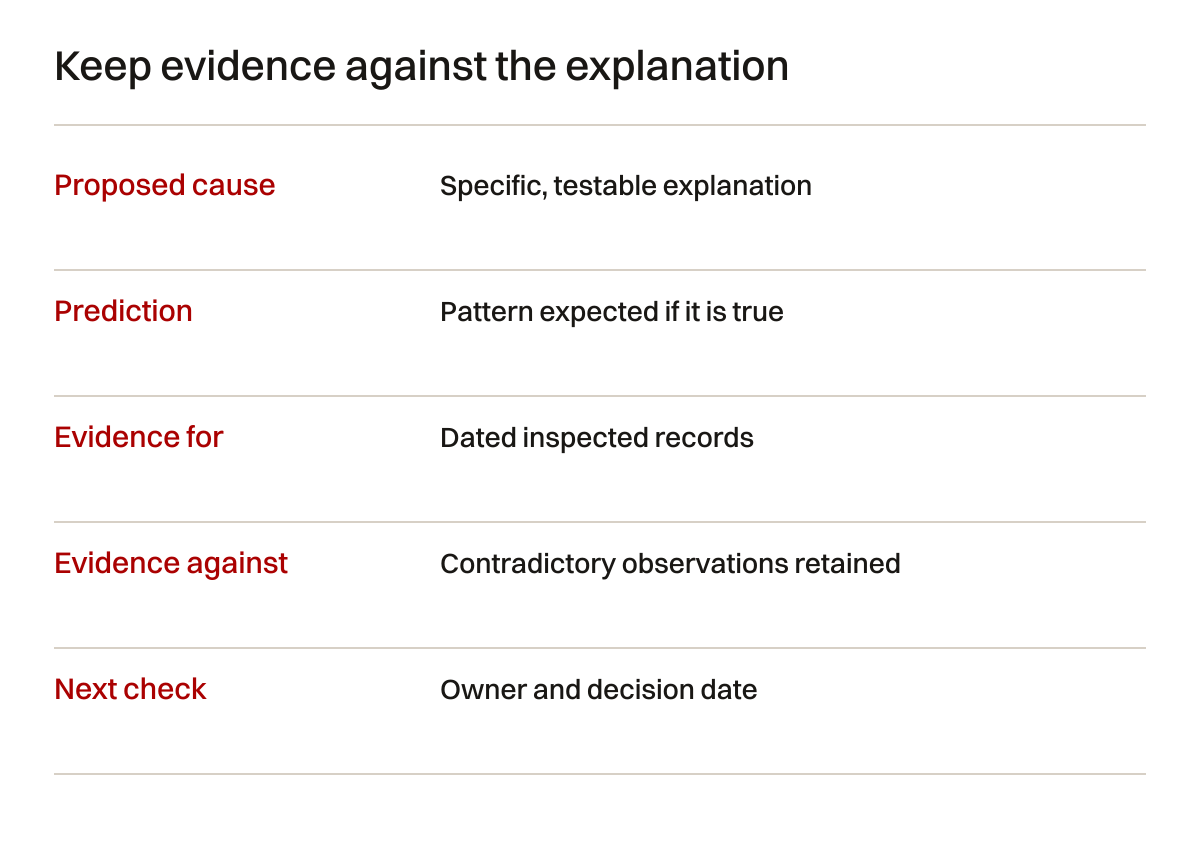
| Synthetic hypothesis | Prediction | Evidence that would support it | Evidence that would weaken it | Next check |
|---|---|---|---|---|
| Analytics collection changed | Sessions fall more than Search clicks | Missing events on affected template | Collection unchanged across templates | Test actual consent states |
| URL mapping is wrong | Loss concentrated on moved pages | Incorrect redirects or destinations | Correct map and unaffected moved pages | Inspect representative old URLs |
| Demand for retired jobs fell | Careers accounts for much of loss | Vacancies closed near the change | Active jobs and stable related interest | Check hiring and query records |
| Capability content lost relevance | Relevant queries and pages weaken | Missing current scope or evidence | Pages answer requirements accurately | Review buyer questions and results |
| Several causes overlap | Patterns differ by segment | Separate technical and demand evidence | Single explanation fits all checks | Keep segmented incident records |
Rank checks by consequence and reversibility
Investigate high-consequence faults first. A page unavailable to visitors or a form delivering nothing needs attention before an editorial preference. Prefer checks that are cheap, informative and do not alter the production state.
Do not confuse confidence with priority. A low-confidence possibility can deserve a quick inspection when the downside is serious. A well-supported minor issue can wait if it affects no important visitor path. Document that distinction so the backlog does not become a popularity contest.
For a proposed change, record how to verify it and how to reverse it if necessary. A careful redirect repair can have a clear test. A full rewrite alters several factors at once. Its effects are harder to interpret. Match the intervention size to the strength of the diagnosis.
Use AI as an assistant, not the investigating authority
AI can help organise a supplied change log or propose questions to ask. It can also produce a confident explanation from a chart that lacks filters and context. Fluent text does not establish that the analyst inspected the account.
Give an assistant a bounded task: identify missing fields, summarise approved notes or list alternative explanations. Keep account credentials and personal lead records out of tools without appropriate authorisation. Have a person verify every numerical transformation and source reference.
Google's generative-AI content guidance emphasises checking accuracy and relevance. Apply the same discipline to analysis sold to a client. An AI-generated incident explanation needs evidence, not just editing for tone.
Reject an explanation that cannot be reproduced
Ask the author which report and settings produced the conclusion. Ask which affected addresses they inspected. Ask what would change their mind. If they cannot answer, you have a proposed narrative rather than a completed investigation.
An assistant may miscalculate percentage changes or confuse percentage points with percentages. In the synthetic example, total clicks fall from 2000 to 1500. That is a 25% decrease. Careers falls from 400 to 100, a 75% decrease. Neither number establishes the cause or the commercial consequence.
Use a calculation sheet with raw inputs and formulas. Keep the written interpretation alongside it. When the data changes, update both deliberately. Do not retain an old “recovery” paragraph attached to a newly refreshed chart.
Repair and verify in layers
First verify the intended implementation: response, content, directive, link or form receipt. Then inspect whether the relevant system has processed the change. Later compare search and commercial observations using the predefined method.
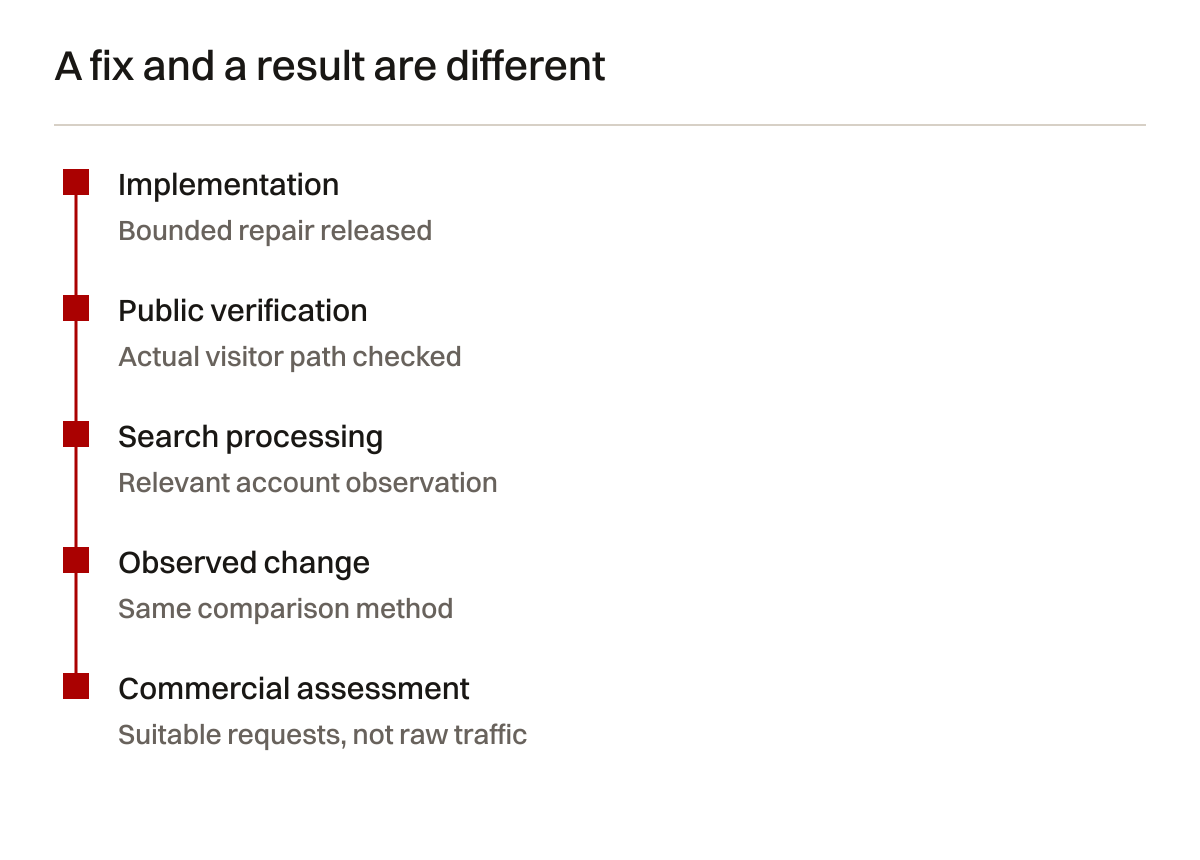
These layers can complete at different times. A public fix is not proof of renewed indexing. Renewed indexing is not proof of restored qualified enquiries. A sales outcome is not automatically attributable to the last technical edit.
Keep the incident open while required checks remain. You can mark the implementation complete without marking the business concern resolved. This is more useful than a green dashboard status that hides which question still lacks an answer.
Do not manufacture a recovery deadline
Set dates for activities you control: inspection, repair, review and communication. Do not promise that a search system will recrawl or restore a position on your deadline. Explain what you will check if no material change appears.
For sparse sites, a short observation period may show little. Widen the comparison carefully and preserve the original incident date. Track suitable enquiries and their source limitations alongside search data. Do not declare failure or success because one request arrived during a quiet week.
If several repairs are necessary, record their individual release times. You may not be able to isolate each effect later. State that limitation. A well-maintained record still helps the next team avoid repeating the same investigation.
Report decisions, not reassuring adjectives
The founder's update should explain the confirmed facts, strongest current explanation, competing explanations, completed checks and next decision. Include commercial significance and uncertainty in normal language. A dense tool export can sit behind the summary, not replace it.
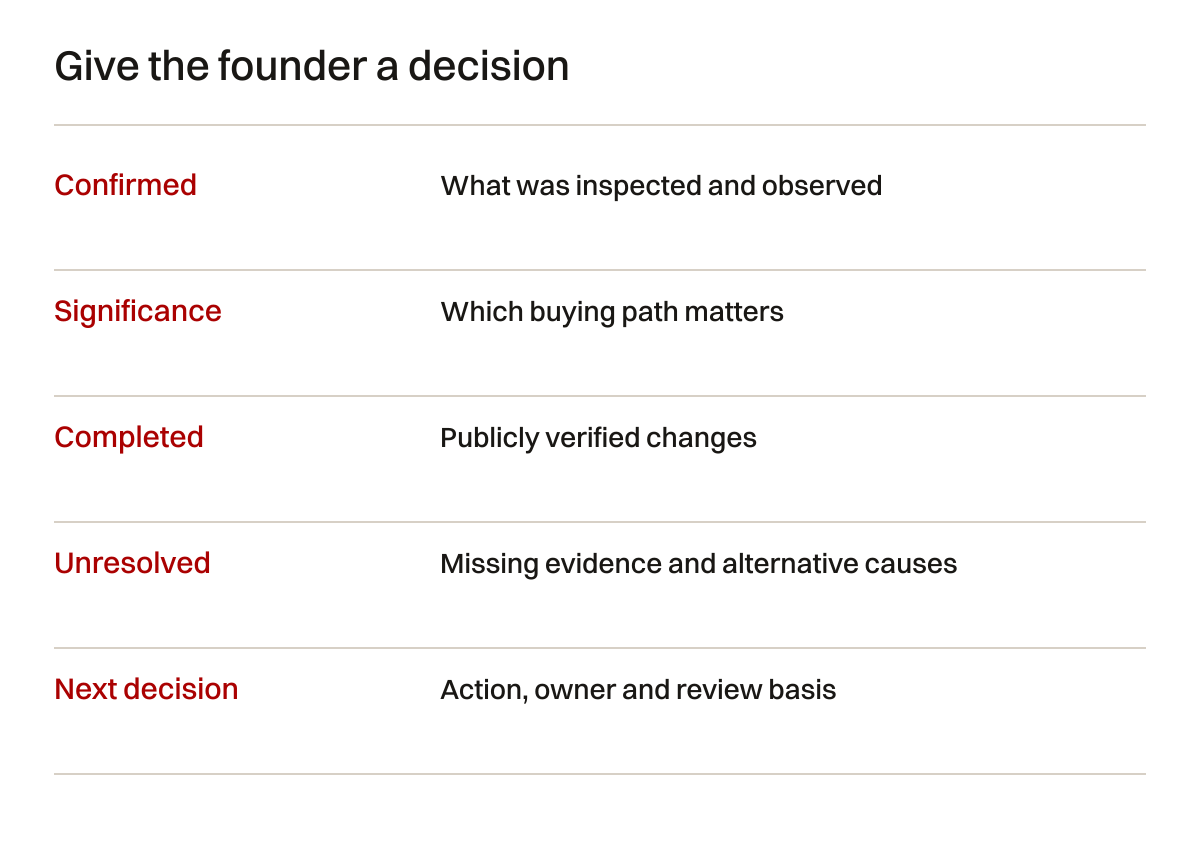
| Report field | Useful synthetic example | Weak substitute |
|---|---|---|
| Observed change | Capability clicks decreased by 180 in matched periods | SEO health declined |
| Confirmed implementation | Two old addresses now reach the intended pages | Technical work completed |
| Unresolved question | Demand change remains untested | Algorithm volatility |
| Business consequence | Suitable enquiry change not yet established | Visibility improved |
| Next action | Product owner checks withdrawn service references | Continue optimisation |
| Review basis | Same page group and complete comparison periods | Look at next month's graph |
Give the person receiving the report a decision they can make. That might be approving a bounded repair, supplying product records or accepting that a retired topic no longer deserves investment. “Keep monitoring” needs a trigger, date and defined observation to be useful.
Work through a mixed incident
Consider a fictional equipment supplier with the page-group counts shown earlier. The team reports a 25% click decline. Its analytics dashboard shows a larger 40% session decline. Sales staff also mention fewer emails, but their count includes recruitment questions and existing-customer support.
The investigator does not average those three observations. They establish separate records. The Search Console comparison covers the same Google Web property and complete dates. The analytics comparison uses its documented source and landing-page settings. The commercial review separates suitable new requirements, support requests, recruitment and spam without publishing personal details.
Next, the developer inspects representative capability pages. Two recently moved addresses lead to a generic company page rather than the intended capability pages. The content remains available at its new addresses. That is a confirmed mapping fault. It deserves a bounded repair regardless of whether it explains the entire decrease.
The investigator also finds a consent-release date near the larger analytics drop. A test shows collection differs between templates under the same documented visitor choice. The measurement owner investigates that inconsistency. They do not infer the missing historical session total from Search clicks. Different metrics cannot be forced into exact equivalence.
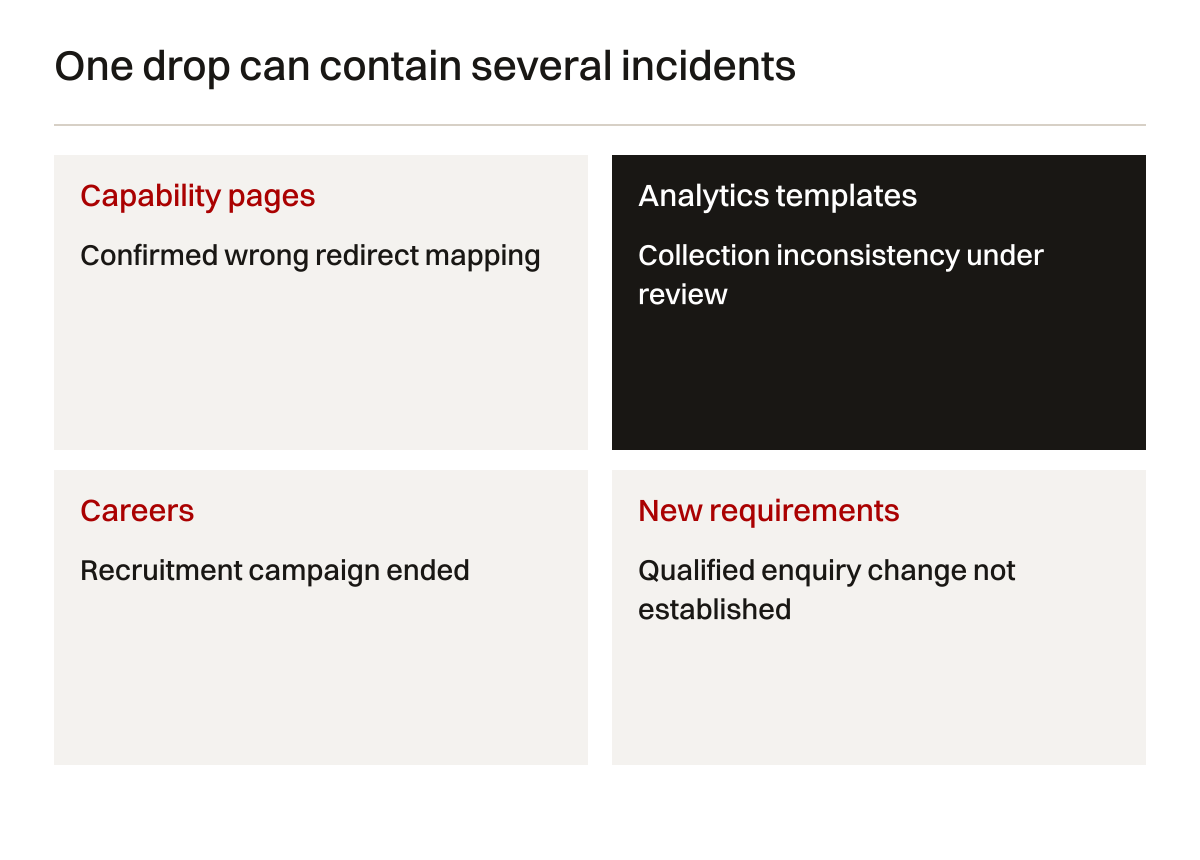
Careers is a third investigation. The hiring owner confirms that a recruitment campaign ended and several vacancies closed. Those facts support a demand explanation for that group. They do not excuse the capability redirect fault. The incident therefore contains three related records rather than one sweeping verdict.
Decide what can be concluded now
The first report states that an erroneous redirect mapping was inspected and corrected. The collection inconsistency has an assigned owner and pending verification. Recruitment demand changed near the careers decrease. The effect on suitable new enquiries remains uncertain because the original count mixed different request types.
The team now has useful work to do. It can verify the redirects, correct the collection fault within its consent requirements, and classify received requests. It does not need to purchase a mass rewriting programme to demonstrate activity.
Later, capability clicks may rise. That observation belongs beside the repair date and comparison basis. It is consistent with improvement, but other influences may remain. The report should not transform the whole sequence into a case study claiming a precisely measured revenue rescue.
Keep a control record even when experiments are imperfect
An unaffected product group can provide context. Check that it has not undergone a separate release and serves a reasonably comparable market. Record the reasons it was chosen. If its query mix is very different, use it as context rather than a formal experimental control.
For business websites, perfect controlled experiments may be impractical. Important repairs cannot always be withheld. You can still improve reasoning by recording the hypothesis before the change, checking implementation, avoiding unnecessary simultaneous edits and retaining contradictory observations.
The goal is not to make every incident sound statistically conclusive. It is to make each decision traceable. Another reviewer should understand why the team acted, what it verified and where uncertainty remains. That standard is achievable even with a small audience and incomplete historical records.
Questions founders should ask
Does a traffic drop mean the site was penalised?
No. Several explanations are possible. Inspect account messages and relevant technical evidence before using that word. Update timing, lost clicks and lower positions do not by themselves establish a manual action or policy violation.
Should we rewrite every article immediately?
Not from an aggregate chart. First identify the affected page groups and check access, collection and business changes. An article may need substantive correction, but a site-wide rewrite is a large intervention. Explain which problem each change addresses.
Can a new website solve the problem?
Only if the diagnosis supports that scope. A redesign can introduce further migration and measurement risks. The refresh-or-rebuild discussion helps frame that decision. It should not substitute for inspecting the present fault.
What should we provide to an investigator?
Controlled access to relevant reports, known release dates, current service priorities and received-enquiry information with personal details protected. Provide what exists. Do not reconstruct an exact historic timeline from memory and present it as a system record.
What if the cause remains uncertain?
State what has been ruled out and what evidence would reduce the remaining uncertainty. A limited, honest conclusion is preferable to a confident fiction. Define the next check and a decision point rather than leaving the issue permanently unexplained.
Start with the problem
If your traffic chart has fallen but the explanation changes every meeting, the next step is not automatically more articles. Bring the incident statement, change history and relevant reports to Creatif Work. Our SEO service starts with the problem that needs investigating, then identifies the work and evidence required.
We do not promise recovery from an uninspected chart. We can discuss a defined investigation, implementation ownership and a reporting method that distinguishes completed changes from observed results. Start with the problem.