

Local SEO for B2B Companies in Singapore

Local SEO for a Singapore B2B company starts with accurate business information and a usable enquiry route. Check whether the company is eligible for a Google Business Profile, represent real locations and service arrangements, and make the website explain what buyers can request. A registered address, delivery territory and customer-facing office are different facts.
A buyer finds a company on a map and travels to its listed address. The address is a mailing service. Nobody there can receive the buyer. Another buyer reaches the right supplier but calls an unattended number copied from an old directory. These are information and operating problems before they are ranking questions.
This guide helps managers make local presence useful without inventing offices, coverage or customer evidence. It separates map results from ordinary website search results. It covers eligibility, locations, categories, reviews, local pages, service boundaries and measurement. Examples are fictional. Generated photographs illustrate ordinary work and do not document an actual office, service visit or client result.
Download the local presence workbook or editable CSV registers. Neither requires a lead form. The five tables below provide a web-readable starting point. Keep actual account identities and sensitive access evidence in a private working copy.
Decide whether a Business Profile fits the business
Business Profile eligibility follows the actual way a company serves customers. Google's representation guidelines describe customer-facing physical locations and businesses that travel to customers. They also place limits on virtual offices and coworking locations. A company registration record alone does not settle those conditions.
Ask where customer contact happens. Can customers visit the premises? Are appropriate staff present during the published customer-facing hours? Does the business travel to customers? Is the address merely a mailing address? Does the company operate only online? Answer these questions from current practice before deciding which profile arrangement is appropriate.
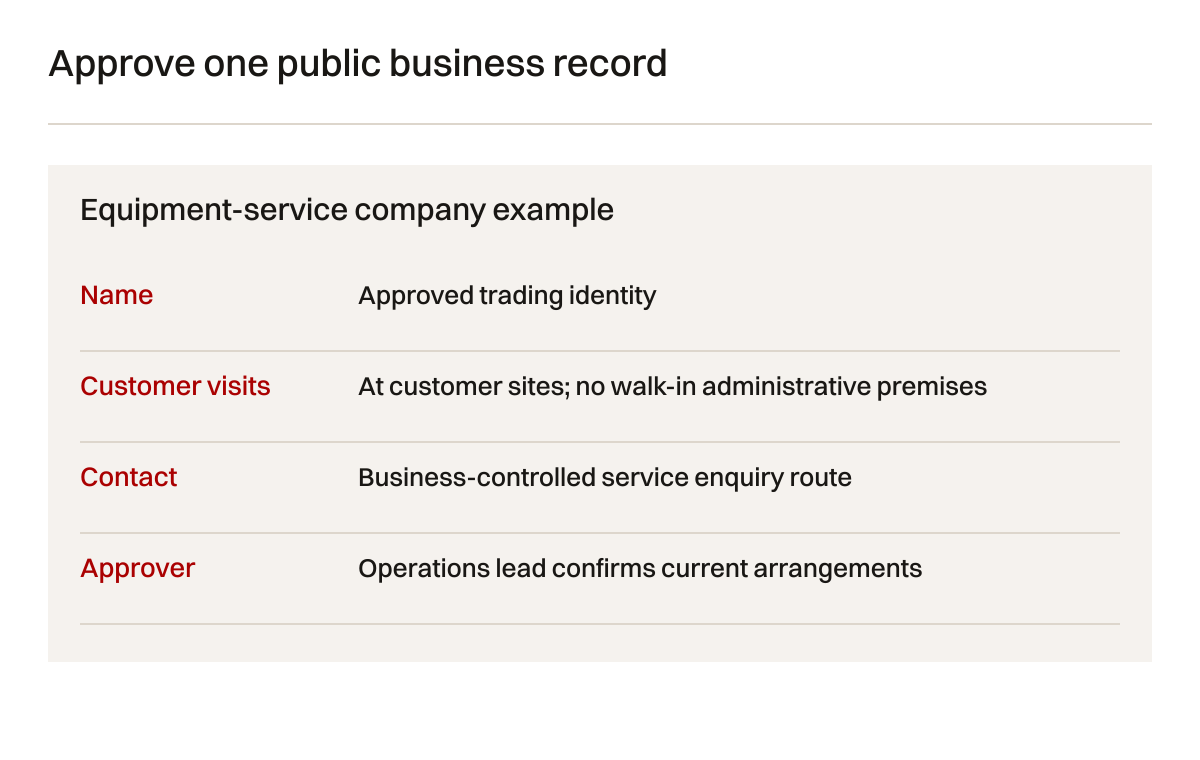
A fictional equipment-service firm visits customers at industrial sites. Its administrative address is a residence with no customer visits. A service-area arrangement may fit if the firm meets the policy. It should not present the residence as a walk-in workshop. A different fictional supplier has a staffed showroom with permanent signage and customer visits. Its facts support a different assessment.
Do not change the business story to suit a desired map appearance. If customers need an appointment, say so where appropriate. If a warehouse accepts collections only after confirmation, do not imply unrestricted walk-in service. If the business is not eligible for a profile, its public website can still explain its work and serve ordinary search visitors.
Table 1: eligibility questions to resolve first. This is a review aid. Google's current policy and the actual business arrangement determine eligibility.
| Situation | Fact to verify | Appropriate next step | Avoid |
|---|---|---|---|
| Customer-facing office | Signage, staffing and real visits | Review location eligibility | Treating a mailing address as an office |
| Service at customer sites | Genuine in-person service | Review service-area settings | Inventing branches in served districts |
| Hybrid operation | Visits at premises and customer locations | Review both arrangements | Publishing unsupported opening hours |
| Coworking office | Policy conditions and own staff | Collect current evidence | Assuming a rented desk qualifies |
| Online-only business | No in-person customer contact | Review website discovery separately | Creating a profile from registration alone |
| Multiple premises | Independent real operating locations | Assess each location accurately | Duplicating profiles for keyword coverage |
The business owner should approve the factual record. A marketing provider can inspect policy and prepare edits, but cannot manufacture evidence of a customer-facing premises. Keep unresolved eligibility questions visible. It is better to diagnose the arrangement once than repeatedly recover from profiles created around an inaccurate address.
Separate map discovery from website search
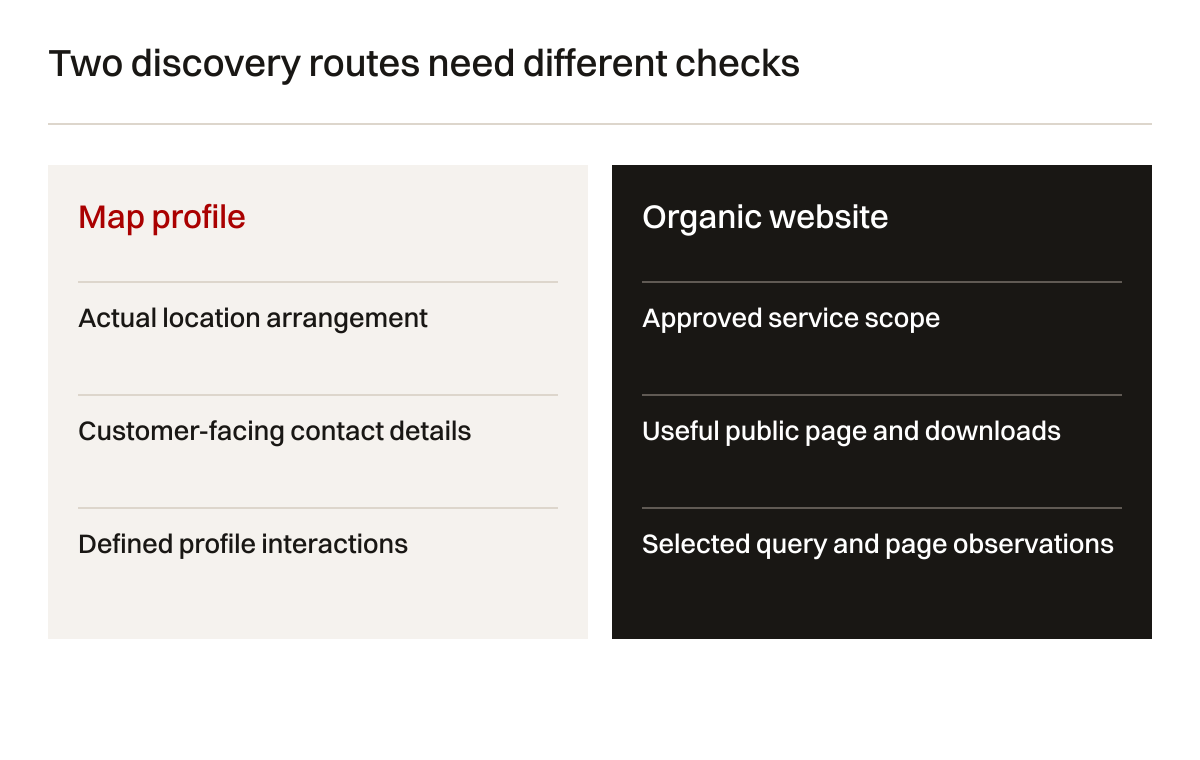
A map result often gives immediate location and contact information. An ordinary organic result can lead to a service page, product family or technical article. The two can support the same buyer, but they do not have identical inputs or reports. A change to a profile is not proof that a website page has become more useful.
Google's local ranking guidance describes relevance, distance and prominence. A provider cannot sell a guaranteed position for every searcher across Singapore. Searcher location and the nature of the request matter. Even a small geography does not make every district, query and operating arrangement interchangeable.
A procurement manager searching for a distributor may need proof of authorisation and technical scope. An engineer searching for an on-site repair provider may need service boundaries and appointment instructions. A map listing can help each find a business, but the website must carry the information required to assess fit. The enquiry team must then handle the request.
Record observations with the query, location context, date and device when relevant. Do not present a single screenshot as a universal ranking. Personalisation, interfaces and result types can differ. A manual observation can help reproduce a buyer problem, but it does not replace authorised account data or establish long-term visibility.
For website discovery, use Search Console guidance to understand the available search observations. Keep profile interactions in their own report. Compare the two only around a clearly defined business question, such as whether visitors can discover and contact a particular service team.
Create one approved public business record
Start with the legal or trading name, customer-facing contact details, actual location arrangement and approved service scope. Identify the person who can confirm each fact. A receptionist may know visiting instructions. The operations manager owns appointment availability. Commercial leadership approves service coverage. A profile editor should not guess across those boundaries.
The record should distinguish facts that look similar. Registered address is not necessarily visiting address. A warehouse may be a collection point rather than a sales office. A switchboard may serve several sites. A service team may travel across Singapore while a spare-parts collection counter has narrower operating hours. These distinctions matter to buyers.
Write a useful business description using approved information. Explain the actual work and who it serves. Avoid inserting every district into the company name or turning the description into a list of unrelated offerings. Categories should describe the business rather than every possible customer request. Review Google's profile policy collection when deciding how specific fields are used.
Table 2: public profile information and its source. These are factual ownership checks, not instructions to expose private account records.
| Field | Authoritative business source | Approver | Visitor check |
|---|---|---|---|
| Business name | Approved public trading identity | Business owner | Matches current signs and website |
| Location | Actual customer-serving arrangement | Operations lead | Directions lead to the right place |
| Hours | Current customer-facing schedule | Office or service manager | Special arrangements are understandable |
| Phone | Controlled business contact route | Commercial lead | Caller reaches the intended team |
| Website | Approved public destination | Website owner | Page explains the location or service |
| Category and description | Actual principal activity | Business owner | Scope agrees with public pages |
Review other public records after approving the source. Association listings, supplier pages and old business directories can carry different information. Correct records that matter to real buyers. Do not purchase indiscriminate directory submissions merely to increase a count. Our editorial link guide covers assessing relationship records and publication context.
Describe service coverage without inventing branches
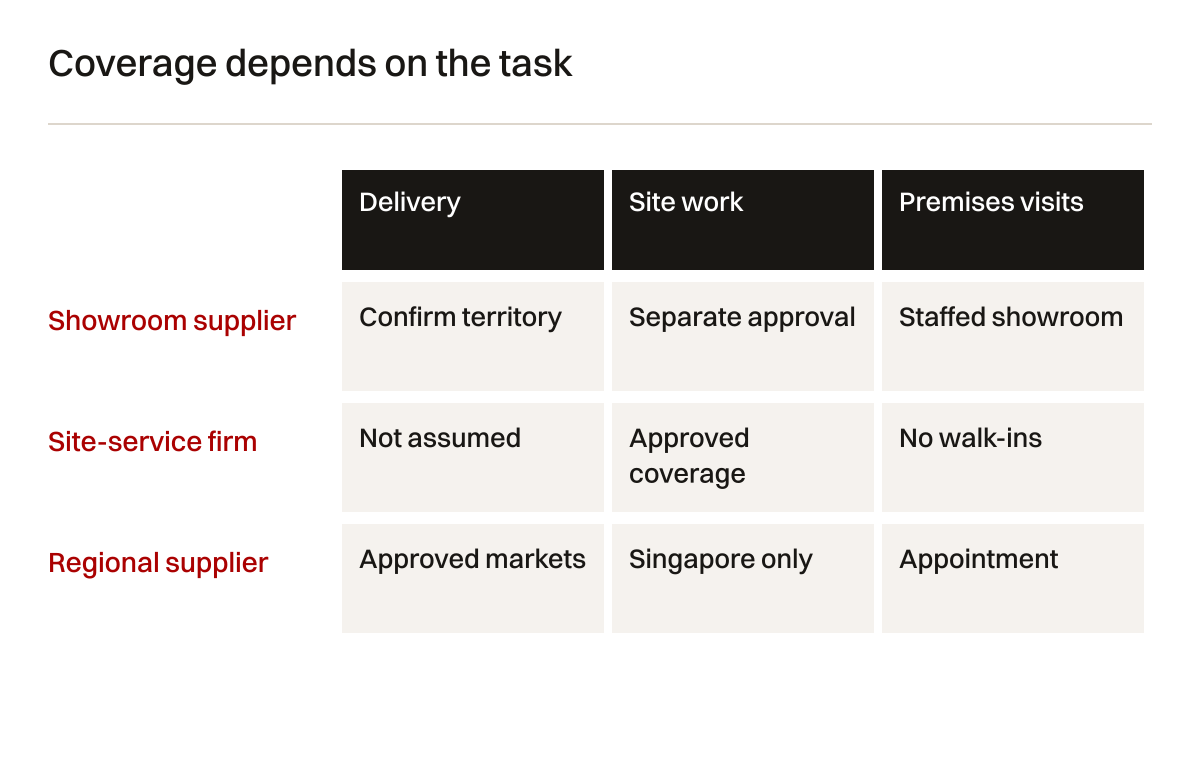
Service coverage explains where and under what conditions the business can perform work. It does not establish offices in those places. A technician travelling to Jurong does not create a Jurong branch. A supplier delivering to Woodlands does not necessarily provide installation there. Write the operating distinction before discussing page architecture.
Google's service-area instructions explain current profile controls and their limits. Those controls are a representation tool, not a business capacity plan. Do not add places because they look commercially attractive if the actual team cannot serve them. The company must approve the underlying operating claim first.
A fictional maintenance firm handles planned site visits in Singapore. Emergency attendance requires confirmation. Its public page should describe planned service and the enquiry route, while avoiding an unverified immediate-response promise. If specialised equipment limits certain visits, tell buyers what information the team needs to assess feasibility.
An industrial supplier may ship to Malaysia while providing installation only in Singapore. That deserves two explicit statements. A broad regional coverage map could conceal the distinction. If international service is being considered rather than offered, label it as a question for the sales team instead of publishing a confirmed territory.
Table 3: coverage claims and their verification. The fictional examples show how to replace an unsupported general statement with a useful operating boundary.
| Proposed claim | Missing distinction | Evidence needed | More useful wording decision |
|---|---|---|---|
| We serve all Singapore | Work type and availability | Approved service plan | Name the work and confirmation route |
| Jurong office | Actual premises or travel only | Staffed location evidence | Describe site visits if no office exists |
| Regional installation | Shipping versus installation | Technical and commercial approval | State each territory by task |
| Immediate support | Response capacity and conditions | Agreed operating commitment | Explain assessment and booking |
| Walk-in collection | Customer access rules | Warehouse procedure | Publish collection confirmation steps |
| All product repairs | Capability and parts limits | Technical scope record | Name covered families and exclusions |
Use the same boundary in the profile, service page, downloadable brochure and enquiry response. When a salesperson privately promises a wider scope, route the question to the decision owner. Public copy should not silently expand to match an unapproved message. A website editor can maintain consistency, but the business retains responsibility for what it offers.
Give a location page a practical job
A location page should help a visitor understand a real location or local operating arrangement. Useful content includes access instructions, the team or function at the premises, appointment conditions, relevant service boundaries and contact routing. If it contains only a district name swapped into a generic paragraph, its purpose needs review.
For the fictional staffed showroom, the page explains that technical consultations require an appointment. Product collection uses a different entrance. It names the information required before a visit and links to the appropriate enquiry form. This information could prevent a wasted journey. It is more useful than repeating “supplier in Singapore” throughout the text.
For the fictional site-service firm, a service page can explain how requests are assessed without pretending to have a showroom. The page should describe site details the team needs, restrictions relevant to the work and the process for arranging a visit. Keep private customer sites and protected project records out of the public example.
Photographs on an actual business location page should accurately depict what they claim. Do not use a generated office photo as evidence of your real premises or signage. The generated work photos in this guide are explicitly illustrative teaching images. A business seeking verification or visitor guidance needs appropriate real evidence and permission.
Google's LocalBusiness structured-data documentation describes supported information and eligibility requirements. Use markup only for facts represented accurately on the page. Adding a fabricated address to structured data does not make a location real. Valid markup also does not guarantee a special search appearance.

Generated illustrative photograph. The vehicle, location and person do not represent a real service operation or prove attendance availability.
Test the mobile enquiry path from the profile
Open the actual public destination on a phone. Start from the profile link where possible. Check whether the page makes the service and next action understandable. A desktop homepage review does not establish the experience of a buyer using a map result while standing at an industrial site.
Test the phone route with an approved controlled call. Confirm the number, routing and customer-facing hours. A tap on the call button is not evidence that the business answered. If voicemail or a receptionist handles the request, check that the instructions lead to the right commercial or technical team.
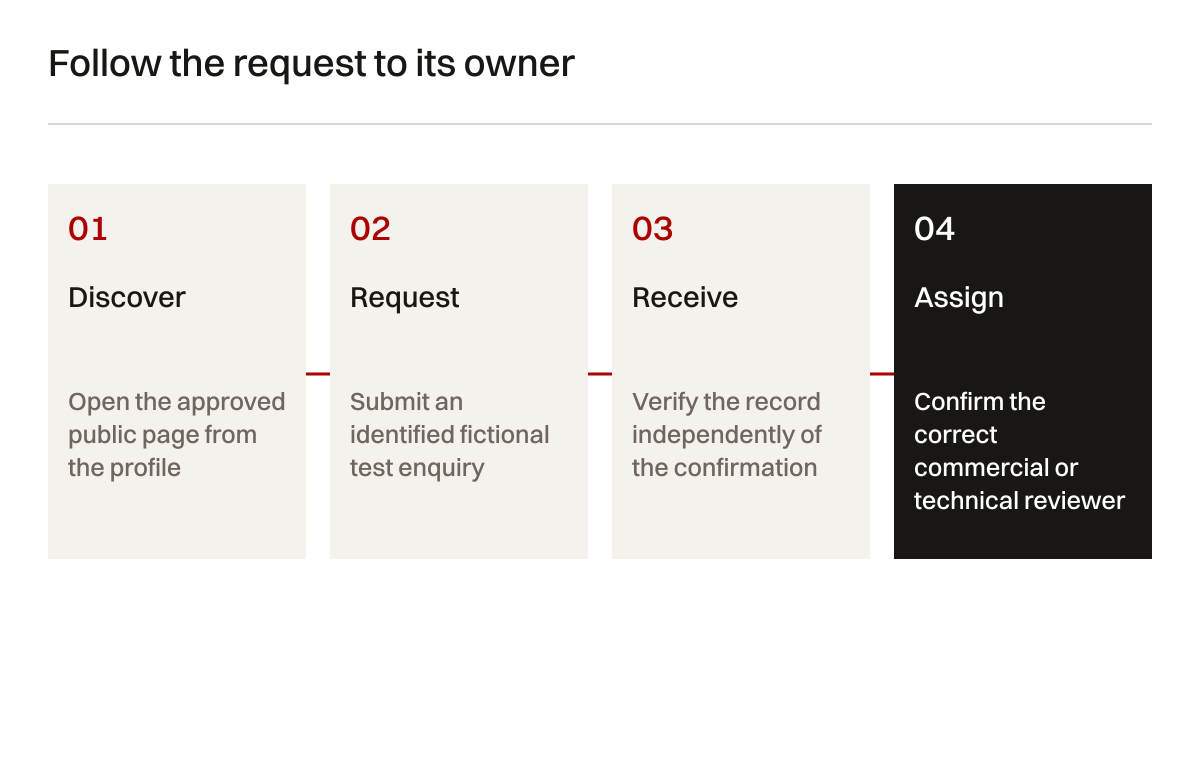
Test forms through receipt and assignment. The visitor should know whether the request was accepted and what happens next. Use fictional test details clearly marked as a test. Avoid submitting protected drawings or actual customer information merely to exercise a form. The business can assess attachment needs through a controlled sample file.
Table 4: enquiry acceptance tests. Agree the relevant checks for the implemented journey. These are example tests, not promised response times.
| Journey | Controlled test | Acceptance evidence | Owner |
|---|---|---|---|
| Profile website link | Open on ordinary mobile browser | Correct usable public destination | Profile and website owners |
| Phone call | Call with approved test reference | Intended team or clear fallback | Commercial operations |
| Enquiry form | Submit fictional request | Confirmation and received record | Website and sales owners |
| Attachment | Upload permitted sample file | File reaches authorised reviewer | Technical enquiry owner |
| Visit instructions | Follow the published directions | Correct entrance and arrangements | Location manager |
| Out-of-scope request | Ask about unsupported service | Clear clarification or routing | Commercial lead |
Pay attention to fields. A local B2B request may need equipment type, site location and a brief task description. It rarely needs every piece of information required for a final quotation at first contact. Ask enough to route the request, then explain how sensitive technical material should be provided privately through an approved channel.
Keep the public and private stages distinct. The service page attracts and informs buyers. The form starts a conversation. A protected portal may later handle customer files and job records. That private workspace is not a local SEO landing page. Search work concerns the approved public pages, while operational integration concerns records and permissions.
Request genuine reviews and handle responses carefully
Reviews can help prospective customers understand experiences, but the request must reflect a genuine relationship. Google's review guidance prohibits incentives for posting, changing or removing reviews. Do not turn review collection into a transaction for discounts or write reviews on behalf of customers.
Decide who can request feedback and at what stage. A completed service visit may be a suitable trigger. A tender invitation is not the same as a completed customer experience. Give the recipient a straightforward route and avoid prescribing the rating or exact wording. The business should keep its communications appropriate to the relationship.
B2B reviews often involve confidentiality. A public response should not reveal equipment details, contract values, protected site locations or private disputes. A customer might choose to mention its own project, but that does not authorise the business to publish everything it knows. Agree response ownership with commercial and technical colleagues.
When a negative review arrives, separate the public response from the private investigation. Acknowledge an assessable issue using permitted information and provide an appropriate contact route. Verify the underlying facts privately. Do not publish an argument assembled from internal emails. If a review appears to violate platform rules, use the stated review route rather than promise removal.
Set acceptance around the process: requests are authorised, feedback is handled, and responses respect public boundaries. A review count target alone may encourage poor requests. A particular rating cannot be guaranteed. Commercial interpretation also requires context, because a small sample can be dominated by a few experiences.
Maintain changes as operating events
A location move, altered visiting hours, changed phone number or withdrawn service should trigger a coordinated review. Start with the approved source record, then update the relevant profile, public pages and downloadable documents. Assign someone to inspect the public result after the edit. A saved dashboard field is not proof of what a visitor sees.
Some platform edits can be reviewed before they appear. Maintain the actual state in the register: requested, submitted, pending, visible or rejected. If the change is urgent, the website may need a clear temporary instruction while the profile is being resolved. Do not report the whole update as complete when one important surface remains wrong.
Keep an exception path. Suppose the fictional showroom closes customer visits while remaining a storage location. The location manager approves the new arrangement. The website removes walk-in instructions and provides collection coordination. The profile owner reviews the appropriate policy and settings. Each public route is checked separately before closure.
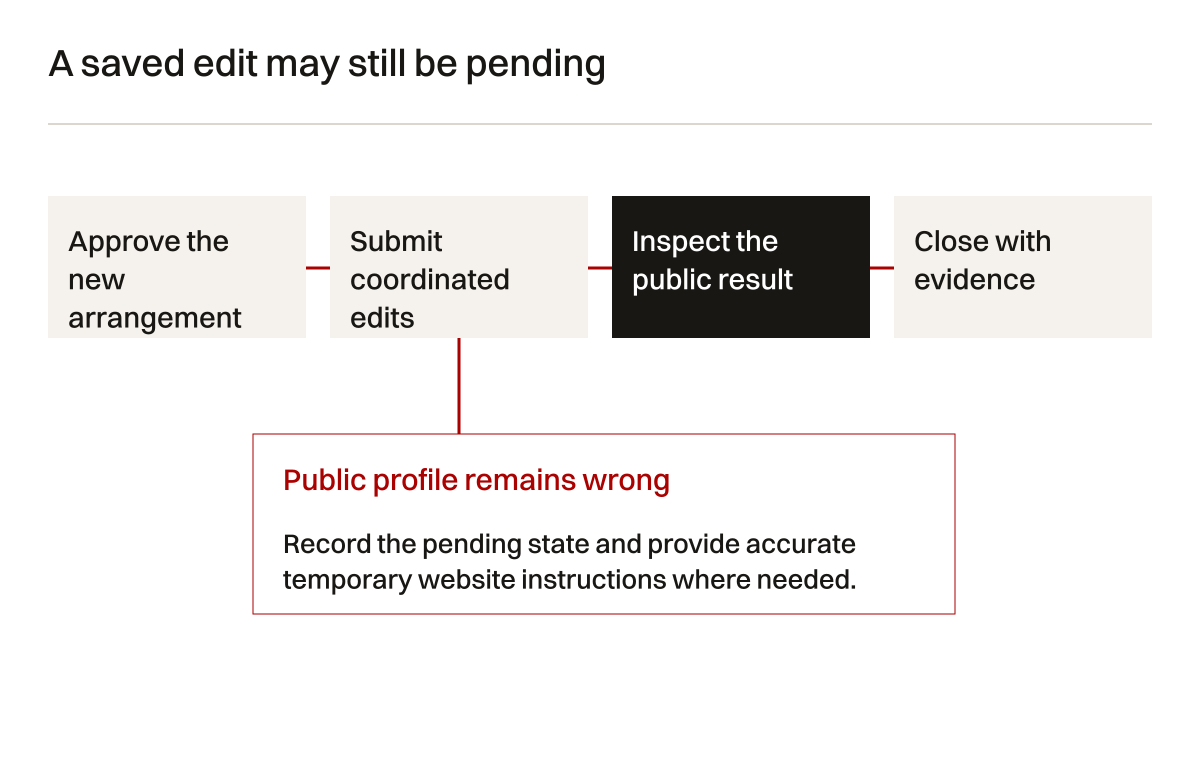
Prevent avoidable ownership gaps. Use named, role-appropriate access and an authorised business owner. When staff or providers change, verify who can approve edits and receive platform notices. Keep recovery records private. The person designing a page does not automatically control the Business Profile, and neither role necessarily controls the domain.
Local facts should also feed wider website maintenance. Our after-launch maintenance guide explains visitor checks and operating ownership. This guide adds the local representation decision. A healthy hosting account cannot compensate for inaccurate customer visiting instructions.
Interpret profile measures using their actual definitions
Google's Business Profile performance documentation explains available interactions. Its call measure concerns clicks on the call button, rather than proof of answered calls. Website clicks concern clicks on the profile link. Read the current definition before assigning a commercial meaning to a number in a report.
Imagine a synthetic planning example with three stages. A profile records thirty website-link clicks during a hypothetical review window. The tracked website records eighteen sessions from the labelled route. The CRM contains four qualified local requests with matching evidence. Those numbers describe different systems and definitions. They should not be assumed to form a complete funnel.
The difference could involve repeated clicks, measurement consent, attribution settings or missing evidence. This guide does not assert which explanation applies. The example's purpose is to show why the report needs definitions and reconciliation. It is not a client result, conversion benchmark or prediction of what a profile will deliver.
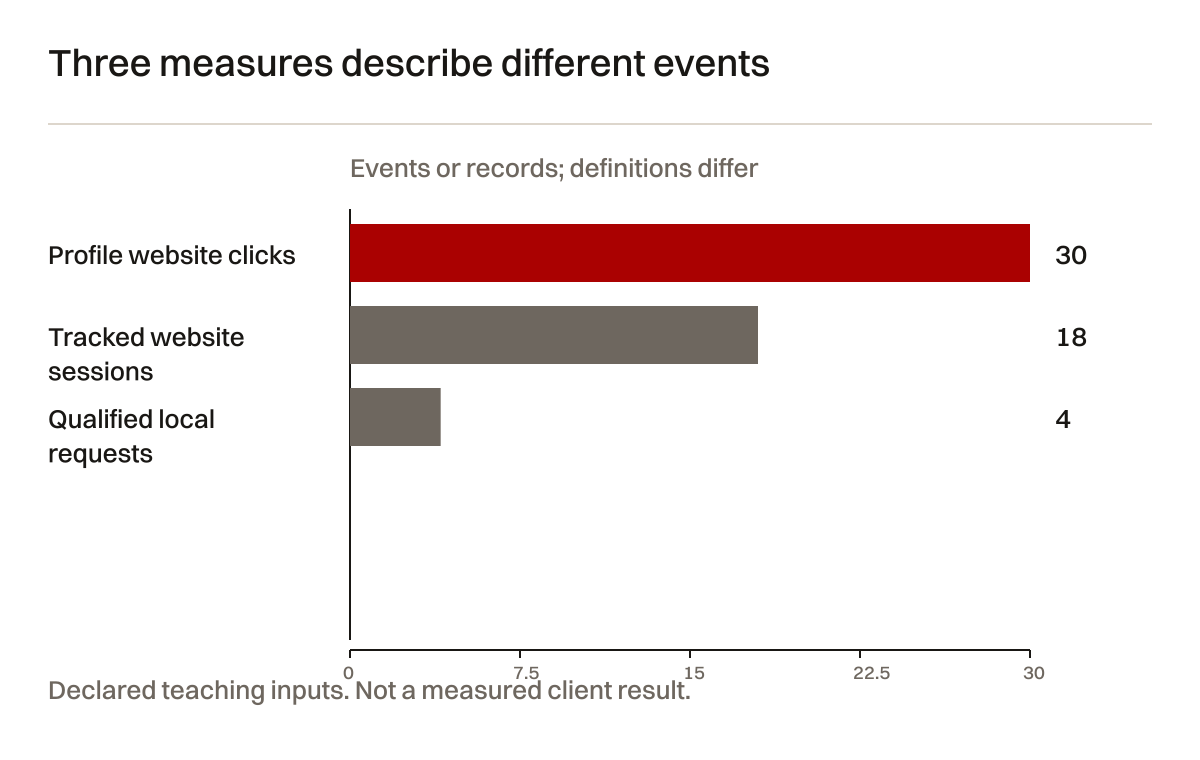
Table 5: measurement questions and practical limits. Keep period, source, definition and exclusions alongside each observation.
| Question | Source | What it can show | What it cannot establish alone |
|---|---|---|---|
| Did someone use the profile link? | Profile performance | Recorded link interaction | Completed website visit or enquiry |
| Did someone tap call? | Profile performance | Recorded call-button interaction | Answered call or qualification |
| Did the website receive tracked visits? | Approved analytics setup | Sessions under its definition | All visitors or profile completeness |
| Did search discovery change? | Search Console | Selected query and page observations | Universal local ranking |
| Did a request fit our scope? | CRM and commercial review | Defined qualified enquiry | Attribution to one profile edit |
| Did the buyer receive help? | Operational task record | Routing and follow-up evidence | Future revenue or satisfaction |
Use a specific review question. If buyers repeatedly ask where to collect parts, inspect directions and enquiry handling. If calls occur outside the staffed hours, review the public schedule and fallback. If a supplier page receives relevant search visits but unsuitable enquiries, review scope and fields. Each question points to a testable problem rather than a generic ranking target.
Avoid tying revenue directly to one profile edit without evidence. A long sales cycle can include referrals, trade events, repeat customers and multiple searches. Where the attribution is uncertain, say so. The business can still improve obvious information faults and monitor subsequent behaviour without claiming a causal result it cannot defend.

Generated illustrative photograph. It represents a controlled phone-route check and does not prove that any actual business answered a call.
Work through a local presence review
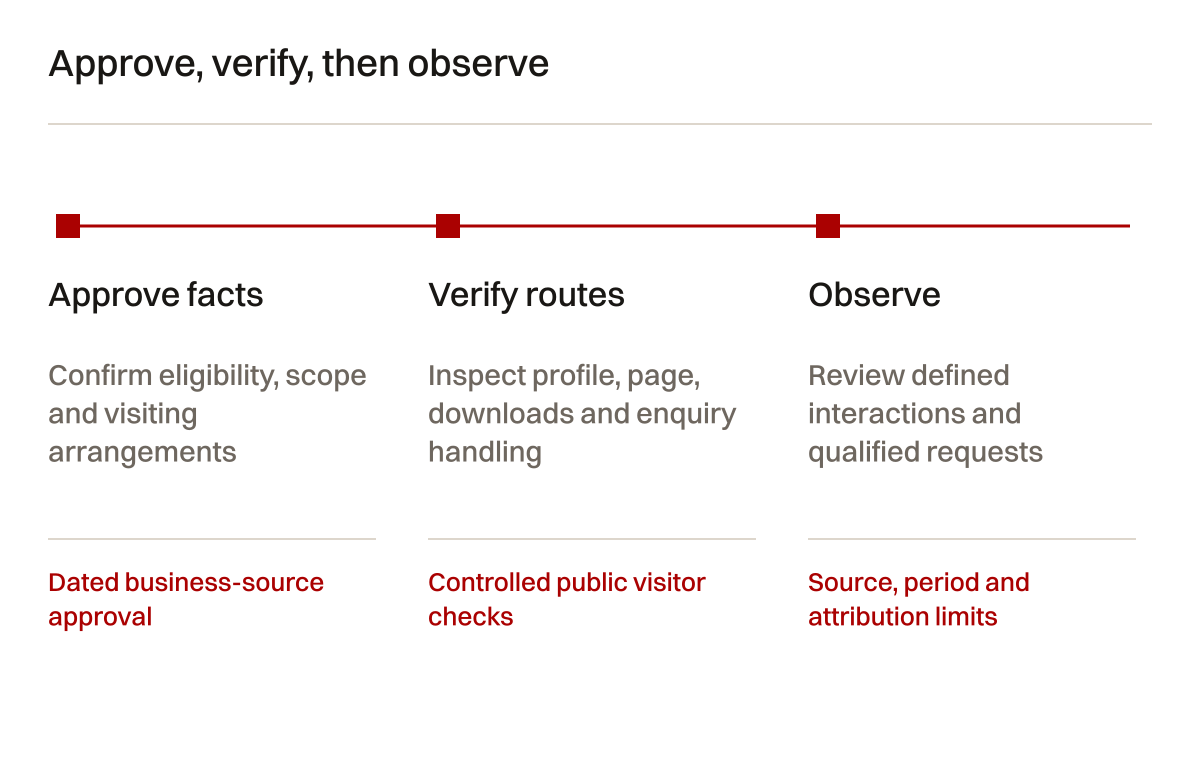
The fictional equipment-service firm begins with an unclear public address. Its operations manager confirms that customers are served at their own sites and do not visit the administrative premises. The business owner approves the true service arrangement. The profile administrator reviews current eligibility and service-area instructions rather than copying a competitor's setup.
The website editor then checks the service page and capability PDF. Both contain an unsupported walk-in statement inherited from an older template. The approved change replaces it with assessment and appointment information. The technical lead confirms the covered equipment families. Sales verifies the phone route and the information needed to assess a site visit.
A controlled mobile enquiry follows. The request uses a fictional equipment description and a permitted test attachment. The form confirms receipt. Sales finds the record and assigns the correct reviewer. An unsupported request takes the clarification path. These checks establish that the approved journey works under the tested conditions.
The profile edit is then inspected publicly. If it is pending review, the team records that state. Once visible, the public location arrangement is checked again. The review closes only after the agreed website, document, profile and contact tests have evidence, or after an authorised owner accepts a named remaining exception.
The later report can compare enquiries and visitor questions with prior observations. It cannot assume that an improved profile caused every change. The immediate value is a public record that agrees with the actual business and a contact route that has been tested. Wider commercial results remain a separate question.
Questions about Singapore B2B local SEO
Keep a small change history alongside the current facts. Record the old value, approved replacement, affected surfaces and public check date. When a buyer reports conflicting information, the team can then identify whether a profile edit is pending, a brochure was missed or an outside directory still carries an old record. Without that history, the same correction can be requested repeatedly without anyone discovering the missed dependency.
Review triggers should follow actual operating changes. A temporary holiday arrangement needs a different review date from a permanent location move. A discontinued service needs its public enquiry route checked as well as its description. A new phone provider needs call tests before the old number disappears. Name the person who receives each trigger, because a shared spreadsheet does not itself notify the website editor.
These records are private operating material. The public page needs the current accurate answer, not a history of internal disagreements or account administration. Publish only what helps the buyer understand the arrangement and take the appropriate next step.
Does every Singapore company need a Business Profile?
No. Check the actual customer-serving arrangement against current eligibility rules. A registration address does not automatically qualify a business. An online-only company can still maintain useful public website content and ordinary search discovery. The right scope follows the facts rather than a universal local marketing package.
Can we create pages for every Singapore district?
Only create pages with a useful, supported purpose. Distinct real premises or materially different service information may justify separate pages. Repeated generic pages that swap district names add little for buyers. Begin with actual operating differences and the information a visitor needs to act.
Should we publish our warehouse address?
Explain the warehouse's real customer role. If collection requires prior confirmation, publish that condition. If visitors are not accepted, do not imply walk-in access. Business Profile treatment depends on its current policies and the actual arrangement. A website can describe logistics without misrepresenting a customer-facing location.
Can adding more service areas guarantee wider map visibility?
No. Profile settings represent where the business actually works; they do not override searcher location or other ranking factors. Approve service coverage operationally before editing the profile. Measure relevant requests with clear definitions rather than promise a position throughout Singapore.
Are generated location photographs acceptable evidence?
They should not be used to claim a real premises, signage or team that they do not depict. Generated photographs in this guide are labelled illustrations. Actual visitor guidance and platform verification need appropriate factual material and permission. Keep illustrative editorial images separate from documentary evidence.
How do we know whether local SEO produced an enquiry?
Use a defined enquiry record and the attribution evidence available under your measurement setup. Profile interactions, website sessions and qualified requests are different events. Ask the commercial team how the buyer found the business when appropriate, but recognise that self-reported attribution also has limits. Report uncertainty rather than fill the gap with a guess.
Choose the next correction from the buyer's task
Bring the current profile, the actual customer-serving arrangement and a recent enquiry example that can be reviewed privately. The first task may be correcting a phone route, clarifying collection instructions or removing an unsupported coverage statement. It may involve public page work and profile ownership rather than a redesign.
Creatif Work connects website implementation with the approved facts and visitor journey. SEO work investigates discovery and suitable buyer questions. The scope depends on what the review finds and what the business can verify. Start with the problem.
Sources checked for this guide
Official documentation checked on 4 October 2026. Profile controls and policies can change. Fictional operating examples and synthetic measurement inputs are original teaching material.