

Traffic Without Buyers: B2B Keyword Research

B2B keyword research should identify questions your business can credibly answer for suitable buyers. Search volume is not buyer qualification. Start with service boundaries, buying tasks and received requirements. Review ambiguous queries before assigning intent. Use demand estimates as one input, and keep unmeasured examples clearly labelled.
A report can contain hundreds of keywords and still fail to describe anyone you want as a customer. “Marine jobs” might attract far more searches than a specialist equipment assessment. That does not make it a sensible target for an equipment supplier that is not recruiting.
The difficulty is not finding more words. It is deciding which questions deserve a public answer, which belong on existing pages and which should be excluded from the content plan. That decision needs commercial knowledge as well as search data.
This guide presents a research and qualification method. All example queries are manually chosen. They are not verified keyword opportunities or measured search volumes. All numerical examples are synthetic. No conversion benchmark or prediction is claimed.
Use the buyer-query workbook or CSV template pack to document the reasoning. The templates are designed to keep evidence and assumptions separate, not to calculate a guaranteed content return.
Define who can actually become a customer
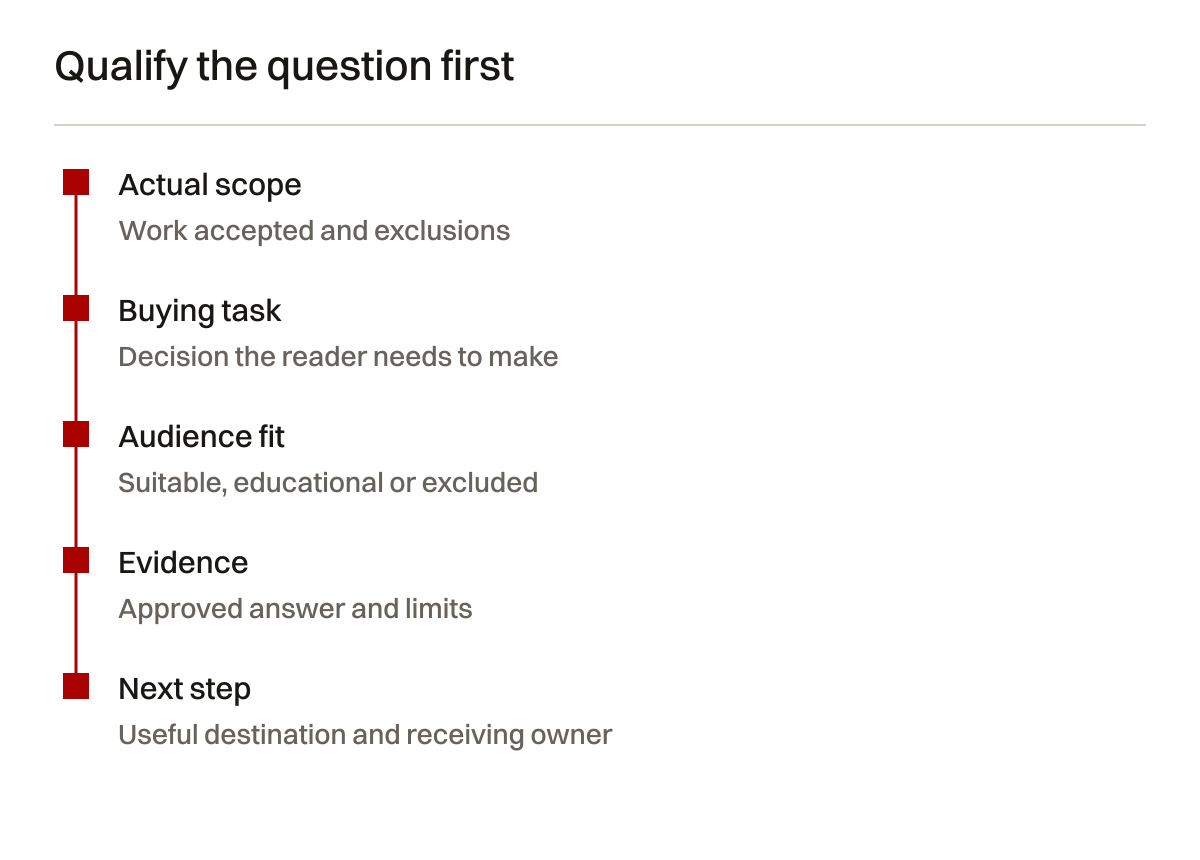
Begin with the work the business accepts. Record services, applications, operating arrangements, capacity boundaries and exclusions. A keyword is not valuable merely because its subject is adjacent to your industry. It needs a plausible connection to work you can perform.
An engineering company may design equipment but not sell components. A construction firm may serve commercial projects but not household repairs. A marine service may cover a particular vessel class but not recreational boating. Those distinctions belong in the research brief before anyone exports a keyword list.
Do not invent a decision-maker profile
A job title is not a search intent. Founders may ask detailed technical questions. Procurement managers may search broad supplier categories. A junior engineer may collect information that later influences the shortlist. Treat these as possible roles, not fixed behaviour patterns.
Ask who raises the need, checks fit, approves risk and signs the appointment. The same company can involve several readers at different stages. Your page should help a defined decision without pretending you know the searcher's job from one phrase.
Record excluded audiences explicitly. Students, job applicants, hobbyists and existing customers may need information, but their visits should not be mislabelled as new sales opportunities. A business can deliberately serve those readers. It should distinguish that purpose from acquisition.
Collect real buying questions before tool suggestions
Review enquiry forms, sales call notes, proposal questions and the issues that delay qualification. Remove personal identifiers before using examples in a wider working document. Preserve the meaning and context of the question, not confidential project details.
Ask the team which missing information creates repeated email exchanges. A buyer may need to know which drawings are required, whether a material is suitable or how responsibility is divided. These questions can reveal useful page gaps even when nobody knows a measured search volume.
Do not turn every private question into a public article. Some answers depend on confidential specifications or a professional assessment. A public page can explain the assessment process and required inputs without making an unsafe blanket recommendation.
| Research input | What it can reveal | What it cannot establish | Record to keep |
|---|---|---|---|
| Received enquiry | Actual wording and context | Total market demand | Anonymised question and service |
| Sales clarification | Information missing before qualification | Universal buyer behaviour | Decision delayed and approved answer |
| Search Console query | Observed discoverability for your site | Every potential searcher | Period, page and filters |
| Tool suggestion | Candidate wording and related topics | Suitability or commercial value | Tool, market, date and limitations |
| Search result review | Current answer types for a sample | Representative conversion rate | Query, context, date and observations |
| Technical reviewer | Scope and evidence requirements | Search volume | Approved facts and boundaries |
Separate terminology from demand
Your internal service name may not match the customer's wording. Record both. Ask whether the phrase describes the same task, a related task or a different responsibility entirely. An apparent synonym can change the commercial meaning.
For example, “inspection”, “survey”, “certification” and “assessment” can refer to different appointments. Do not optimise around the most popular word if it implies an authority you do not possess. Have a responsible service owner approve the terminology.
Keep regional language variations in a vocabulary record. A term used in the UK may mean something different in Singapore. Translation also needs subject review, not just word substitution. Search relevance cannot justify a misleading description of your actual service.
Use demand tools with their limitations visible
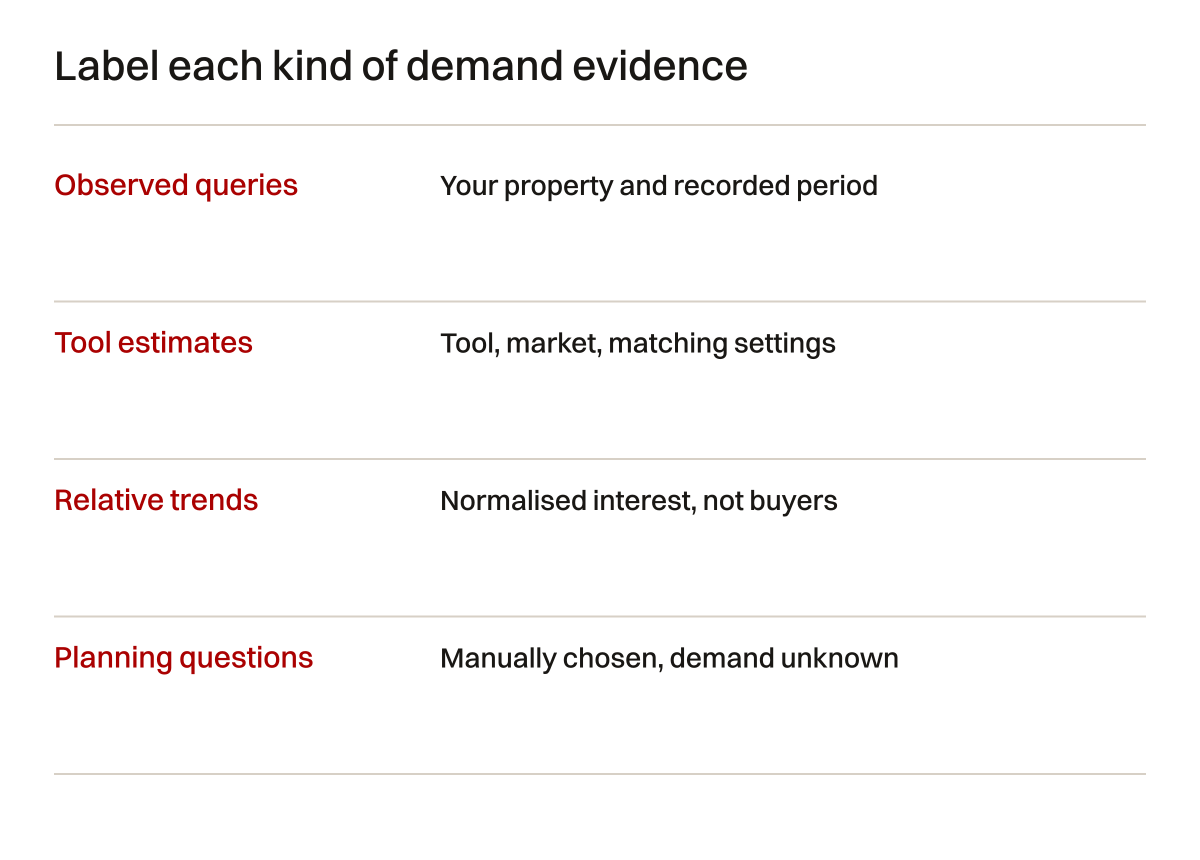
Record the tool, market, language, date range and matching settings beside any volume estimate. Keep the original export. Do not paste rounded tool numbers into a chart and call them actual monthly buyers.
Google Keyword Planner's forecast documentation concerns advertising forecasts. Those forecasts are not forecasts of your organic rankings. An SEO plan should not silently repurpose paid-search estimates as an expected number of organic leads.
Google Trends' data documentation describes relative, normalised interest. A Trends value of 100 is not one hundred enquiries or an absolute search count. Sparse terms may not support useful comparisons.
Do not punish uncertainty with invented precision
A phrase with unavailable demand data can remain a candidate. Mark demand as unknown and explain why the question matters. That is different from claiming “zero searches but high conversion” without evidence.
Likewise, a large estimated audience can remain a poor target. Its searchers may need a job, an academic definition or a service in an unsupported market. A bigger number does not remove those exclusions.
Use confidence labels tied to the evidence. “Observed in received requirements” and “suggested by a tool” are useful distinctions. A coloured score without an explanation is not. The reader should see which conclusion came from an account record and which came from an analyst's judgement.
Review ambiguous queries before assigning intent
Inspect a small, documented sample of search results for each important ambiguous query. Record market context, language, date and device assumptions. Look for answer types and meanings, not just which competitor appears first.
A query might show job boards, product suppliers and informational articles. That mixed pattern is evidence of ambiguity in the sample. It does not reveal the exact proportion of buyers. Keep the conclusion modest: this phrase needs clarification or a narrower answer.
| Manually chosen query | Possible audience | Commercial fit question | Editorial decision |
|---|---|---|---|
| Marine jobs | Applicants | Are we recruiting? | Keep separate from acquisition plan |
| Steel grades | Students, buyers, engineers | Do we advise on a relevant specification? | Answer only within verified scope |
| Factory automation | Broad research and buyers | Which process and appointment do we cover? | Narrow to a supported decision |
| Offshore equipment inspection documents | Technical or procurement readers | Can we explain required inputs? | Review terminology and evidence |
| Construction company Singapore | Several project types | Do our projects match the likely need? | Clarify actual appointment and exclusions |
| Equipment repair near me | Urgent local readers | Is local repair actually available? | Exclude if operating arrangement does not fit |
These are illustrative phrases, not researched demand findings. The decisions depend on the actual business. Another organisation could correctly treat recruitment or local repairs as a priority.
Inspect the destination you would send someone to
A query can look commercially relevant while the planned page is unsuitable. If a buyer needs technical prerequisites, a gallery with no conditions will not answer the question. If they need an urgent contact, a long academic article may be unnecessary.
Open the intended page on mobile. Can the reader identify scope, evidence and next action? Does the contact route ask for appropriate information? Can the receiving team assess that request? Search research is incomplete when it stops at a phrase and never checks the destination.
Do not assume an article must be the answer. A service-page correction, maintained technical sheet or short explanation may resolve the question more directly. Choose the format after identifying the task, not before.
Apply exclusion gates before scoring opportunities
Weighted opportunity scores can disguise a bad fit. High volume can overpower weak relevance if the spreadsheet gives volume enough weight. Prevent that by applying basic eligibility gates before any ranking score.
The gate asks whether the business can accurately answer the question, serve the relevant requirement and maintain the information. A failed gate should not be rescued by a large demand estimate. Exclusion is a reasoned decision, not an admission that the keyword list is too short.
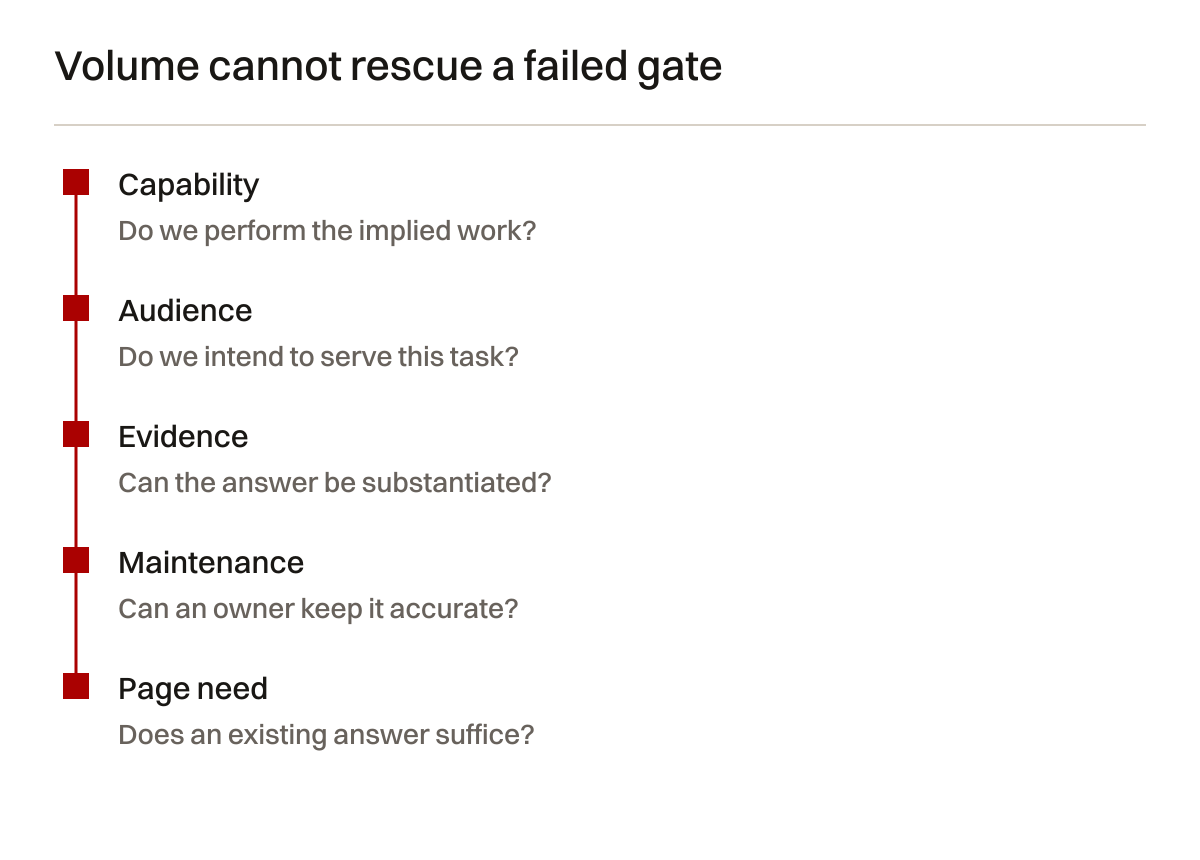
| Gate | Pass question | Example failure | Appropriate response |
|---|---|---|---|
| Service fit | Can we perform the implied work? | Phrase implies certification we cannot issue | Exclude or explain correct scope |
| Audience fit | Is this a reader we intend to serve? | Jobs phrase included as a sales target | Move to recruitment purpose |
| Evidence | Can we substantiate the answer? | Article needs unsupported technical claims | Obtain review or hold publication |
| Operating arrangement | Can we serve the implied market? | Local-office claim where none exists | Remove invented local positioning |
| Maintenance | Can an owner keep it accurate? | Fast-changing information with no owner | Assign ownership or defer |
| Distinct page need | Does the answer need another URL? | Existing page already answers it | Update the current page |
Make exclusions reviewable
Keep a short reason and review trigger. A business may later add a service, hire a qualified specialist or establish a delivery arrangement. The excluded question could then become relevant. Do not erase the history and claim the phrase was always suitable.
Allow an exception only with a defined purpose. A general educational article might be useful to existing customers or staff. Mark it as education rather than acquisition. Set an appropriate measure and maintenance plan.
This prevents a common reporting trick: publishing broad material, showing its visits as commercial progress, then blaming the sales team when the readers do not buy. The content may be useful. The claim about its role is the part that needs correction.
Prioritise the eligible questions
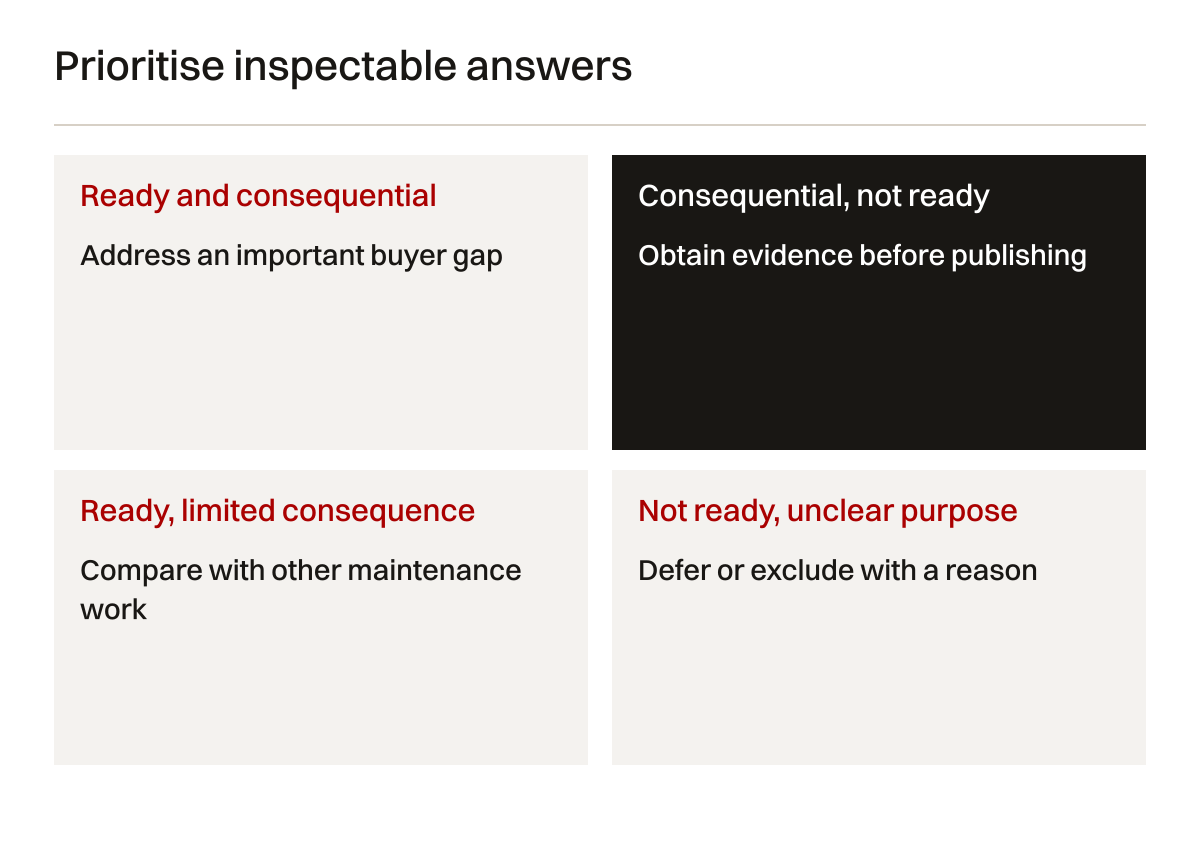
After the gates, compare buyer consequence, evidence readiness, existing page gap, maintenance cost and observed demand. Use scores as discussion aids, not objective truth. Write down the reasons that produced them.
A query that resolves a recurring qualification problem may deserve attention before a broad high-volume article. That is a strategic judgement. It still needs review after publication to see whether the expected task was served.
Keep urgency separate from opportunity
A safety-critical correction or withdrawn-service update can be urgent even with little search demand. Fix it because the current information is wrong. Do not require the content team to invent a traffic forecast to justify the work.
A promising new topic may have no urgent deadline. It can wait until a technical reviewer and useful example are available. Publishing an inaccurate answer early is not a sensible advantage.
Use a rolling backlog with three states: ready to publish, requires evidence, and excluded for a recorded reason. The states describe work readiness, not expected ranking positions. Include an owner and next review date so the backlog remains usable.
Demonstrate why raw traffic can mislead
The following invented example compares two page groups over the same period. It is designed to show why visits and suitable requests need different denominators. It is not a claim that narrow topics always outperform broad ones.
| Synthetic page group | Visits | Received requests | Suitable requests | Suitable requests per visit |
|---|---|---|---|---|
| Broad educational pages | 2400 | 24 | 3 | 0.125% |
| Specific capability pages | 400 | 20 | 8 | 2% |
| Combined | 2800 | 44 | 11 | About 0.393% |
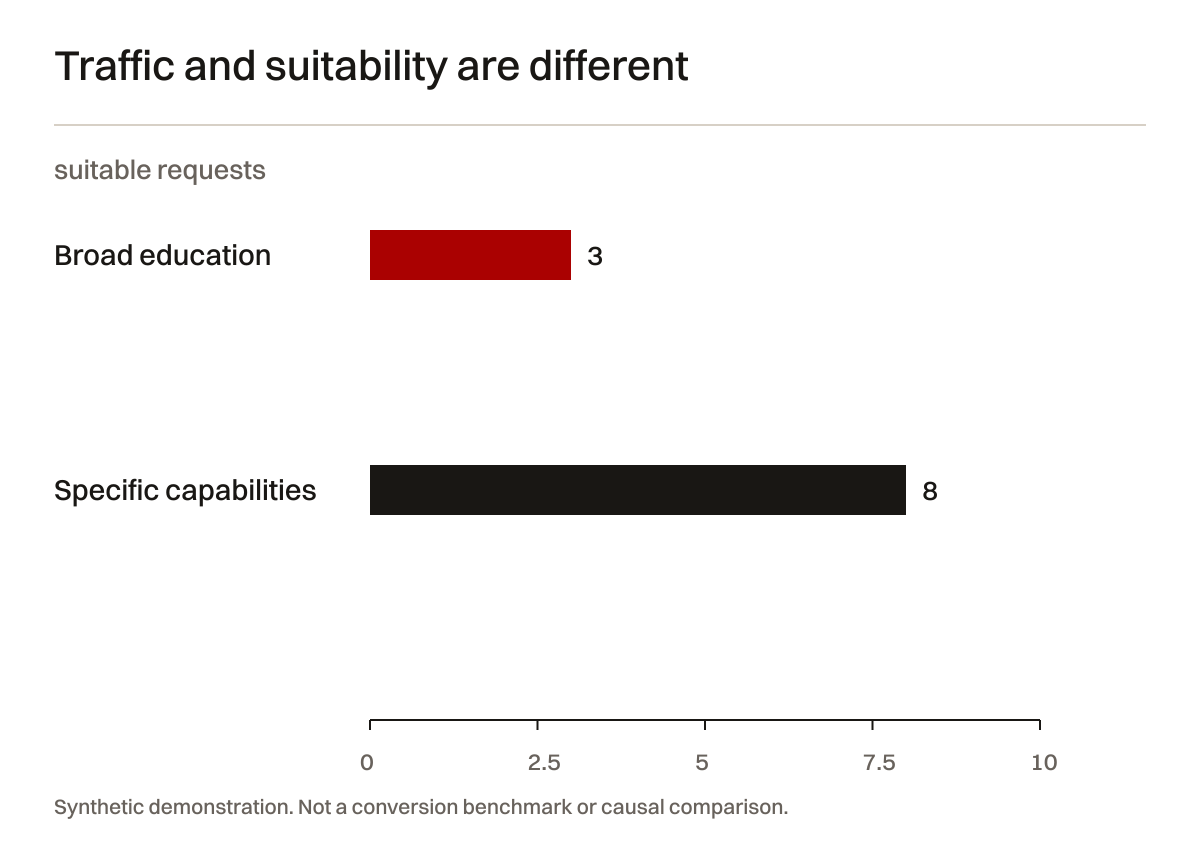
The broad group has six times the visits in this example. The specific group has more suitable requests. These counts do not prove that the specific pages caused the requests. They show why a traffic-only report can obscure the commercial question.
Define suitability before classifying the requests. Use actual service scope, region and requirement information. Do not call every unsuccessful sale an unsuitable lead. A genuinely suitable buyer can choose another provider. Keep qualification separate from closing performance.
Do not turn the example into a forecast
The two groups can differ in brand familiarity, existing-customer use and referral patterns. A visit may not represent a unique buyer. Attribution can miss earlier interactions. Those limitations matter when estimating future outcomes.
Use your own authorised records once available. Retain raw counts, classification rules and missing information. Report unknown suitability separately rather than quietly classifying it in whichever way makes the programme look better.
For a small B2B business, a handful of requests creates unstable rates. Review the actual requirements and use a sufficiently informative observation period. Do not multiply one month's rate by a keyword tool's volume and present the result as expected revenue.
Map questions to pages, not one keyword per URL
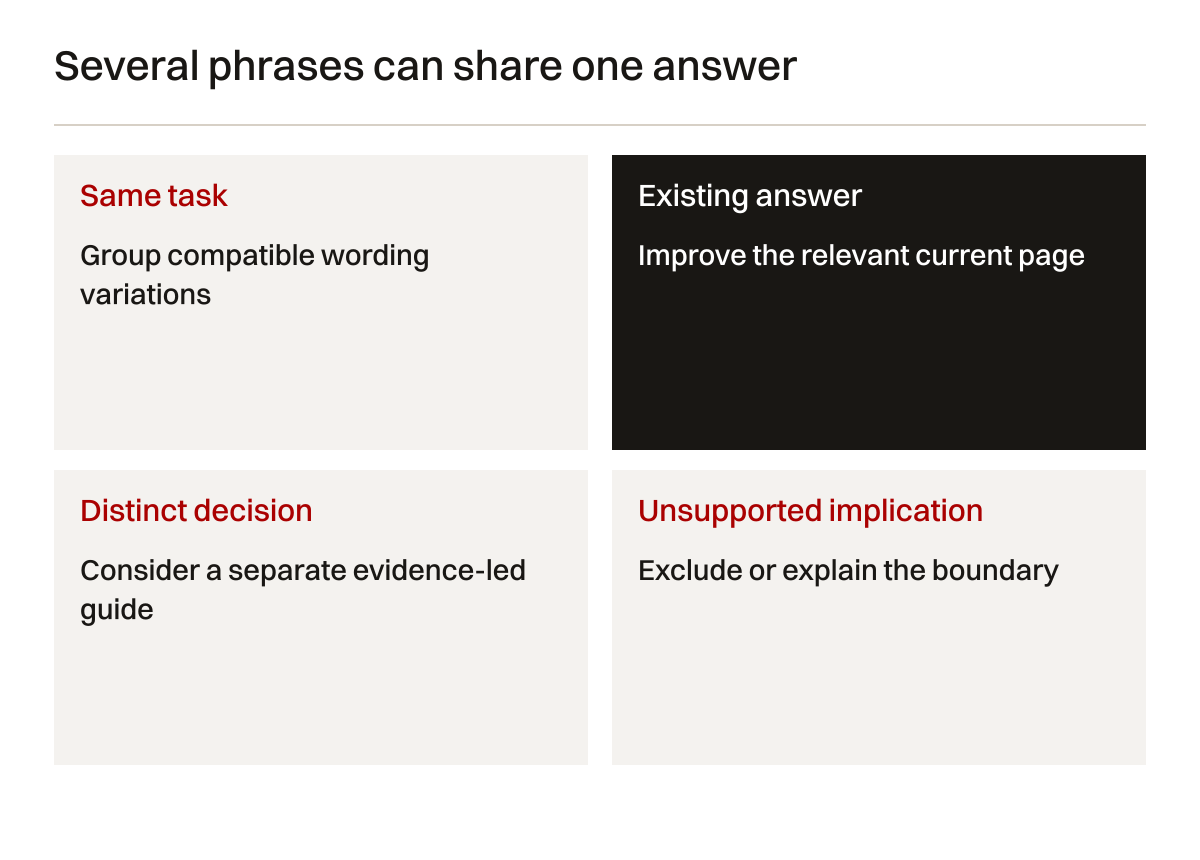
Group questions that share the same buyer task and answer. Different wording does not automatically need separate pages. A useful capability page can explain scope, prerequisites, exclusions and enquiry information together.
Separate a page when the audience, decision or required evidence genuinely differs. A buyer-selection guide and a detailed installation record may deserve different treatments. Their link should explain the relationship rather than repeat the same paragraph in both places.
Google's helpful-content guidance asks whether content provides useful information for its intended audience. Our page-map method is an editorial recommendation, not a published algorithm rule.
Resolve overlap before production
Write the proposed page's one-sentence purpose. Compare it with existing page purposes, not just titles. If both pages answer the same question with the same evidence and next action, explain why the new one is necessary.
Check existing impressions and received questions where authorised data exists. That can reveal useful wording missing from a page. It does not mean every visible query should become a heading. The page still needs a coherent reading order.
Keep a record of the chosen primary destination. This helps future writers avoid accidental duplication. A page may legitimately answer several related phrases. An editorial map should help people find the best answer, not mechanically allocate a separate address to every keyword.
Build a brief that a technical reviewer can challenge
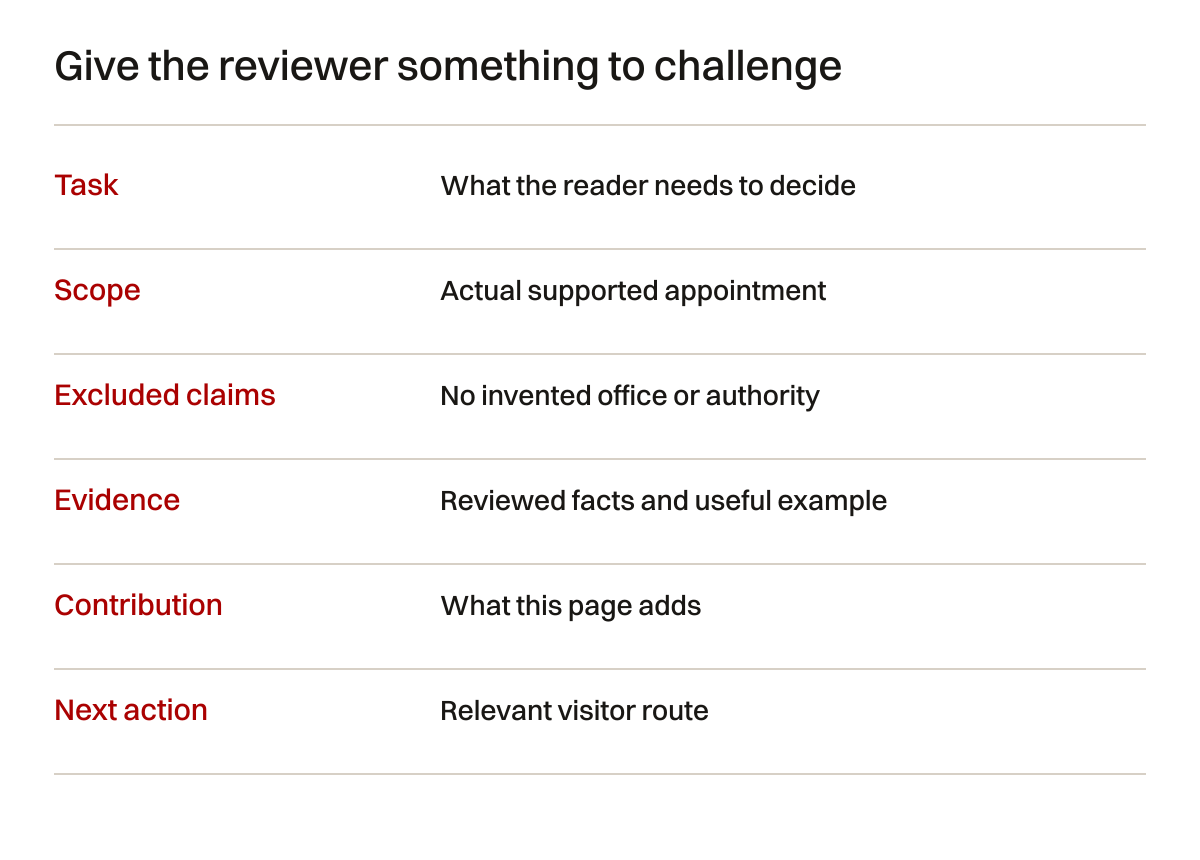
Include the reader's task, page purpose, supported service, excluded claims, evidence requirement, original contribution and intended next step. Add the query candidates with their status: observed, estimated or manually chosen.
The reviewer should be able to reject an inaccurate implication. A writer may choose a term because it reads naturally while a technical owner knows it means a regulated responsibility. Resolve that disagreement before publishing, not after a buyer points it out.
Require a reason for the visual
A diagram should explain a relationship the prose makes difficult. A chart should show data with units, source and limits. A product image should show the relevant item accurately. Do not add a generic industrial photograph and call it evidence of experience.
Keep the useful answer in accessible text. A query map shown only as an image can be hard to inspect and update. Provide descriptive alt text and a readable table or explanation where needed. The visual supports the argument; it does not replace the facts.
For anonymised examples, obtain approval and remove identifying details. If the example is invented, label it. A fictional procurement question can be instructive without pretending it came from a prestigious client.
Make page titles and previews accurate
Write a title that reflects the answer. Do not put an unsupported “best”, location or certification claim in metadata to attract the reader. Google's title-link documentation is a relevant implementation reference.
The snippet guidance describes how Google may use page content and metadata for result snippets. A meta description is not a guaranteed display instruction. It should still describe the page honestly.
Use important terminology naturally where it helps the reader. Repeating every variation makes scope less clear. A good title identifies the task; the article explains the conditions. Search-facing writing should not create a different promise from the visible page.
Connect the research to actual navigation
Link a useful article to the relevant capability page, approved evidence and appropriate assessment route. Use descriptive anchor text that explains where the reader goes. Google's link guidance supports meaningful, crawlable links.
Test the public path. A link to a scheduled article that is not yet public is a dead end for the reader. A redirect to an unrelated homepage also fails the task even if it returns a successful response. Inspect the destination rather than checking only that an address exists.
A broad educational page may offer a narrower next step without insisting every reader contact sales. Let someone who is not ready continue researching. A suitable business enquiry becomes easier when the surrounding information answers basic fit questions first.
Apply the method to three industries
For engineering, distinguish component purchase, professional advice and a defined design appointment. An illustrative phrase such as “pump sizing” can involve several meanings. Public content can explain required inputs and assessment boundaries without offering an unsupported calculation for every system.
For construction, separate residential repairs, commercial fit-out and specialist subcontract appointments. A generic company phrase can attract all three. The page needs the actual project type, responsibilities and limits before a volume estimate has practical meaning.
For marine, distinguish recruitment, recreational use, vessel maintenance and offshore equipment work. A broad term can conceal a different audience. Start with the actual service and operating arrangement, then inspect candidate wording. Do not use “marine” as a universal qualifier that makes any article commercially relevant.
These are planning examples, not industry keyword findings. Technical, regulatory and contractual questions need the responsible professional's review. A search strategist should not invent that authority to make the content plan seem comprehensive.
Use AI to organise candidates, not certify intent
AI can suggest wording variations or sort supplied questions into provisional groups. It does not know which services your company can safely provide unless you give it accurate information. Even then, a plausible categorisation needs review.
Require a separate evidence status for each candidate. Do not ask for “high-converting keywords” and accept a list as research. Without measured demand and observed buyer records, that phrase is a prediction dressed as a fact.
Google's generative-AI guidance calls for accuracy review. Its spam policies also describe doorway and scaled-content abuse. An AI tool does not make invented location pages or repeated low-value answers acceptable.
Check the output's commercial assumptions
Ask whether the proposed term implies a local office, urgent response, stocked product or formal approval the business does not offer. These assumptions often hide inside otherwise ordinary phrases. Correct the implication rather than merely rewriting the sentence.
Ask which existing page already answers the question. An assistant generating candidates without the content inventory cannot reliably make that decision. Provide a controlled inventory, then have the editor inspect the proposed mapping.
Finally, ask what original information the article adds. Rephrased public material may help organise a brief. It does not automatically justify another published page. The practical contribution could be a reviewed checklist, defined process or useful example within actual service scope.
Review commercial usefulness after publication
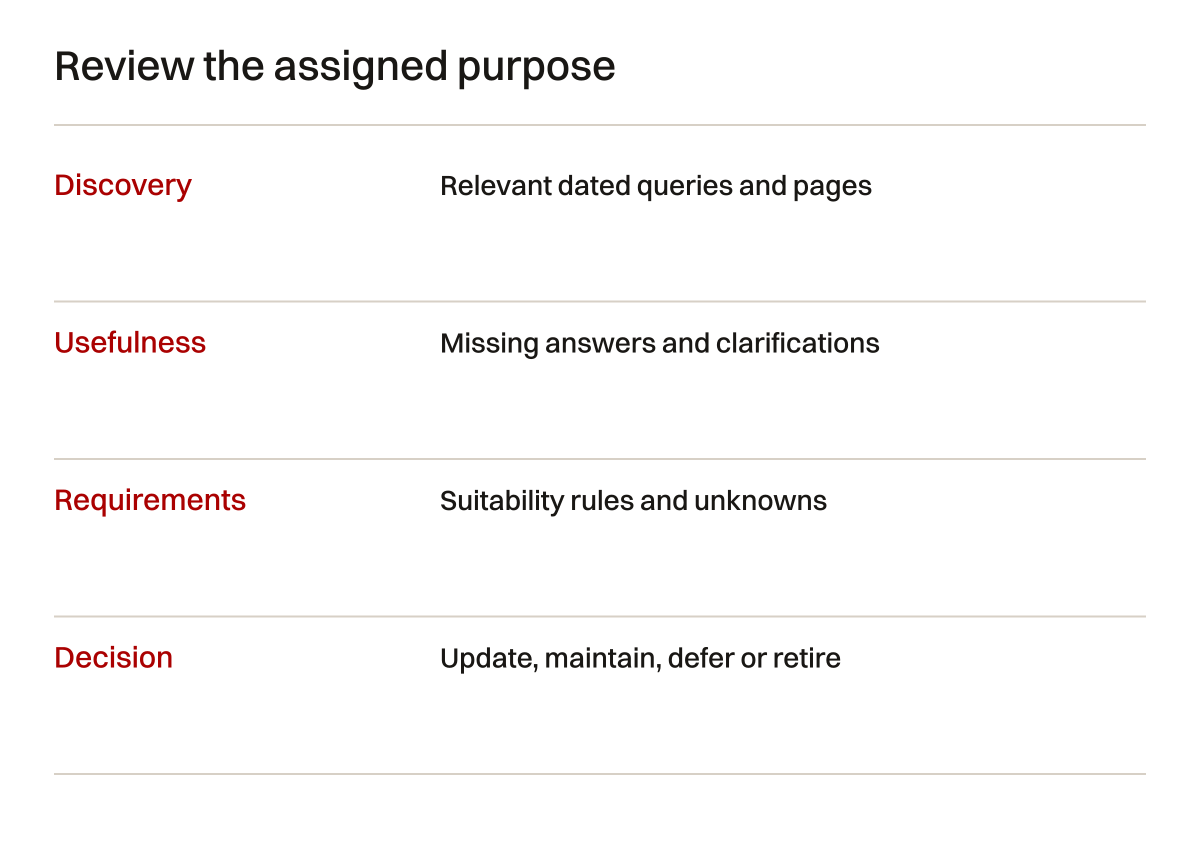
Use relevant page and query observations, not the entire domain's traffic. Google's Search Console introduction explains available performance breakdowns. Combine them with carefully defined website actions and received requests where permitted.
| Review question | Evidence to inspect | Possible action | Limit to state |
|---|---|---|---|
| Is the page discovered for relevant questions? | Dated page/query observations | Refine scope and explanation | Visible query data is not every search |
| Does the destination answer the task? | Page review and buyer clarification | Add missing verified information | Activity alone does not prove satisfaction |
| Are received requests suitable? | Approved classification and requirements | Improve qualification information | Missing source or suitability remains unknown |
| Is a broad topic crowding out useful work? | Backlog and review capacity | Reallocate editorial effort | Visits alone do not establish wasted value |
| Has the business scope changed? | Approved service records | Update or retire inaccurate claims | Search demand does not override business truth |
Set a review date and a useful decision. Do not declare a page successful because it ranks for unrelated wording. Do not delete a useful customer resource because it generates no new-business requests. Evaluate the purpose you actually assigned.
Work through an ambiguous brief
A fictional automation firm receives a request for a content plan around “factory automation”. The proposed list mixes general definitions, student project ideas, equipment catalogues, recruitment and implementation questions. No measured keyword dataset accompanies it.
The commercial owner first states the appointment: assessment and integration of specified production processes. The firm does not sell every component, provide coursework or recruit through this campaign. Those boundaries remove several candidate purposes without requiring a volume debate.
Next, the team anonymises recurring qualification questions. Buyers ask which process records are needed, how an existing line is reviewed and where the client's operations team must contribute. Those questions become candidate page tasks. They remain unmeasured search opportunities until evidence says otherwise.
The technical reviewer checks the wording. One proposed phrase implies an assurance the firm cannot make before inspection. The brief is corrected to explain inputs and assessment, not a guaranteed production result. A second candidate repeats the service page. That answer belongs in a service-page update rather than another article.
Choose a smaller, inspectable plan
The resulting plan contains an improved service explanation, a reviewed assessment-preparation guide and a maintained enquiry checklist. The team records why each exists and who approves it. It does not claim that three items will produce a fixed number of buyers.
The excluded phrases stay in the workbook with reasons. If the company later establishes a recruitment programme or sells components directly, those purposes can be reconsidered. Until then, they do not inflate an acquisition forecast.
After publication, the team reviews relevant discovery and received requirements. If buyers still misunderstand responsibility, the content needs correction. If enquiries remain sparse, the team checks demand assumptions and distribution rather than simply producing more variations of the same article.
This method does not eliminate uncertainty. It makes the uncertainty visible before money and review time are spent. The founder can see which work addresses a real question, which claim needs evidence and which attractive keyword has been excluded for a commercial reason.
Handle international demand without inventing local presence
A Singapore company can receive overseas requirements without operating an office in every target country. Describe the actual arrangement. A page aimed at Germany, France, Malaysia, Australia or the UK should explain a real difference where one exists, not merely change a country name.
Ask which buying conditions differ. Language, document requirements, communication hours, partner responsibilities and delivery boundaries can matter. Have the commercial owner confirm them. Do not infer a local arrangement from an overseas enquiry or an aspirational market list.
Research each relevant market with its own settings and vocabulary record. An English phrase used in Singapore may not represent how a German technical buyer describes the appointment. Translating a candidate does not establish demand. A local subject reviewer can check meaning while a search review checks observed wording and result context.
Preserve the difference between reach and fit
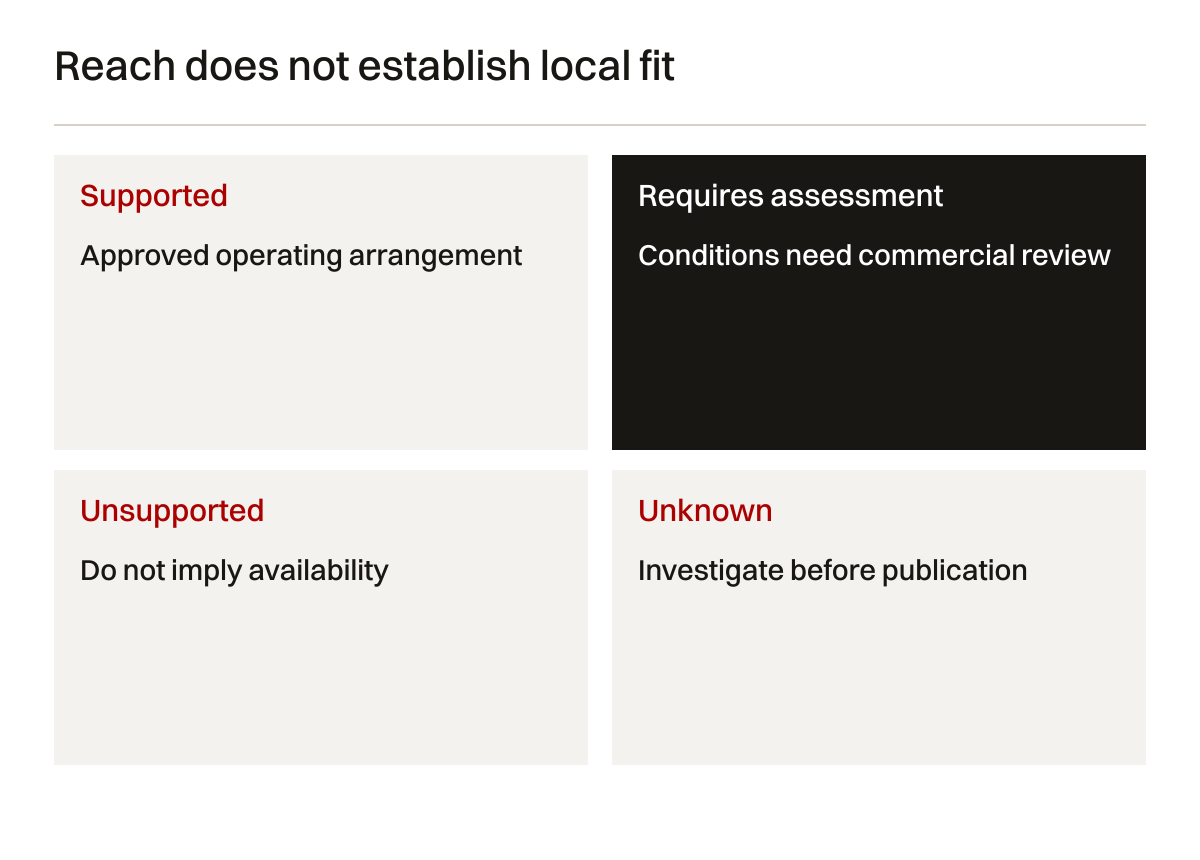
Suppose a fictional firm receives many visitors from a country it cannot currently serve. That observation may suggest interest. It does not automatically justify a dedicated sales page. The next business decision could be whether to establish a delivery arrangement, not whether to publish more local keywords.
Conversely, a firm may accept occasional overseas projects through a defined process. Its main service page can explain that process clearly. A separate page is justified only when it answers a genuinely distinct market question with maintained information.
Keep a market-fit column in the query map. Use values such as supported, requires assessment, unsupported and unknown. Define them from the business records rather than an analyst's optimism. An unsupported query can still merit a helpful clarification, but it should not be counted as an acquisition target.
Check the public promise at every entry point
Review the title, description, main answer, contact instructions and downloadable material together. A cautious body paragraph does not repair a title promising an unavailable local service. The whole visitor path must describe the same offer.
Record who reviews future changes. If an overseas partner arrangement ends, the affected pages and candidate keywords need review. Search demand is not an excuse to keep obsolete geographic claims active.
This record also helps a founder compare providers. One provider may propose dozens of country pages without evidence. Another may explain the actual delivery scope, identify a few unresolved market questions and recommend a bounded test. The second plan is less dramatic, but the reasoning is easier to inspect before production starts.
Questions to ask before approving the plan
Ask what makes each query a suitable buyer question. Ask whether demand was observed, estimated or not measured. Ask which existing destination already answers it and which responsible person approves technical claims.
Ask what would make the provider stop pursuing a topic. A plan without an exclusion rule can keep producing broad traffic indefinitely. Ask how maintenance effort was considered, particularly when product records or service arrangements change frequently.
For the broader scope of search work, see the B2B SEO and AI-search strategy guide. This article's narrower job is buyer-query qualification. It should not replace the technical, editorial and measurement responsibilities in a complete programme.
Start with the problem
If your keyword report looks impressive but the enquiries do not fit your work, bring the query map and qualification problem to Creatif Work. Our SEO service can begin with actual service boundaries, useful buyer questions and evidence requirements before recommending a publishing programme.
We will not call an invented phrase researched demand or promise sales from a volume estimate. The first discussion should identify what the plan is failing to explain and what needs checking. Start with the problem.