

SEO Retainer or One-Time Setup: What Actually Changes?

One-time SEO work can fix foundations and prepare important pages. Ongoing SEO is useful when the business, market, content and search results keep changing. A retainer should fund repeated decisions and implementation, not a monthly report that restates the same issues.
The right model depends on the size of the opportunity and who can do the work.
What is the difference between one-time SEO and an SEO retainer?
One-time SEO defines and fixes a bounded set of issues: measurement, crawling, indexing, page structure, metadata, redirects and priority content. A retainer continuously researches demand, improves pages, publishes useful content, reviews technical change and measures business outcomes.
| Work area | One-time setup | Ongoing programme |
|---|---|---|
| Technical | Audit and priority fixes | Monitor releases, errors and site change |
| Content | Map key pages and rewrite priorities | Research, create, consolidate and refresh |
| Internal links | Establish structure | Improve as new content appears |
| Measurement | Configure and baseline | Review quality, trends and decisions |
| Competition | Initial comparison | Track material market and result changes |
| AI search | Clear entity and service information | Expand evidence and answer new questions |
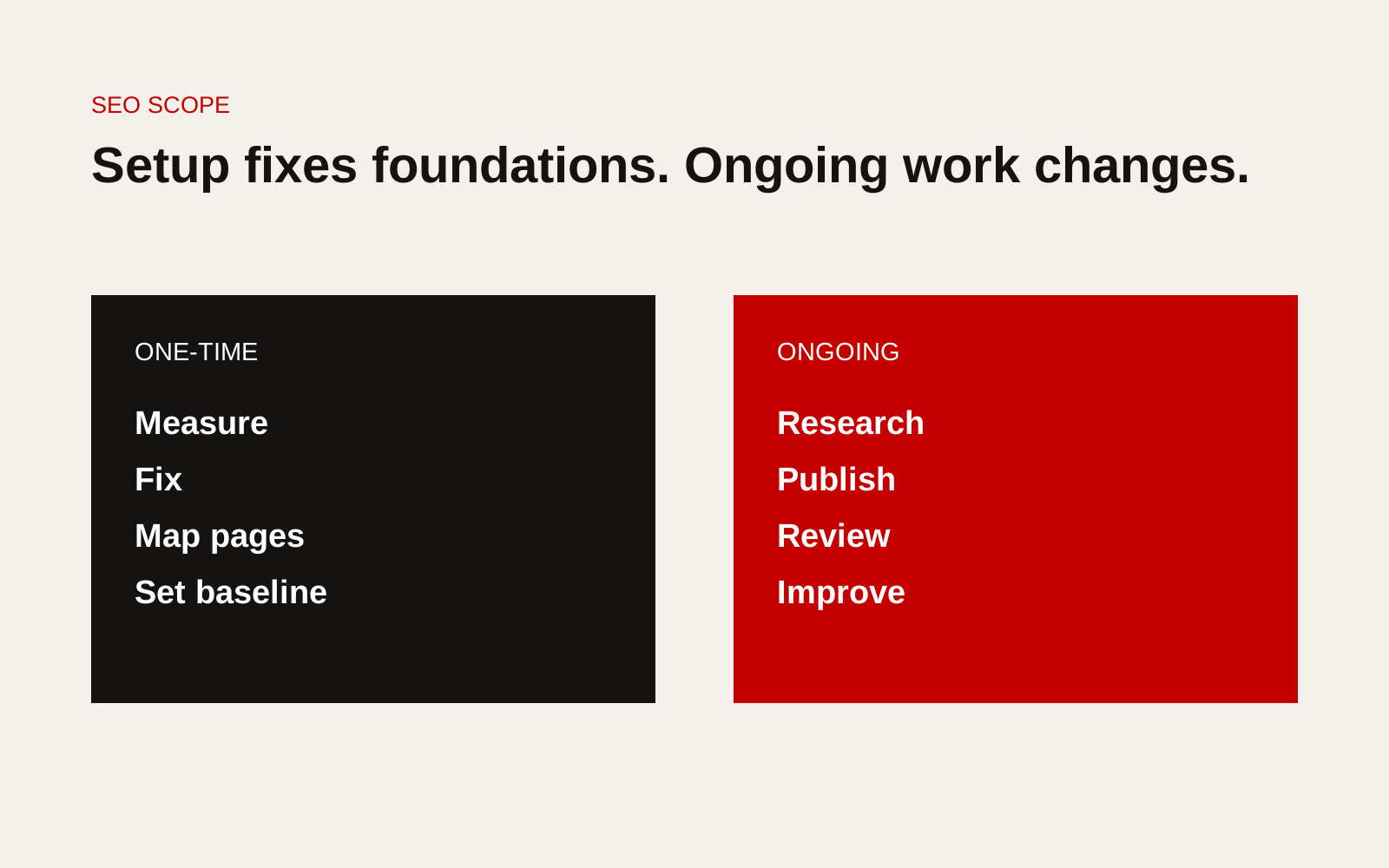
SEO work comparison showing one-time foundations and ongoing research, content, technical review, measurement and improvement.
When one-time work is enough
A fixed project may fit when the site is small and stable, key pages are missing basic structure, a migration needs search planning, the team can maintain content afterward, or a technical issue has a bounded fix.
The scope should include implementation or a clear owner. An audit alone creates no result.
When ongoing work is justified
Ongoing work may fit when buyers research many technical questions, the company serves several sectors or countries, products and regulations change, competitors publish actively, or internal teams need research and writing support.
A retainer should have a rolling plan and a way to stop low-value work.
Separate setup from recurring tasks
Define the first 60 to 90 days: analytics checks, technical priorities, buyer research, content inventory, page mapping and initial improvements. Then define the recurring cycle.
Avoid disguising a large initial project inside a low monthly fee or charging recurring fees for tasks that happen once.
Require implementation ownership
For every recommendation, name the implementer, reviewer and release date. SEO work may need developers, designers, technical experts and client approvals.
Google's Search Essentials set baseline technical and spam guidance. No provider can guarantee a ranking, indexing date or AI citation.
Measure business usefulness
Track priority-page visibility, qualified organic enquiries, assisted conversions, relevant downloads and sales feedback. Rankings can diagnose change but do not show whether traffic is commercially useful.
For content, review:
- target decision and searcher
- impressions and relevant queries
- engagement with evidence and next pages
- enquiry quality
- assisted sales use
- accuracy and update need
Define the recurring production system
An ongoing programme needs a workflow for research, briefing, expert input, drafting, fact checking, design, approval, publishing and later review. State expected volume only after the client time and evidence are understood.
Create a calendar that balances permanent service content, timely industry decisions and updates to existing pages. New articles should not crowd out fixing an important service page.
Include technical change review
Product releases, navigation changes, migrations, consent tools and third-party scripts can affect crawling and measurement. The retainer should state whether the SEO team reviews planned releases and who implements fixes.
Keep a change log beside analytics. It helps distinguish the effect of site work from market demand, seasonality or search-system changes.
Use an exit and handover plan
The client should retain access to analytics, search tools, research, briefs, content, dashboards and accounts. At the end, provide current priorities, unresolved issues, measurement notes and content review dates.
A useful ongoing service should leave the organisation with better records, not dependence on a private dashboard.
Include AI visibility without creating a separate fiction
AI systems also need clear company, service, product and evidence information. The work overlaps with good technical SEO and content: crawlable pages, direct answers, source-backed claims, consistent entities and useful internal relationships.
Do not pay for mass synthetic articles presented as AI SEO. A smaller set of maintained expert pages is safer and more useful.
Compare proposals on outputs and decisions
Ask providers to state:
- initial scope and deliverables
- ongoing activities and likely volume
- research and review process
- client inputs and approval time
- implementation ownership
- reporting and meeting cadence
- tools and account ownership
- content rights and handover
- success measures
- cancellation and transition process
Decision checklist
- Search opportunity tied to business goals
- One-time technical and content gaps identified
- Internal implementation capacity known
- Ongoing research or publishing need evidenced
- Retainer has a rolling priority plan
- Reports lead to decisions and actions
- No ranking or AI inclusion guarantees
- Content quality and expert review defined
- Accounts and data remain accessible
- Results reviewed against qualified demand
Ask for a 90-day operating plan
Before agreeing to ongoing work, request the first 90 days in operational terms. The plan should list the decisions to make, pages to improve, research to complete, technical risks to resolve, responsible people and the measure for each item. It should also state what the client team must provide.
At the end of each month, review completed changes rather than a report alone. Confirm what was published, what was measured, what was learned and what will change next. Separate delayed implementation from weak recommendations so responsibility remains clear. If the same audit finding appears for three months without an owner, the retainer is not functioning as an improvement system. A useful provider should also explain when recurring work is no longer justified, how accounts and source files will be handed over, and which maintenance tasks the internal team must continue.
Creatif Work provides SEO and AI visibility services tied to the website, content and evidence system. We also design websites, which means recommendations can be implemented in the structure and templates rather than left in an audit document.