

QLASSIC and SHASSIC Evidence for Malaysian Contractors
QLASSIC and SHASSIC are different assessment systems. Malaysian contractors should publish each result with its project, assessment basis, date and scope instead of combining scores into a general claim about quality and safety.
The buyer must be able to tell which project was assessed, what the result refers to and whether the evidence is relevant to the work being procured.
What evidence should contractors show for QLASSIC and SHASSIC?
Show the assessed project, location, contractor role, building or work scope, assessment date, score or result as officially recorded, assessing body, applicable standard or method and a link or route to verification.
CIDB Malaysia describes QLASSIC as a system for measuring and evaluating workmanship quality based on the relevant construction quality assessment standard. CIDB's SHASSIC information covers safety and health assessment in construction. Check current programme rules directly with CIDB before applying or publishing a procedural claim.
| Evidence field | QLASSIC | SHASSIC |
|---|---|---|
| Project identity | Name, location and building type | Name, location and work stage |
| Contractor role | Main contractor or stated scope | Employer or contractor scope assessed |
| Assessment basis | Current applicable quality standard | Current safety and health assessment method |
| Timing | Assessment date and completion context | Assessment date and project stage |
| Result | Official score or recognition | Official score or recognition |
| Public claim | Workmanship evidence for that project | Safety and health system evidence for that assessment |
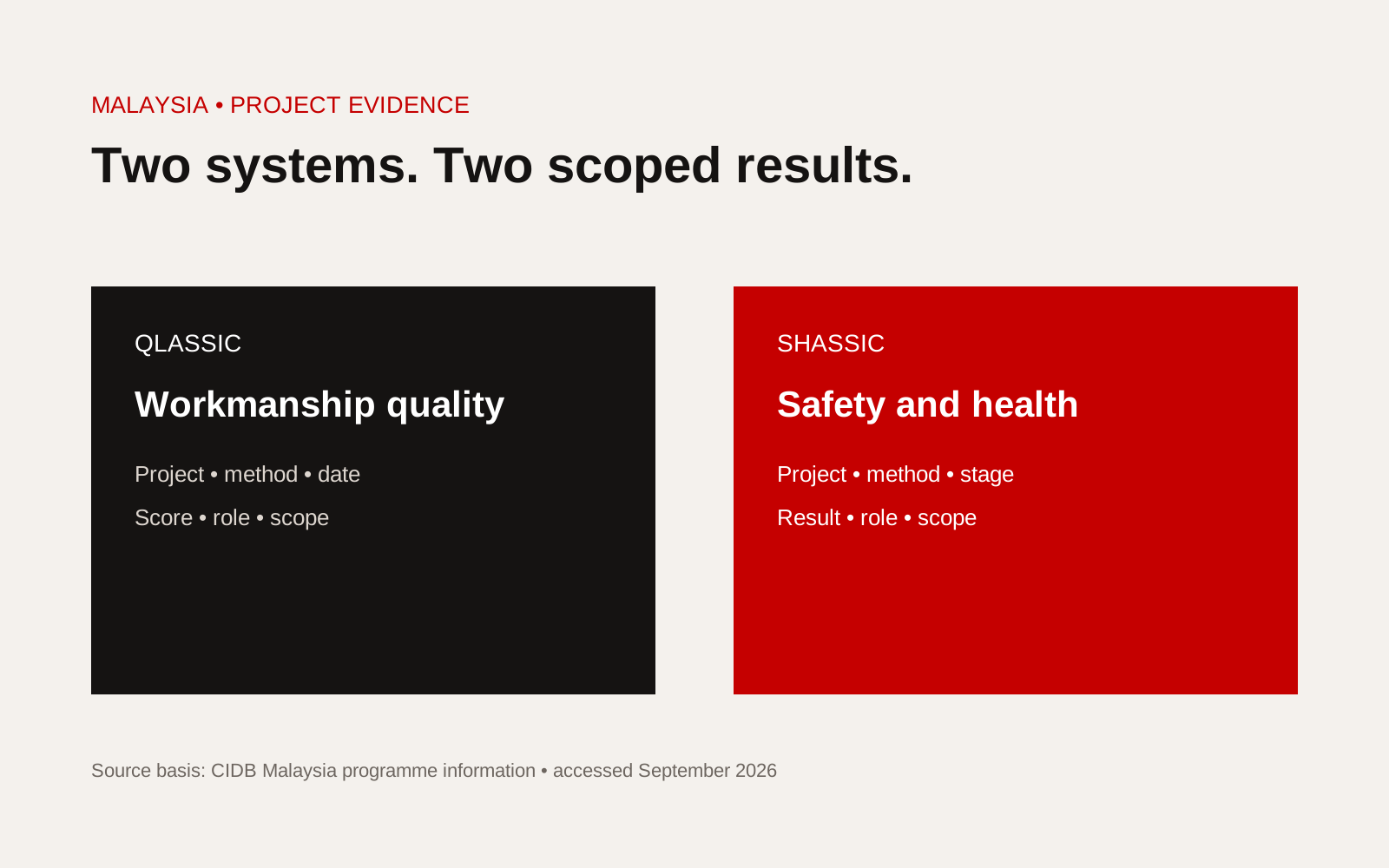
QLASSIC and SHASSIC project evidence map separating quality workmanship and safety and health assessment records.
Keep project context beside the result
A score without context is difficult to compare. State the project type, size where approved, construction stage, contractor role and date. If a company uses a project delivered by a joint venture, explain the entity and role.
Do not turn one assessment into a company-wide performance claim. A result supports the named project under the stated method.
Store the source record
Create an evidence record containing:
- official project name and internal ID
- client and publication permission
- contractor and joint-venture entity
- assessment application and correspondence
- standard or method version
- assessment date and assessor
- official result or certificate
- approved public wording
- expiry or review date if applicable
- owner responsible for corrections
The website, tender library and capability statement should draw from this record rather than separate copies.
Explain what the systems do not prove
QLASSIC evidence does not replace product certification, design compliance, testing or client acceptance. SHASSIC evidence does not replace the project safety management system, statutory duties or current performance records.
Use the assessment as one layer in a wider evidence set:
- company systems and current certification
- project-specific planning and controls
- independent or programme assessment
- inspections, tests and corrective action
- approved project result
Connect the score to working practices
A case study should explain what the team did, not only display the result. For quality, this may include mock-ups, inspection hold points, trade sequencing, sample approvals and defect close-out. For safety and health, it may include planning, supervision, worker engagement, site controls and review.
Avoid claiming that one practice caused the score unless the assessment and project records support that conclusion.
Make comparisons honest
Before comparing projects, confirm that the same assessment method, scope and stage apply. A newer standard, different building type or different timing can change the meaning.
Use a table:
| Project | System | Method/version | Date/stage | Result | Contractor role |
|---|---|---|---|---|---|
| Approved name | QLASSIC or SHASSIC | Official basis | Assessment context | Official record | Exact role |
Do not rank teams publicly unless the comparison is valid and approved.
Connect the assessment to tender answers
Use the result where it answers a criterion: workmanship history, site safety and health management, or project improvement. Include the project context rather than dropping the score into the company profile.
When a questionnaire asks for company-wide performance, provide the appropriate set of projects and explain the boundary. Do not select one high score as representative without stating the selection.
Prepare the site team before assessment
Evidence quality begins during delivery. Assign document owners, keep inspection and corrective-action records current, and ensure the project team understands the assessment scope. Do not assemble a parallel file that differs from the records people use.
After assessment, record findings, actions and lessons even when the final result is strong. This gives the next project a practical improvement plan rather than only a badge.
Review public use with CIDB requirements
Confirm current rules for naming, logos, certificates and result verification before publication. If CIDB updates a method or portal, revise instructions and links. The contractor's technical and marketing reviewers should approve the same public wording.
Publication checklist
- QLASSIC and SHASSIC are described separately
- Project and contractor entity are correct
- Method or standard version recorded
- Assessment date and stage visible
- Score matches the official record
- Claim is limited to the assessed scope
- Client and programme marks approved for use
- Supporting practices come from project records
- Old or superseded results remain clearly dated
- Website and tender copies use one source record
Build a score publication record
Create one short internal record before a QLASSIC or SHASSIC result appears online. It should state the project, assessed scope, assessment date, official score or result, source document, approving person and exact public wording. Add a review trigger for any correction, appeal or change in project naming.
The record should also answer three practical questions. Can the result be matched to the correct legal entity? Does the page make clear whether the score covers the whole project or a defined assessment? Would a buyer understand why the result is relevant without assuming it guarantees future performance? If any answer is no, add context before publication. Keep the official document in the controlled evidence library and link the public claim to that record internally. This makes later tender checks faster and reduces the chance of a score being copied into a new page without its original boundary.
Creatif Work builds construction websites where assessment results sit beside the project evidence that gives them meaning. Our website service can turn QLASSIC, SHASSIC and other controlled records into consistent public pages, while our guide to Malaysian engineering supplier evidence covers a related approach to scoped credentials.