

Taking Over Website Maintenance From Another Provider

A website maintenance takeover is complete when the receiving team can perform the agreed work with verified access, usable material and known dependencies. A password list is only one input. Before ending the old arrangement, inspect ownership, exports, recovery, licences, open faults and the visitor journeys that must continue working.
The website is live. The old provider says the handover is ready. The new provider has a CMS login but cannot find the hosting account, source repository or renewal contact. An enquiry form depends on a service billed to the outgoing team. Support can change hands on paper while the actual operating dependencies remain unresolved.
This guide is about that transition. It is distinct from regular maintenance after launch. It does not assume the outgoing provider has acted poorly or that every takeover requires a hosting move. All examples are fictional. Generated photographs illustrate handover work and do not document a real transition, recovery or client result.
Download the provider-transition workbook or editable CSV registers. Both are ungated. The five web tables provide the working structure. Keep credentials, recovery codes and private customer data in an appropriate private system rather than these public examples.
Establish the authority to hand over the website
Begin with the authorised business owner. Confirm who can request access, approve a transfer, accept remaining issues and end the existing arrangement. A staff member who edits pages may not have authority to change billing or ownership. A provider who holds administrator access may still need a director's instruction before transferring an account.
Review the actual agreement and delivery records privately. Identify rights to code, design files, photography, fonts, templates and licensed extensions. Technical possession and legal permission are different questions. A folder can be downloadable while its contents cannot be reused under the proposed arrangement. Record unresolved rights without guessing what the contract means.
Agree the transition scope in plain terms. Is the receiving provider taking over content edits, releases, hosting support, enquiry checks or all those tasks? Does search work continue with the same team? Does the outgoing provider retain an unrelated application? A maintenance takeover should not accidentally become a domain, email and customer-record migration.
Set the communication route with the business. The new provider can prepare a request list and evidence checklist. Contacting the outgoing provider or other account owners still requires the agreed authority. Keep the request specific and factual: which system, what access or material, who should receive it and how acceptance will be checked.
Inventory systems before collecting files
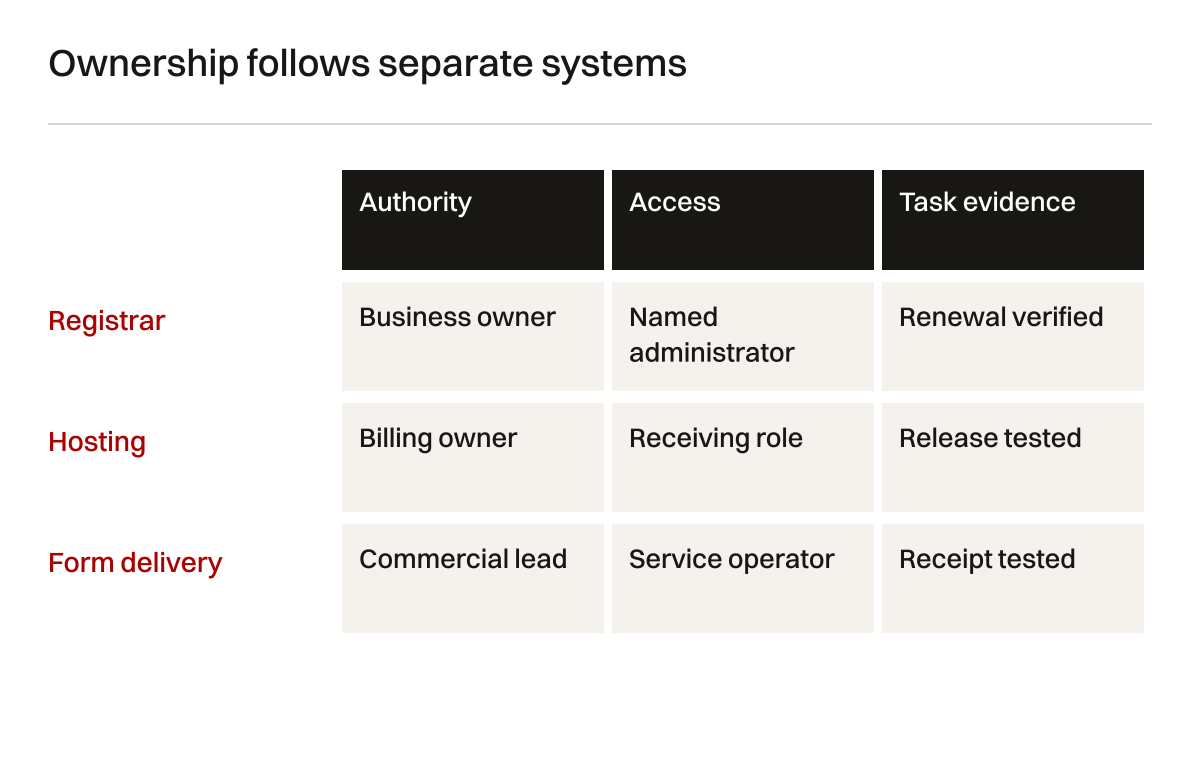
Map the domain registrar, DNS manager, hosting platform, CMS, repository, asset storage, form delivery, analytics and search accounts. Add licences, scheduled tasks and third-party integrations. Many transitions fail because the visible website is treated as the whole system while a small external dependency carries a critical visitor task.
Table 1: system inventory for the transition. The categories are examples. Include only systems actually used by the website.
| System | Business owner | Current working owner | Evidence required |
|---|---|---|---|
| Domain registrar | Authorised business owner | Account administrator | Account, renewal and recovery route verified |
| DNS | Named business authority | DNS administrator | Current records and change authority |
| Website hosting | Business billing owner | Hosting administrator | Project access and billing continuity |
| CMS and content | Website owner | Editors and administrators | Named roles and usable content access |
| Source and assets | Contractual rights owner | Developer or designer | Repository, files and permissions |
| Enquiry delivery | Commercial operations | Form and mail service owners | Tested receipt and dependency ownership |
Document where each dependency actually sits. The domain may be registered with one provider, DNS served by another and website hosted by a third. Email can remain separate. A transfer of one does not automatically transfer the others. This is why the new provider needs a dependency map before proposing a move.
Record the installed platform and relevant versions without treating the list as a health certificate. A current plugin may still be misconfigured. An older version may need careful compatibility work. The takeover assessment should identify conditions and open decisions, not imply that a version inventory proves the website is maintained.
Distinguish available material from usable material
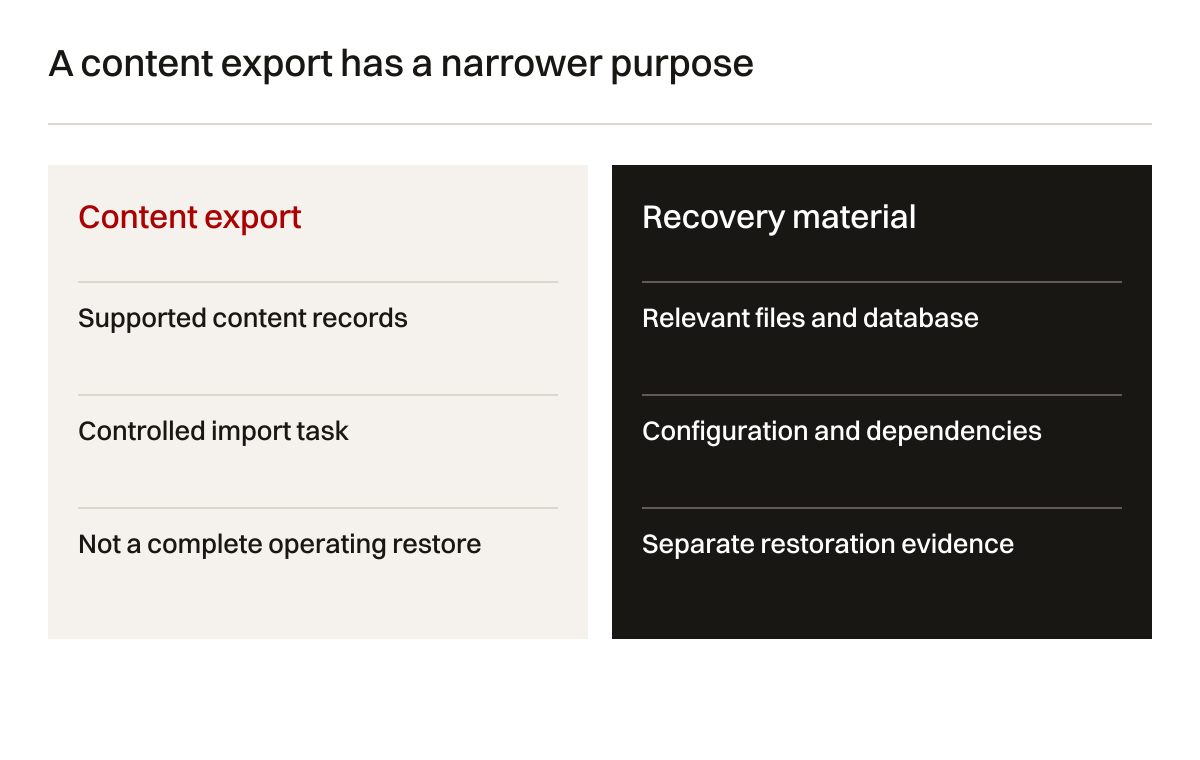
A handover file list can look reassuring while containing the wrong kinds of material. A CMS content export is different from a database backup. A repository may contain source but omit deployment settings. A screenshot of a page is not its editable design file. Keep a separate description of what each item enables the receiving team to do.
For WordPress, the Tools Export documentation describes the WXR content export. It is useful for particular content transfers. It is not, by itself, proof that a complete operational website can be restored with its themes, plugins, configuration and external dependencies.
The WordPress backup handbook distinguishes database and file material for a typical full restoration. Check the actual website's structure. Upload storage, custom code, scheduled jobs and services outside WordPress may need separate records. The platform's standard backup advice cannot identify every custom dependency for you.
Table 2: available versus usable handover material. The receiving team should inspect the actual item before marking the corresponding task complete.
| Material received | What it may support | Additional question | Acceptance evidence |
|---|---|---|---|
| CMS content export | Importing supported content | Are media and custom fields usable? | Controlled sample import |
| Database and file copies | Restoring website state | Are configuration and external dependencies covered? | Separate controlled restore |
| Code repository | Editing and rebuilding source | Are required settings and permissions available? | Reproducible build and release route |
| Design source files | Editing approved visual assets | Are rights and fonts available? | Open and edit permitted source |
| Account invitation | Access to a system | Does the role permit agreed work? | Named task completed with that role |
| Operating notes | Understanding procedures | Are instructions current and testable? | Receiving team performs the task |
Keep versions and dates beside copies. A backup taken before a recent form change may restore older behaviour. A repository branch may not match the public website. A design file may predate the current identity. The item exists, but its relationship to production remains an evidence question.
Do not ask the old provider to export everything without a purpose. That can create unnecessary private-data exposure and leave the new team with a large unclassified archive. Define the records needed for the agreed work, the permitted storage route and the person who approves receipt. Personal mailbox exports are not a normal website takeover requirement.
Verify access through actual tasks
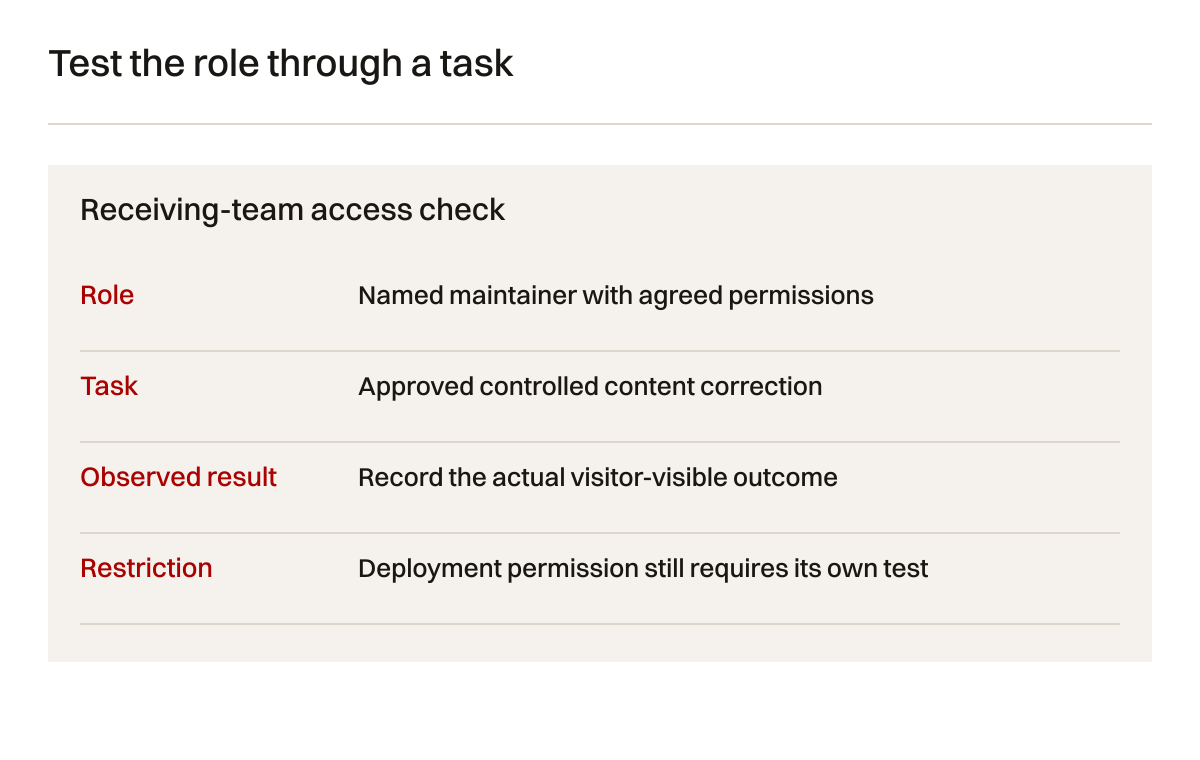
An invitation email proves an invitation was issued. A successful sign-in proves one account could enter. Neither proves the role can perform the agreed maintenance work. Test a small permitted task in each important system. Record the task, role, date and any restriction. Do not put passwords or recovery codes in the evidence register.
WordPress roles and capabilities describe the standard role model. Match access to actual responsibilities. An editor can perform many content tasks without needing administrator authority. A developer handling plugin and release work may need different permissions. Custom roles and multisite arrangements require inspection rather than assumptions.
For a code-based website, verify repository access, deployment access and the environment configuration route separately. The receiving developer may be able to read source while unable to deploy the correct project. Conversely, deployment access without source can leave the team unable to reproduce a release. Both cases should appear as named limitations.
Where a GitHub transfer is relevant, consult the official repository transfer instructions. Ownership and permissions affect eligibility and behaviour. A repository transfer is not the same as providing a copy of the code. Review associated automation and external services before declaring the operating handover complete.
Where a Vercel project transfer is relevant, use Vercel's transfer documentation for the actual project arrangement. Account, team and integration conditions can matter. Check the public domain and release route after the transition. Do not promise universal portability merely because a transfer control exists.
Inspect the current website before changing it
Record a baseline of the important visitor journeys. Include service pages, contact forms, downloads, relevant language routes and any protected area within scope. For a store or booking system, the scope may require additional critical tasks. Agree those explicitly rather than assume every maintenance provider can test every commercial workflow.
Open public pages in ordinary browser conditions. Check the mobile enquiry route and linked files. An authenticated administrator can see different content from a public visitor. A cached page can behave differently from the editor preview. The baseline should represent the visitor tasks the business depends on.
Record current faults honestly. A broken download found during takeover did not necessarily begin during the transition. A slow page may be an existing condition. Keeping the baseline prevents later disputes about what changed and gives the receiving team an ordered backlog. Do not use the assessment as an opportunity to make unsupported accusations about the previous provider.
The outgoing team may know exceptions that are absent from the files. Ask about manual deployment steps, licence dependencies, unusual form routing and known unsupported features. Record them as inspectable claims and test important ones. A verbal explanation is useful context, but the new team's ability to operate the site still needs verification.
If the website uses WordPress, check proposed update work against the official updating guidance. Do not perform broad updates simply to make the takeover look active. First preserve recovery material and understand dependencies. A rushed platform change can obscure the baseline you need to evaluate the handover.

Generated illustrative photograph. The drive and checklist do not establish an actual backup or successful restoration.
Prove recovery in a separate controlled environment
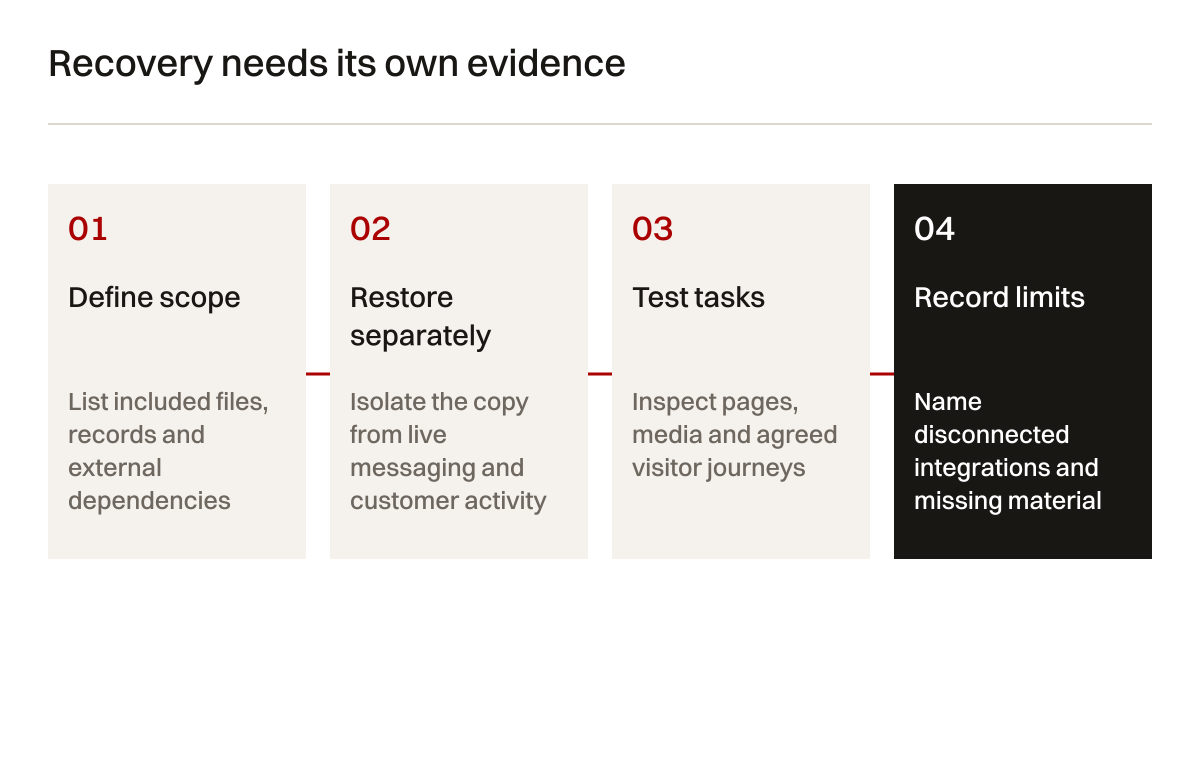
Define what the restored website should include. Files and records are necessary inputs for many platforms, but the functional result may also depend on domains, external storage, licence activation or enquiry services. Some dependencies should remain disconnected in a test environment to avoid sending real messages or altering live records.
Use a controlled restoration that protects live operations. Mark test data clearly. Review public access and indexing. Confirm that a test copy cannot be mistaken for the live website or become an unintended source of customer enquiries. The receiving provider should document these conditions before starting the exercise.
Test the recovered visitor tasks that are meaningful in that environment. A page opening is useful evidence but does not establish complete recovery. Check media, navigation and representative content. For forms, use an approved test destination or otherwise isolate delivery. For external integrations, name what was tested and what remains disconnected.
A fictional takeover receives a file archive and database dump. The receiving team restores them to a separate environment. Public pages work, but an upload depends on an old external-storage account. The restore is partly successful. The correct report identifies the missing storage dependency rather than announcing that recovery is complete because the homepage loads.
Keep the recovery procedure usable by another authorised person. Record the copy date, included components, dependencies, test conditions and result. Store sensitive settings privately. The public workbook only carries references to that material. The aim is a repeatable operating task, not a collection of screenshots with no instructions.
Allocate responsibilities through the transition
The business approves facts and authority. The outgoing provider supplies agreed material and identifies relevant dependencies. The receiving provider inspects and tests what it receives. Those responsibilities overlap but are not interchangeable. A new maintainer cannot approve the business's licence rights or rewrite its existing contract through technical work.
Table 3: transition responsibilities. Adapt these roles to the actual agreement and account model.
| Decision or task | Business role | Outgoing role | Receiving role |
|---|---|---|---|
| Scope and authority | Approve requested transition | Confirm appropriate contact | Prepare concrete request and tests |
| Files and rights | Resolve permitted use | Provide agreed source material | Inspect editability and dependencies |
| Account access | Authorise business ownership | Assist permitted transfer | Verify role through named tasks |
| Baseline defects | Accept known priorities | Explain existing exceptions | Record observed current conditions |
| Recovery test | Approve test boundaries | Supply agreed copies | Restore and document limits |
| Closure | Accept evidence and exceptions | End agreed responsibilities | Confirm operating ownership |
Set a single register for open questions. Each item needs an owner, consequence and next decision. “Access pending” is incomplete. “Receiving developer cannot deploy because project membership is missing; business owner to authorise invitation” is actionable. Avoid allowing several providers to assume another team is handling the same gap.
Keep ordinary maintenance separate from transition repair. A takeover may reveal work that belongs in a later improvement project. Name it and agree whether it blocks acceptance. If a download is essential to quotation requests, it may be a blocker. If a rarely used design asset is unavailable but the business accepts the limitation, it may remain an open issue.
Move billing and licences deliberately
Identify who currently pays each recurring charge. The visible hosting invoice may exclude email delivery, storage, premium themes or a domain renewal. The receiving provider needs a complete dependency view before the old account is cancelled. Do not assume a software licence owned by an agency can be transferred to the client.
For every service, agree whether it stays, transfers or is replaced. Check the actual vendor terms and account controls. A replacement can change behaviour even if the website looks identical. An email-delivery change needs message tests. A storage change needs upload and download tests. A licence replacement may affect updates rather than immediate page rendering.
Avoid invented prices or universal transition costs. The useful cost record identifies the component, billing owner, renewal trigger and decision. Actual charges depend on the chosen vendor arrangement. A provider can explain those components without publishing a fixed package or implying that every website has the same operating needs.
Sequence cancellation after acceptance of the dependency it supports. A successful invitation does not justify deleting the old account if recovery copies or routing still depend on it. Some services cannot run in parallel under the proposed licence. Record that constraint and agree a controlled replacement path rather than promise zero interruption.
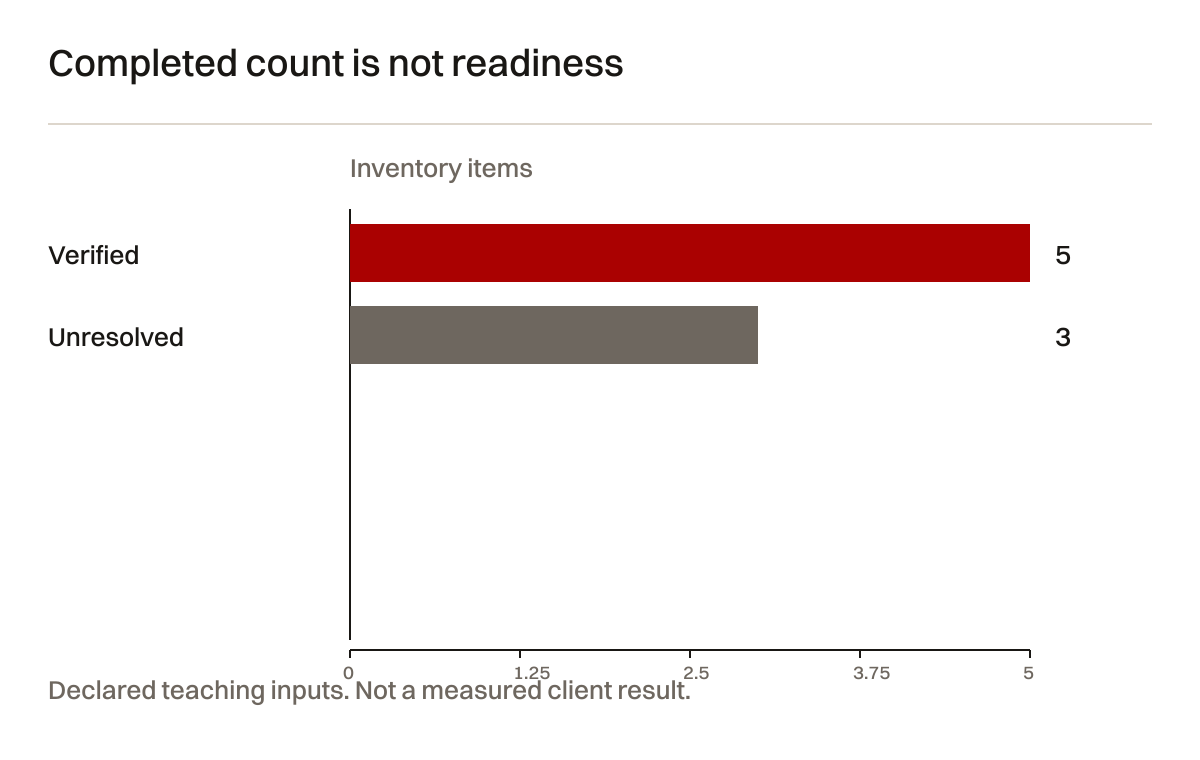
The chart uses a fictional eight-item inventory. Five items have evidence of the agreed task; three remain unresolved. Five divided by eight is 62.5%, but that percentage does not establish takeover readiness. If the missing item is production deployment authority, the consequence can outweigh several completed low-risk records. The dataset illustrates reporting limits, not a client handover result.
Set acceptance around the work that must continue
Acceptance should identify tasks the receiving team can perform, the evidence retained and the conditions of the tests. A signature saying “handover complete” is too broad unless it points to those records. Agree critical tasks before the transition so the test does not change after the old arrangement ends.
Table 4: takeover acceptance tests. These are suggested checks. Additional commercial workflows require their own agreed scope.
| Test | Required condition | Evidence to retain | Limit to record |
|---|---|---|---|
| Access | Named receiving role can perform agreed task | Task, account role and date | Untested permissions remain unknown |
| Release | Receiving team can produce controlled change | Release reference and visitor check | Future updates need new tests |
| Recovery | Agreed material restores controlled site | Included parts and results | Disconnected integrations remain unproved |
| Enquiry | Fictional request reaches intended owner | Confirmation and received record | No real customer outcome implied |
| Document | Current file opens with correct context | Actual file and public address | Outside copies may remain stale |
| Ownership | Billing and operating authority are agreed | Named owner and private references | Contract questions need resolution |
If the takeover changes public URLs or domains, use a separate migration scope. Google's site-move guidance applies to URL changes. A provider change that keeps addresses and content stable is different. Do not apply broad redirects just because support has changed hands.
Search responsibility also needs a clear handover. Preserve authorised Search Console and analytics access where relevant. Explain which previous observations and definitions are available. A new maintainer inheriting hosting does not automatically inherit the monthly search analysis. The earlier maintenance and SEO guide explains that operating distinction.
Handle unresolved exceptions before ending support
Some material may be genuinely unavailable. A designer may have used a licensed font that requires a new account. A custom integration may have no current documentation. A former staff member may still be the recovery contact. Record the precise gap and what it prevents. Avoid treating “not available” as either automatic failure or automatic acceptance.
Table 5: open risks and decision ownership. A business owner can accept a named limitation only after its practical consequence is understood.
| Gap | Consequence | Safe next action | Decision owner |
|---|---|---|---|
| Missing deployment authority | Receiving team cannot release changes | Resolve role or transfer eligibility | Authorised business owner |
| Unknown form service billing | Delivery may stop after cancellation | Identify account and test replacement | Commercial operations |
| Incomplete recovery material | Website cannot be fully restored | Obtain missing dependency or define limitation | Website owner |
| Unclear asset rights | Reuse or editing may be restricted | Review actual licence or agreement | Business rights owner |
| Undocumented custom task | Support relies on one person's memory | Observe and write a repeatable procedure | Operating lead |
| Open technical defect | Important visitor journey may fail | Prioritise repair and retest | Business and receiving provider |
Separate repair from evidence gathering. If the new provider has not yet inspected a dependency, the issue is unknown, not necessarily broken. If a controlled test fails, the issue has evidence. If the business approves deferral, record the consequence and review trigger. Those states help the team make practical choices without overstating certainty.
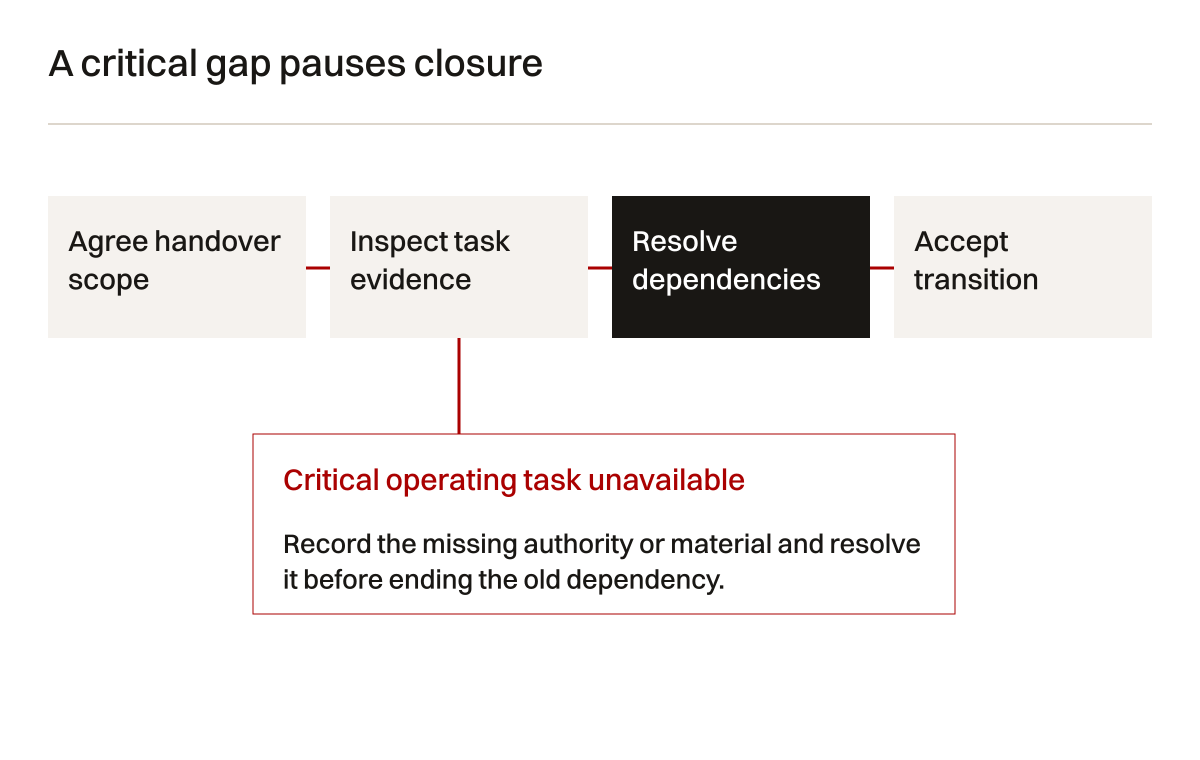
Work through a fictional maintenance takeover
The business initially requests a provider change without moving the website. Its owner authorises access inspection and a request for agreed material. The receiving provider maps registrar, DNS, hosting, CMS and form delivery. It finds that website hosting is business-owned, while form delivery uses an outgoing-provider account.
The old provider supplies a current copy and identifies the delivery arrangement. The receiving team restores a controlled test copy and records which external services remain disconnected. A CMS content export is retained separately for its specific use. Repository and licence questions are checked against the actual platform and agreement.
The business chooses an approved replacement delivery account. The receiving team configures it under the agreed scope and performs a fictional enquiry test. The confirmation appears, the received message arrives and the commercial coordinator verifies assignment. Only then does the team decide whether the old dependency can be ended.
The baseline also contains an outdated PDF. The technical owner approves a new document. The receiving team updates the public reference and inspects the actual download. An unavailable design source file remains an accepted exception because it does not prevent the agreed maintenance tasks. That exception still has an owner and review trigger.
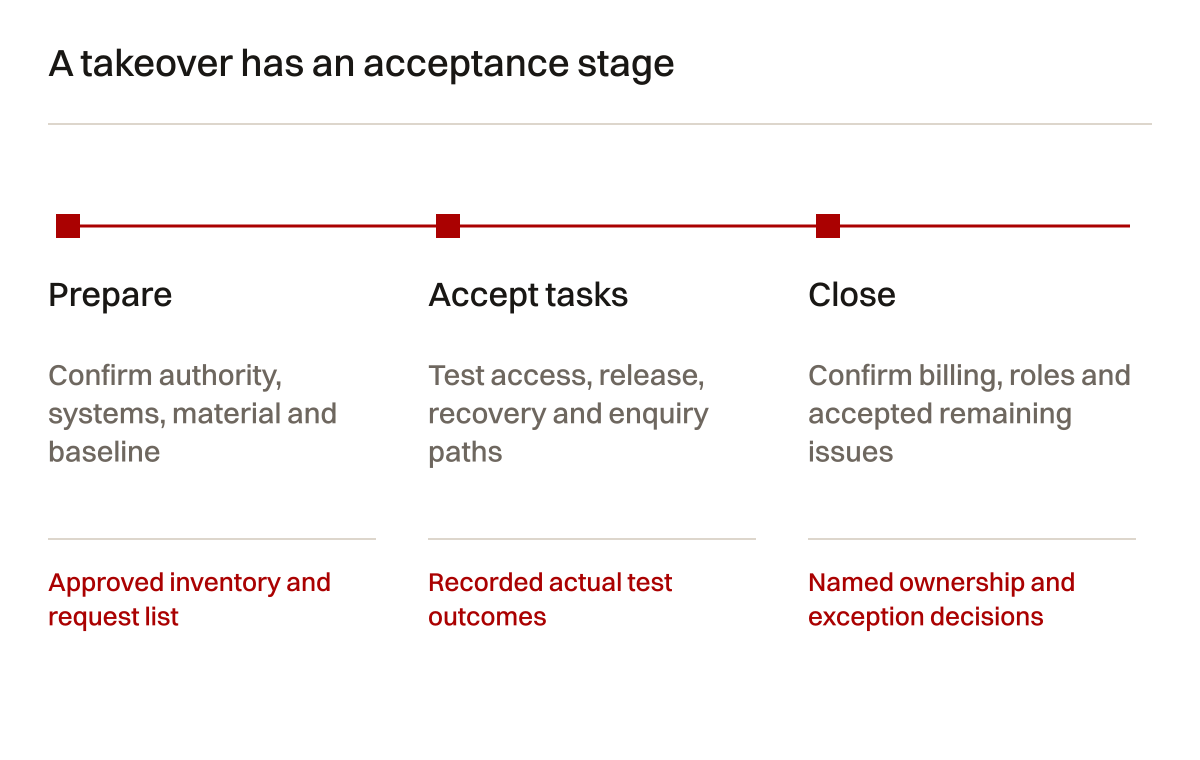
The closure record states what changed, who now owns each system and what remains unresolved. It does not announce that every future fault has been prevented. It demonstrates that the named tasks have been tested under recorded conditions and that the business understands the remaining limits.

Generated illustrative photograph. It represents a visitor-path check, not proof of an actual successful submission.
Questions about taking over website maintenance
Confirm where renewal notices will arrive after closure. A correctly transferred account can still use an obsolete billing contact. Test that operating detail separately and name the person responsible for future notices.
A receiving-team task exercise
Ask the receiving maintainer to make a controlled, approved correction using the supplied instructions. Choose a non-sensitive content item in a separate environment. The person should locate the source, identify the appropriate editing route, apply the correction, verify the visitor output and record the result. Observe where they need knowledge held only by the outgoing provider.
If the exercise stalls at an undocumented deployment command, the missing instruction becomes a concrete handover task. If it stalls because an account invitation has the wrong role, the access question has evidence. If the copy can be edited but the generated download cannot be rebuilt, the content dependency needs attention. These findings are more useful than asking whether the new provider has received “everything”.
Where a WordPress move is actually required, consult the WordPress migration handbook for the specific arrangement. Keep a platform move separate from a provider change that leaves hosting untouched. The task exercise should reflect the agreed outcome, not introduce unnecessary infrastructure changes simply to demonstrate activity.
Include one exception exercise as well. Give the maintainer a fictional report that the public enquiry confirmation appears but the received message is missing. Ask which systems they inspect, who owns each dependency and when they involve commercial operations. The objective is an understandable triage route. The maintainer should not claim delivery failure or success without the relevant evidence.
Then ask another authorised person to read the resulting operating note. Can they identify the current release, recovery reference and responsible owner? If the note depends on unexplained nicknames or a person's memory, revise it. Handover documentation should be usable after staff changes, not merely comprehensible to the people who attended the meeting.
Agree how task evidence is stored. Keep release references, observed visitor results and open issues in the transition register. Keep credentials, private source material and customer records in their appropriate restricted locations. A shared acceptance workbook should point to those records without copying their contents into every working file.
Finally, name the boundary of the exercise. A successful controlled edit establishes the tested route at that date. It does not certify every administrative feature or future update. A useful closure statement identifies what the receiving team can do, which dependencies were verified and what the business accepted as unresolved. That creates an operating record the next maintainer can inspect.
Do we have to move hosting to change providers?
No. The support arrangement and hosting location are separate decisions. Existing hosting may remain suitable if the business has appropriate ownership and the receiving team can perform the agreed work. Diagnose access, dependencies and operating needs before proposing a migration.
Is a CMS export enough for handover?
It can support a particular content-transfer task. It does not automatically supply a complete operational website, source, configuration or external dependencies. Describe what the export includes and test the intended use. A recovery task needs its own scope and verification.
Should the new provider update everything immediately?
First establish recovery material, dependencies and a baseline. Then assess updates according to compatibility and consequence. A takeover is not proof that broad changes are needed. Applying many updates at once can make it harder to identify which change affected a visitor task.
Can every account be transferred to our company?
No universal rule applies. Vendors have different account models, transfer conditions and licence terms. Some arrangements need invitations, new billing or a replacement service. Verify the specific platform and agreement. Do not treat a downloadable code copy as evidence of account ownership.
When can we end the old provider's access?
After the authorised owner has accepted the agreed transition evidence and dependency decisions. Coordinate access removal with remaining obligations and vendor rules. Do not remove a critical operating route before the receiving team can use the approved replacement. Record exceptions and the actual closure state.
Does maintenance takeover include SEO?
Only if that responsibility is agreed. Hosting, releases, public facts and enquiry checks differ from search research and analysis. Keep authorised account access and prior definitions where relevant, then specify what the receiving team will inspect or improve. A provider change alone does not establish a ranking improvement.
Bring the unresolved operating question
Start with the accounts you know, the material you can access and the task nobody can confidently perform. Creatif Work's hosting and support work can begin with that diagnosis. Where public structure or content needs repair, website work and SEO require separately defined acceptance.
The objective is a receiving team that can operate the agreed website tasks and explain what remains uncertain. That is reviewable before any old dependency disappears. Start with the problem.
Sources checked for this guide
Official guidance checked on 4 October 2026. Platform eligibility, licence terms and account conditions must still be checked for the actual transition.