

Alternative Fuel Trials in Australia: What Evidence Comes First
An alternative fuel trial should not begin with a promotional claim about future emissions. It should begin with a controlled description of the vessel, fuel, operating profile, hazards, responsibilities and evidence needed to decide whether the next step is safe.
For Australian operators and suppliers, that first evidence matters because several fuel pathways have different maturity, handling and incident-response needs.
What evidence comes first?
Start with the trial boundary and decision. Define the vessel, fuel pathway, operating area, duty cycle, change from the current system and the question the trial must answer. Then document hazards, regulatory and class engagement, competence, controls, test method, stop criteria, data ownership and post-trial review.
AMSA's shipping decarbonisation industry feedback notes that methanol and electrification may be realistic near-term options for some vessels, while hydrogen and ammonia still bring material safety, handling and operational questions. AMSA also stresses early regulator engagement and clear guidance for trials.
This article is an evidence-planning guide, not approval for a fuel, vessel or voyage.
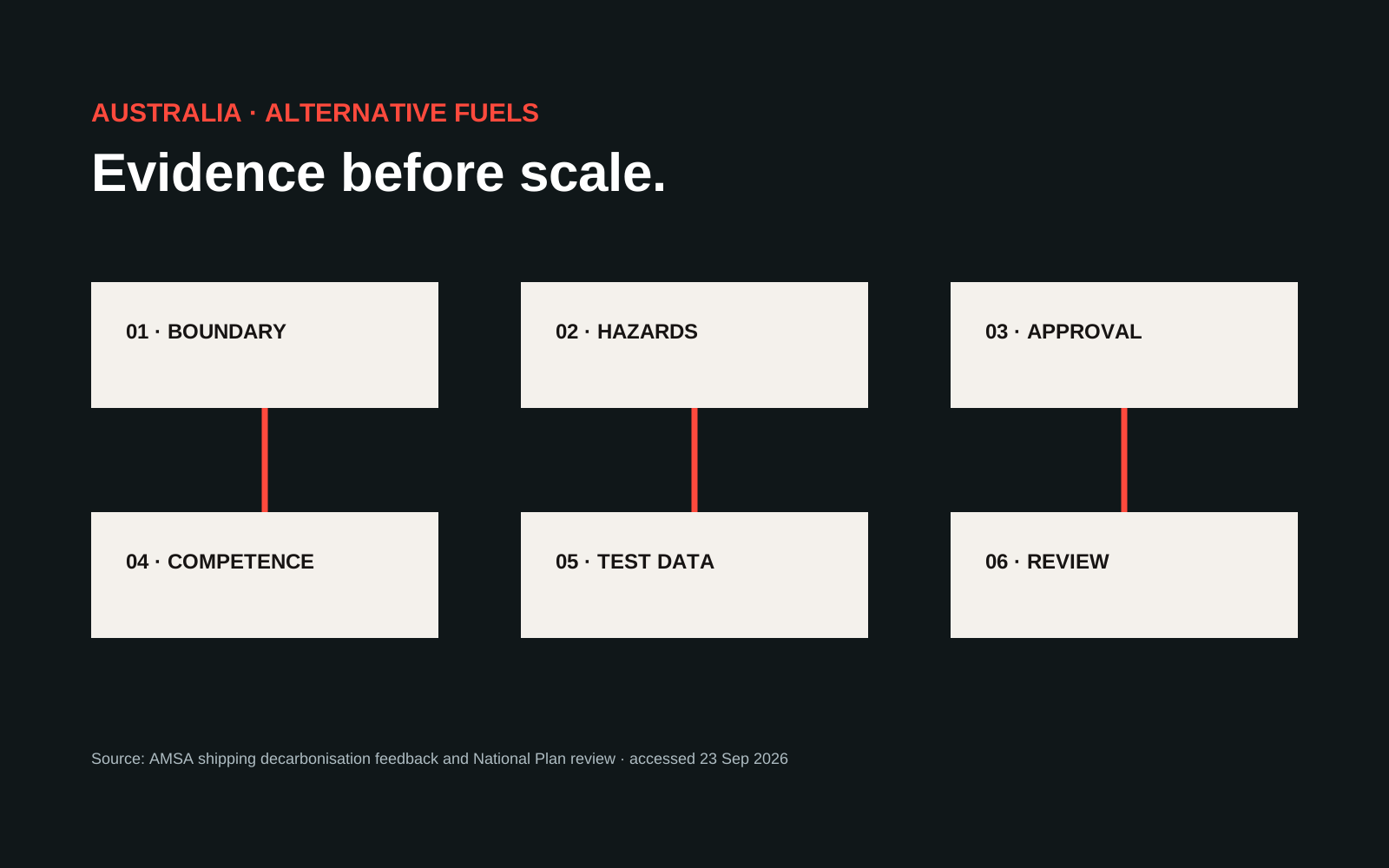
Alternative fuel trial evidence gate showing boundary, hazards, controls, competence, test data and review.
Define the decision before the data
| Trial question | Evidence boundary | Example decision |
|---|---|---|
| Can the system meet the duty cycle? | Route, load, weather, reserve and charging or bunkering | Proceed to longer operational trial |
| Can fuel be handled safely? | Transfer, storage, ventilation, detection and emergency response | Revise design or procedure |
| Can crew operate and recover? | Training, drills, normal and degraded modes | Approve supervised operation |
| Does performance justify the next stage? | Energy, emissions boundary, reliability and maintenance | Stop, repeat or scale |
Do not collect every available signal without deciding how it will be used. A smaller, traceable dataset is more valuable than a dashboard with no acceptance criteria.
Establish hazards and response capability
AMSA's review of the National Plan for Maritime Environmental Emergencies found that alternative fuels such as ammonia, methanol and hydrogen can create different public-safety and response challenges from oil. Hazards may include toxicity, fire, explosion, corrosivity and different recovery needs.
Record the credible scenarios for the selected fuel and installation. For each one, identify detection, immediate action, isolation, protection of crew and public, external response, evidence preservation and recovery criteria.
The trial team should know what local responders can actually do. A plan that depends on equipment or knowledge not available at the operating location is not complete.
Map approval and responsibility early
List the regulator, class, port, flag, designer, equipment supplier, fuel provider, operator and emergency-response parties that may need to review the trial. Name one owner for each submission and decision.
AMSA's 2026 consultation on novel vessel survey requirements shows why emerging technologies can sit outside established technical standards. Confirm the current requirements for the specific vessel rather than assuming a consultation outcome.
Create a responsibility matrix for design, fuel quality, transfer, operation, data, incident command and public communication. A partnership announcement is not a responsibility allocation.
Test competence, not attendance
Training records should connect people to tasks. Define who can authorise bunkering or charging, who monitors the system, who changes operating mode and who can stop the trial.
Use a scenario before live operation. Include a sensor disagreement, communication failure or unexpected exposure so the team must interpret conditions rather than follow a perfect script. Record decisions, confusion and required changes.
Competence evidence can include supervised practice, observed drills, system-specific assessment and defined limitations. Attendance at a briefing is only one input.
Design the trial record
The record should include:
- approved boundary, method and configuration;
- fuel or energy data and chain of custody;
- instrument list, calibration and time synchronisation;
- operating conditions and deviations;
- alarms, interventions and maintenance;
- safety observations and incidents;
- calculated results with assumptions;
- review decision and open actions.
Put the source beside every important result. If a metric is modelled, label it as modelled. If the comparison excludes upstream production or infrastructure, say so.
Publish the trial without overstating it
A public project page can show the question, bounded configuration, parties, method, approved result and next decision. It should not turn an early technical trial into proof of fleet-wide readiness.
Use technology readiness language carefully. Our guide to using TRLs without hiding risk explains how to pair a level with system, environment and remaining evidence.
Decide what would stop the trial
Stop criteria deserve the same attention as success criteria. Define thresholds for loss of containment, unexpected exposure, unstable operation, instrument disagreement, emergency-system failure and departure from the approved operating window.
State who has authority to stop, how the system moves to a safe state and what evidence must be captured before reset. A commercial observer should not be able to overrule the responsible operating authority.
After a stop, separate immediate recovery from the decision to resume. The review should confirm cause, affected evidence, required design or procedure change and approval. Record whether previous results remain valid.
Plan evidence for the next scale
Before the trial, ask what a yard, class society, insurer, financier or operator would need before a larger installation. Add those evidence needs to the test where safe and proportionate.
This may include repeatability, degradation, maintainability, crew workload, spares, fuel quality variation or local response. A trial that proves one performance point but cannot support the next decision may have to be repeated.
Creatif Work builds marine websites that help technical readers separate tested facts from future intent. Our website service can turn an approved trial record into a clear project page while sensitive safety and design material remains controlled.