

Use Technology Readiness Levels Without Hiding the Real Risk

A technology readiness level can help teams describe progress. It can also hide risk when a single number is detached from the system, environment and evidence used to assign it.
For a marine buyer, “TRL 7” is not the final answer. They need to know what was demonstrated, where it ran, what changed from the proposed installation and what remains unresolved.
How should a company use TRLs?
Use a TRL as a labelled summary, not a claim of overall readiness. Name the exact subsystem, the scale and environment of the demonstration, the evidence date, the party that assessed it and the remaining technical, safety, integration, manufacturing and operating risks. A commercial or deployment decision needs more than the level.
AMSA's alternative-fuel industry feedback shows why readiness differs by technology and operating case. Methanol, electrification, hydrogen and ammonia do not share the same maturity, infrastructure or safety questions. A readiness statement should preserve those differences.
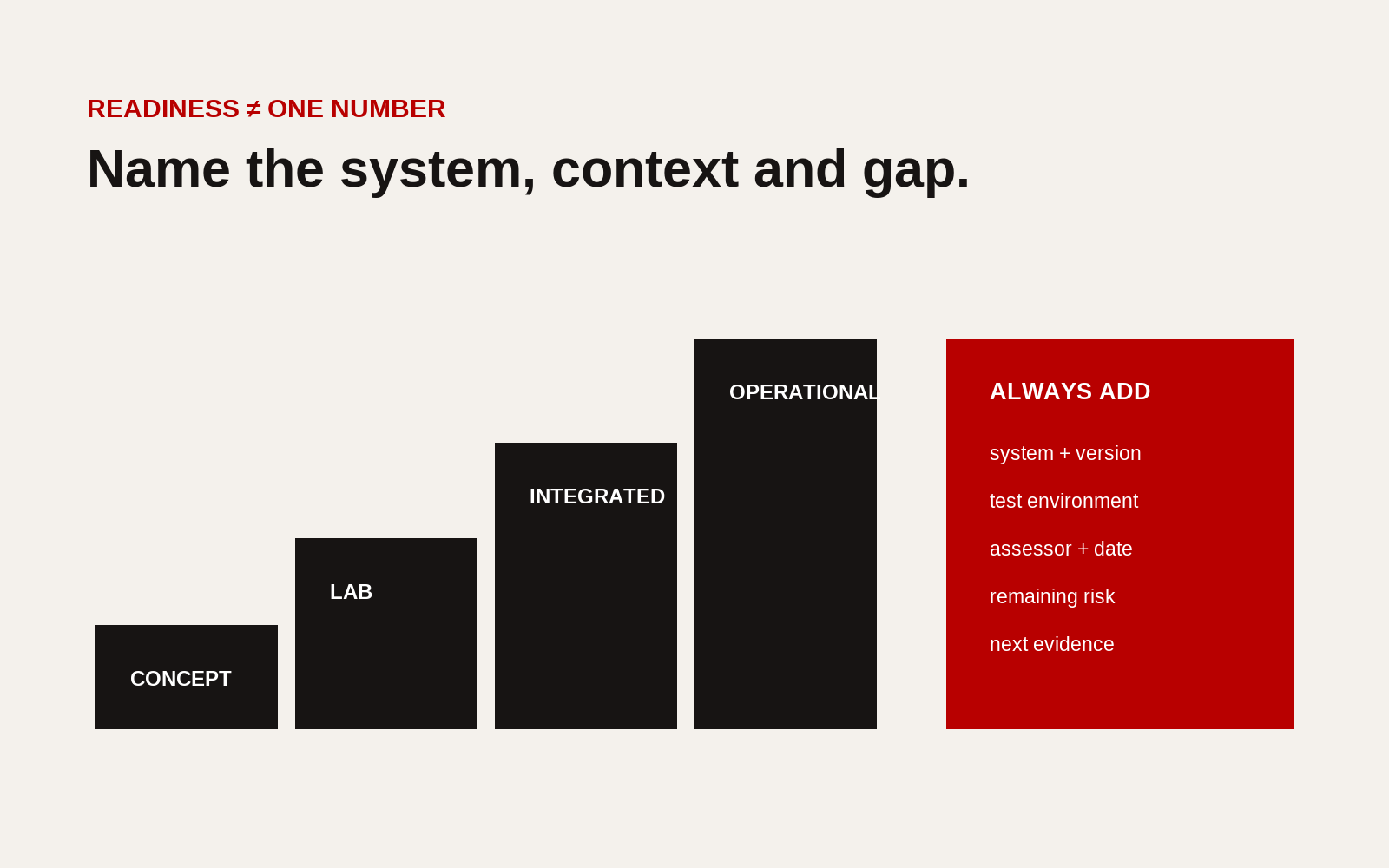
Technology readiness ladder paired with operating environment, evidence confidence and remaining risk.
Add four qualifiers to every level
| Qualifier | Question | Example evidence |
|---|---|---|
| System | What exact component or integrated system is rated? | Configuration and interface list |
| Environment | Where and under what load was it demonstrated? | Test conditions and duty cycle |
| Assessment | Who assigned the level and on what date? | Review record and criteria |
| Remaining risk | What still blocks the next decision? | Open actions, owner and evidence plan |
Without these qualifiers, teams may assume that a tested component makes the whole vessel installation ready.
Separate kinds of readiness
Technical readiness is only one dimension. Track at least:
- safety and regulatory readiness;
- integration readiness;
- manufacturing and supply readiness;
- crew and operating readiness;
- maintenance and service readiness;
- infrastructure and fuel readiness;
- commercial and finance readiness.
A prototype may perform at sea while fuel availability, crew competence or local response arrangements remain immature. Do not average these into one reassuring score. Show the profile.
Use evidence gates between stages
For each stage, define the decision, evidence and stop condition. An early bench test may prove a principle. A controlled integrated test may prove interfaces. A limited operational trial may prove performance in a representative environment. Each step should close named uncertainties.
An evidence gate can include:
- approved configuration and test objective;
- hazard and regulatory review;
- instrument and data plan;
- acceptance and stop criteria;
- independent or competent review where needed;
- decision, limitations and next evidence.
If the test changes, reassess what the result proves. A successful demonstration outside the required load, climate or duty cycle should not inherit the stronger claim.
Show confidence and consequence together
Two gaps with the same evidence confidence may deserve different attention. Failure of a user-interface preference is not the same as failure of containment, propulsion or emergency shutdown.
Use a simple risk view:
| Evidence confidence | Consequence if wrong | Management response |
|---|---|---|
| High | Low | Monitor through normal development |
| Low | Low | Test when efficient |
| High | High | Preserve controls and independent review |
| Low | High | Do not scale until the gap is reduced |
This avoids the false comfort of a high average readiness level when one safety-critical interface remains weak.
Publish readiness with a boundary
A public technology page should state:
- system and version assessed;
- demonstration environment and date;
- result and limitation;
- next evidence step;
- partners or assessors with publication approval;
- whether the level is self-assessed or externally reviewed.
Do not use TRL language as a substitute for product availability. State whether the technology is a concept, pilot, limited deployment or orderable product, and what a customer receives today.
Our Australian alternative fuel trial guide sets out the records needed before and during a live trial.
Review readiness when the context changes
Revisit the assessment after a design revision, new supplier, different vessel class, new operating profile or regulatory change. Readiness does not automatically transfer between contexts.
Keep previous assessments for traceability, but make the current one obvious. The website, proposal and technical file should use the same system name and version.
Use a readiness review that can be challenged
Bring engineering, operations, safety, manufacturing, service and commercial owners into the review. Each should identify the evidence they accept, the gap they still see and the consequence if the assumption is wrong.
Record disagreements rather than forcing an average. A manufacturing team may be ready to repeat a component while operations still lacks a safe maintenance method. Both statements can be true.
Set the next review against an evidence event, not only a date. Examples include completion of an endurance test, approval of a hazard action, first installation, a supplier change or a defined number of operating hours.
Questions for an investor or buyer
- Which exact configuration holds the stated level?
- Was the environment representative of the proposed use?
- Who assessed the level and which criteria were used?
- Which high-consequence gaps remain open?
- What evidence is required for the next stage?
- Can the product be ordered and supported today?
Answers to these questions turn a maturity label into a decision record.
Creatif Work designs marine websites that make technical maturity understandable without turning development into marketing theatre. Our website service can create a readiness and project structure tied to approved evidence, limitations and the next decision.