

Can AI Search Understand a Singapore Engineering Company?
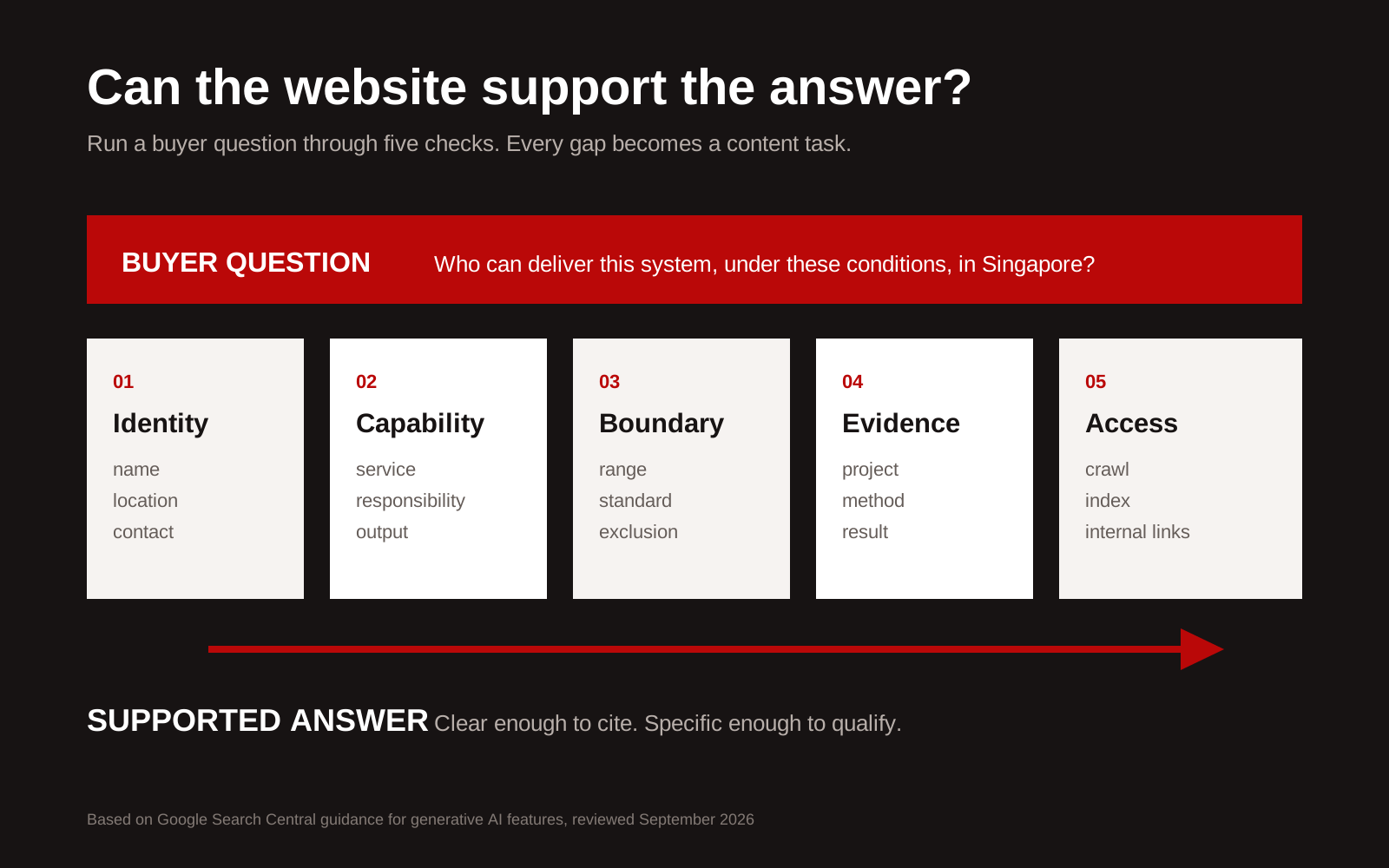
An AI search system cannot reliably explain a Singapore engineering company if the website never states what the company does in precise, connected terms. The problem is rarely a missing “AI SEO” file. It is usually a company name that changes between pages, services described as slogans, specifications trapped in PDFs and projects that never say what the firm delivered.
The useful test is simple: could an unfamiliar buyer answer a technical question from the public site and cite the page that supports the answer?
What does AI search need to understand a company?
It needs crawlable pages that identify the business, define each capability, state useful technical boundaries and connect claims to first-hand evidence. There is no special schema or AI text file that guarantees inclusion. The same clarity helps people, conventional search and AI features.
Google's official guide to generative AI features in Search says existing SEO foundations still apply. Pages need to be accessible to Search, useful to visitors and supported by unique, first-hand material. Google also says there is no special schema markup or llms.txt requirement for its AI features.
That guidance rules out a common shortcut. Adding a technical file cannot repair vague company information.
Run five buyer questions through the website
Choose five questions a real buyer may ask. Use the actual service, material, asset, industry and location names. For example:
- Which Singapore companies commission high-voltage systems for data centres?
- Which supplier can fabricate this material and tolerance range?
- Has the company completed work in an operating plant?
- Which standards and inspection methods apply to the service?
- Who should receive an RFQ with drawings and a delivery date?
Now find the best page for each question. Score it against this table.
| Test | Pass condition | Common failure |
|---|---|---|
| Identity | Legal or trading name, location and contact are consistent | Abbreviated names and old addresses conflict |
| Capability | One page names the exact service, inputs, outputs and exclusions | Every service sits in one paragraph |
| Technical boundary | Materials, systems, capacity or conditions are stated | “End-to-end engineering” replaces detail |
| Evidence | A project connects role, method and result | Gallery images have no scope or outcome |
| Access | Page returns normally, is indexable and links from the site | Information exists only in a PDF or script-only interface |
| Freshness | A date, revision or current status can be checked | Expired certificates and undated claims remain live |
A company does not need to publish confidential drawings or customer data to pass. It needs to publish the facts that allow a buyer to qualify the fit.
Start with company identity
Use one public name consistently. If the trading name differs from the registered entity, state the relationship. List the real operating locations and the work done at each one. Keep telephone numbers, domain, address and business profile current.
This sounds administrative, but it affects interpretation. A search system may find a distributor page, an old directory listing and the company website. If each uses a different name or location, the relationship is harder to establish. The same ambiguity makes a procurement manager pause.
The homepage should answer three questions in plain text:
- What type of engineering work does the company perform?
- For which systems, industries or operating conditions?
- From which location or service region?
Avoid claiming every sector the company has ever touched. A precise current description is easier to verify than a long list.
Give each capability a stable page
A service page should state the problem, responsibility, inputs, process, output and boundary. If a company designs, supplies, installs and maintains a system, explain which stages are available together and which can be purchased separately.
Put important parameters in HTML text and tables. A PDF can remain available for download, but it should not be the only place where a buyer can find:
- materials and applicable standards;
- size, load, pressure, voltage or tolerance range;
- design and approval responsibility;
- inspection and testing method;
- site, workshop and commissioning coverage; and
- information required for a quotation.
Our article on turning a specification sheet into a web page shows how to keep the downloadable document while making the main facts readable and searchable.
Connect capability to first-hand evidence
Google's 2026 guidance emphasises content based on direct knowledge rather than summaries that could have come from anywhere. An engineering company has a strong source of that material: completed work.
For each case study, publish:
- the operating problem or requirement;
- the company's exact role;
- site or production constraints;
- the method or system used;
- the evidence created; and
- the measured or verified result.
If the client cannot be named, preserve the engineering context. “Confidential semiconductor facility in Singapore” plus the system, scale, role and constraint is more useful than “leading global client”.
Link the case to the capability page and link the capability page back to relevant cases. This allows a reader and retrieval system to follow the claim to its evidence.
Check the technical route into Search
Google's technical requirements are short. Googlebot must not be blocked, the page must return a successful HTTP status and the page must contain indexable content. Meeting those requirements does not guarantee indexing or visibility, but failing them removes the page from consideration.
Ask the person responsible for the website to verify:
- important pages return
200, not a soft error; - canonical URLs point to the intended page;
- robots rules and
noindexdo not block public content; - internal links reach every capability and project page;
- important text is present in the rendered page;
- images have useful alternative text; and
- visible facts match any structured data.
Do not treat a green technical audit as proof that the content is useful. Access is the entrance requirement. The engineering evidence is the reason to include the page in an answer.
Measure answers, not vanity rankings
In 2026 Google introduced a generative AI performance report in Search Console. It reports impressions, pages, countries, devices and dates for visibility in generative AI features. That can show which pages appear, but it does not tell management whether the page helps a suitable buyer.
Track three layers:
- Visibility: relevant pages are indexed and appear for useful questions.
- Qualification: visitors reach capability, project and contact information.
- Commercial result: suitable enquiries mention the service, system or project evidence they found.
Review poor-fit enquiries as well. If visitors repeatedly ask for work the company does not offer, the website may be clear to a crawler but unclear about its boundaries.
A 30-minute management test
Ask someone outside the engineering and marketing teams to use the public website and answer:
- What is the company best at?
- Which technical parameters can they confirm?
- Which completed project proves it?
- Which standards or certificates apply?
- Which person or team should receive the enquiry?
Give them five minutes per question. Record the page used and every assumption they had to make. Those assumptions become the content backlog.
This approach is more useful than creating dozens of near-identical pages for slightly different search phrases. Google warns that publishing scaled variations mainly to influence rankings or AI responses can breach its spam policies. One strong capability page should answer related wording naturally.
Creatif Work builds engineering websites around technical buyer questions and first-hand evidence. Our SEO and AI visibility service connects those pages, checks how search systems access them and improves the material over time. If nobody can explain what the current site lets a buyer verify, start with the problem.