

How Much Content Does a Service Website Need?

A service website needs enough content to answer the buyer's important questions and prove the claims. It does not need a page for every keyword or a fixed word count. Page count should follow distinct services, audiences, markets, evidence and enquiry paths.
Start with decisions, then design the content model.
How much content should a service website have?
Create one strong page for each distinct service or buyer decision, supported by relevant sector, project, location, company, insight and contact content. Merge pages that repeat the same scope and proof. Add pages only when they answer a materially different question.
| Content type | Create when | Minimum useful depth |
|---|---|---|
| Service | Deliverables, buyer or process differ | Problem, inputs, outputs, limits and proof |
| Sector | Operating context changes the service | Constraints, requirements and projects |
| Project | It proves a useful claim | Role, scope, constraint and outcome |
| Location | Presence, rules or delivery differs | Coverage, local proof and contact |
| Insight | A real decision needs explanation | Direct answer, sources and next action |
| Qualification | Buyers need reusable evidence | Entity, credentials, systems and request route |
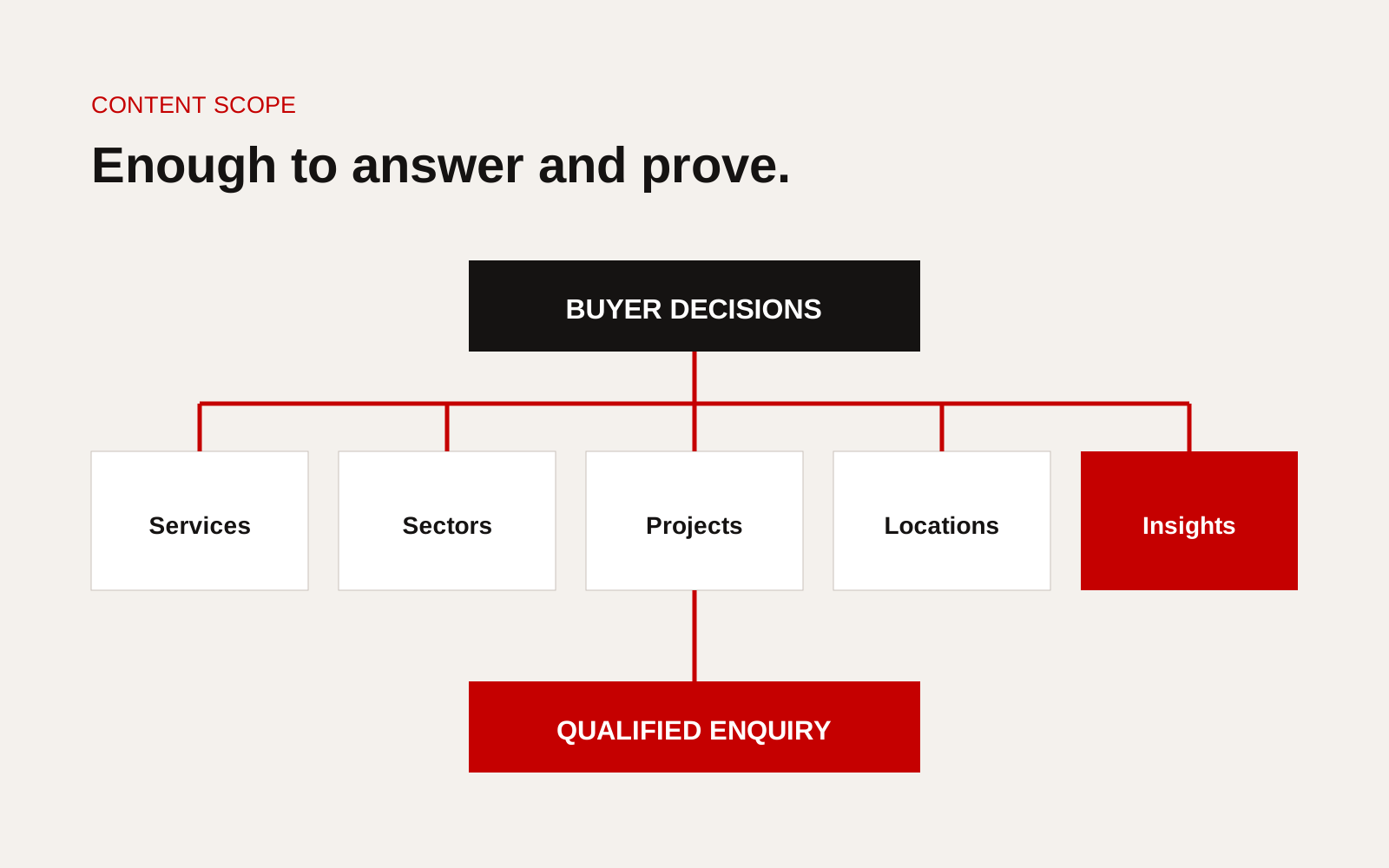
Service website content model connecting buyer questions to service pages, proof, process, locations and enquiries.
Begin with buyer questions
Interview sales, delivery and customers. Review enquiries and proposals. List the questions buyers ask before contact and before award.
Group them by decision:
- Does this company perform the work?
- Does it understand my industry or situation?
- Has it delivered something comparable?
- What will I receive and what is excluded?
- Can it support my market or location?
- What evidence can I verify?
- What should I send to get a useful response?
Each group may justify a page or section.
Decide when a service deserves its own page
Create a separate page if it has a distinct buyer, deliverable, process, evidence, search demand or enquiry. Keep services together when the difference is only internal terminology.
One detailed page can rank and convert better than several thin pages that repeat the same introduction.
Use sector pages only when context changes
A sector page should explain different assets, regulations, constraints, procurement or project evidence. Replacing "marine" with "construction" in the same paragraph creates no value.
If the service is identical across markets, use one service page with relevant projects and sections.
Let evidence determine project depth
A service firm may need a small number of detailed case studies rather than dozens of image cards. Choose projects that prove different scopes, markets, constraints or outcomes.
Keep a larger controlled evidence library for tenders and sales if not every project can be public.
Use articles to answer changing questions
Articles are useful for regulation, procurement, technical comparisons and decisions that do not belong on a permanent service page. Link them back to the relevant service and update them when facts change.
Do not publish at high volume without expert review and a maintenance plan. Google's helpful content guidance advises creating people-first content with clear expertise and purpose.
Estimate the content workload
For every proposed page, record:
- audience and decision
- owner and technical reviewer
- source material
- evidence and images
- approval need
- update trigger
- relationship to other pages
The site only needs pages the team can make useful and maintain.
Plan depth by risk and purchase stage
A low-risk, familiar service may need a concise page. A technical service with long procurement, safety implications or several decision-makers may need process, responsibility, evidence, documents and FAQs. Content depth should follow the cost of misunderstanding.
Early research pages can explain the problem and comparison criteria. Shortlisting pages need scope, proof and fit. Enquiry pages need inputs and next steps. Do not place every detail on the home page because several audiences exist.
Reuse facts without copying pages
Maintain company, project, location and credential records centrally. Reuse fields and relationships, but write each page for its decision. A project can appear on a service and sector page through a card while its full evidence remains on one canonical record.
This reduces factual drift without producing duplicate paragraphs. It also makes expiry and correction manageable when a certificate, contact or service changes.
Include removal in the publishing process
Set review dates and merge or remove pages that no longer answer a distinct question. Redirect a retired URL to the closest useful replacement when appropriate. A content plan is incomplete if it only adds.
Review overlap before writing
Create a matrix with proposed pages as columns and buyer questions as rows. If several pages answer the same questions with the same evidence, merge them. If one page serves unrelated decisions, split it.
Measure gaps, not raw volume
Track whether users reach the right service, inspect proof, submit qualified enquiries and whether sales uses the page. More indexed pages are not automatically better.
Content-scope checklist
- Priority audiences and decisions defined
- Services separated by real scope or buyer need
- Sector pages contain distinct context
- Project stories prove different claims
- Location pages reflect real presence or coverage
- Articles answer sourced, changing questions
- Duplicate page concepts merged
- Each page has source material and owner
- Internal links connect decision to evidence
- Update and removal triggers agreed
Budget for maintenance before adding pages
Estimate the annual effort for each repeatable page type. A stable service page may need a quarterly fact check, while a regulatory article, staff page or product range may need event-driven review. Include evidence approval, image rights, accessibility, internal links and removal, not only writing time.
If the team cannot name an owner and review trigger, reduce the initial scope or simplify the content model. Ten maintained project records are more credible than fifty incomplete galleries. Use a backlog for useful topics that lack evidence, and publish them only when the source material and reviewer are ready. During each review cycle, merge pages that answer the same decision, redirect retired URLs and update links to the strongest current source. This keeps the site focused as the business changes and prevents content volume from becoming a maintenance liability.
Creatif Work's website service begins with information architecture and evidence, not a preset page count. Use our diagnostic if the current site has plenty of pages but buyers still cannot find the useful part.