

A 90-Day Content Review: Keep, Update, Merge or Remove

Website content does not need constant rewriting. It needs regular decisions. A 90-day review catches expired facts, weak evidence and overlapping pages before they become a migration problem.
The outcome should be one of four actions: keep, update, merge or remove.
How does a 90-day content review work?
Review every important page against business relevance, user need, factual accuracy, evidence quality, search performance and maintenance cost. Keep a page that still works, update one with a correctable gap, merge pages that answer the same decision, and remove content that is obsolete, unsupported or harmful. Preserve redirects and internal links when URLs change.
Google's people-first content guidance asks whether content serves an audience and demonstrates useful first-hand expertise. Its Search Essentials prioritise helpful, reliable content over material made mainly for rankings.
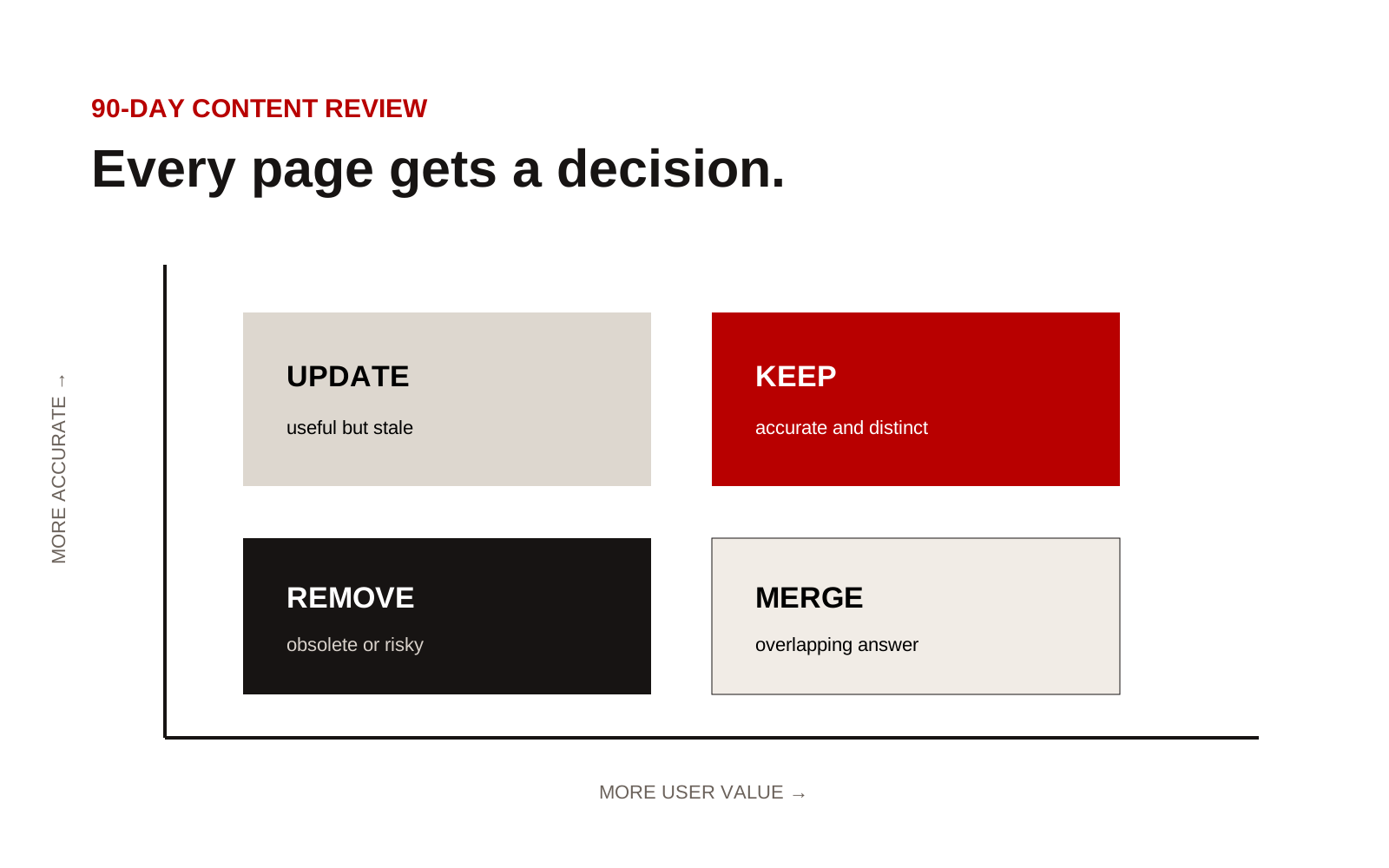
Content review decision matrix with keep, update, merge and remove routes.
Score the page before choosing the action
| Test | Keep | Update | Merge | Remove |
|---|---|---|---|---|
| Business relevance | Current offer or audience | Offer changed slightly | Overlaps another offer | No longer offered |
| User value | Resolves a real decision | Missing current detail | Split across pages | No useful purpose |
| Accuracy | Facts and links current | Correctable errors | Best facts scattered | Cannot be supported |
| Evidence | Specific and traceable | Needs stronger proof | Duplicate evidence | Misleading claim |
| Performance | Useful visits or conversion role | Potential but weak | Competes with sibling page | No role and no value |
Do not remove a page only because traffic is low. A low-volume technical page may help a small number of high-value buyers.
Start with high-risk content
Review prices, specifications, regulatory dates, certifications, named staff, service locations, partners and availability first. These can create business harm when wrong.
Then review key service, product and campaign pages. Blog archives and general studio content can follow.
Assign a subject owner as well as an editor. The editor can improve clarity, but a competent owner must verify the technical fact.
Keep pages that still earn their place
A page can stay unchanged when it remains accurate, useful, distinct and connected to the buyer journey. Record the review date and owner even when no edit is needed.
Check that the title, description, internal links and enquiry still match the page. A useful article may be correct but linked to an old service or contact route.
Update a bounded gap
Update when the page still serves the right decision but facts, examples, structure or proof need work. Prioritise corrections before stylistic rewrites.
Add a direct answer, dated source, better comparison, current project or clearer next step where needed. Do not expand the page only to increase word count.
Merge competing answers
Merge when two pages target the same audience and decision with little distinct evidence. Choose the stronger URL based on relevance, links, performance and maintainability.
Move useful material, create a redirect from the retired URL, update internal links and revise sitemap references. Google's canonical guidance explains how Search chooses a representative URL, but a clean redirect and internal-link update are clearer when a page is genuinely retired.
Remove obsolete or risky material
Remove content when the offer is gone, the claim cannot be supported, the page creates legal or technical risk, or no useful information can be preserved.
Decide whether the URL should redirect to a true replacement, return a not-found or gone response, or remain as an archive with a clear status. Do not redirect every retired page to the homepage.
Google's removal guidance notes that changing or removing the source content is part of removing information from search.
Run the review as a short operating cycle
- Export the page list and assign owners.
- Flag high-risk and high-value pages.
- Review evidence, analytics, links and enquiries.
- Choose one action and record the reason.
- Implement content, redirect and link changes.
- Quality-check the published result.
- Set the next trigger or review date.
Our website content audit before redesign provides the deeper 25-question review for a major rebuild.
Measure whether the library improves
Track stale claims fixed, duplicate pages reduced, broken links removed, key pages with owners, and enquiry paths improved. Search traffic can be reviewed, but it should not be the only score.
The best content review often leaves fewer, stronger pages that the business can maintain.
Keep a decision register
For each reviewed URL, record the action, reason, owner, approval, implementation date and next trigger. Include the destination for any redirect and the pages that must update their internal links.
This register prevents repeated debates. A page retired because the service ended should not return six months later as part of a campaign draft. A page kept for a small procurement audience should not be removed later only because traffic remains low.
Share the register with sales, technical and service teams. They may know that a low-traffic page supports a live tender, or that a popular page describes work the company no longer wants.
Review the result after publication
Check redirects, links, sitemap, search indexing and forms after changes go live. Monitor whether merged pages retain useful visits and whether enquiry routes still work.
Do not reverse a sound decision after a few days of movement. Search systems need time to recrawl, and buyers may use a page infrequently. Set an appropriate review period and record the next decision date.
Creatif Work combines website design with ongoing SEO work. We can run the initial review, implement the structure and establish a practical cycle so the site does not slide back into an unmanaged archive.