

How Long Does a Custom Business App Take to Build?

A custom business app can take weeks or many months. The useful answer depends on the number of workflows, roles, integrations, data migrations and approval points. A date given before those are understood is a sales estimate, not a delivery plan.
The fastest way to get a reliable timeline is to define the first operational outcome and remove everything that does not need to be in the first release.
How long does a custom business app take?
A focused internal app with one workflow and few integrations may reach a working first release in roughly two to four months. A multi-role system with migration, complex approvals or external integrations usually takes longer. The estimate should follow discovery, because data and decision dependencies often matter more than screen count.
These are planning ranges, not a quote. Every project should be estimated from its own evidence.
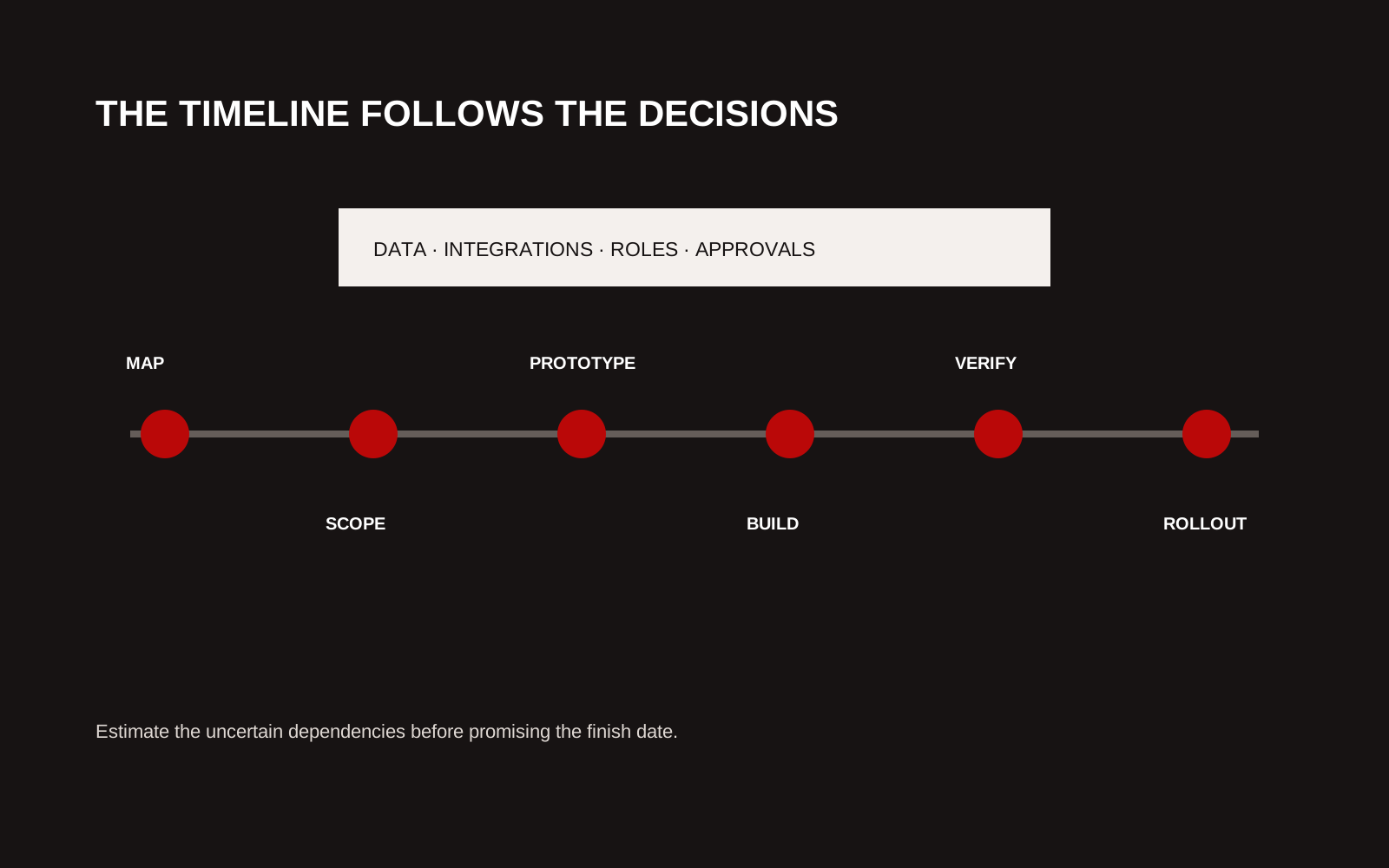
Custom business app timeline showing discovery, prototype, build, testing and rollout dependencies.
Estimate stages, not one finish date
| Stage | Main question | Typical output |
|---|---|---|
| Problem mapping | What failure or delay should change? | Workflow, baseline and success measure |
| Scope decision | What belongs in release one? | Prioritised requirements and exclusions |
| Prototype | Can users complete the critical task? | Tested interaction model |
| Technical proof | Can data and integrations work? | Architecture and integration findings |
| Build | Can the team produce a usable system? | Working increments |
| Verification | Does it work with real roles and data? | Test evidence and issue closure |
| Rollout | Can the business operate and support it? | Training, access and support plan |
Stages can overlap, but their decisions cannot be skipped. Coding a screen before agreeing who can approve a transaction simply moves the decision into rework.
The five biggest timeline drivers
Workflow uncertainty
If two teams describe the same process differently, the project needs a decision before automation. Map the current route, exceptions and ownership. Do not digitise an argument.
Integrations
An integration is not just an API endpoint. It includes access, data mapping, rate limits, errors, test environments and ownership. Confirm who controls each external system and how long approvals take.
Data migration
Old spreadsheets and databases contain duplicates, missing fields and undocumented meanings. Profile real data early. A clean migration sample is stronger than an assumption that import will be simple.
Roles and permissions
Every new role multiplies test paths. Define who can create, view, approve, edit, export and delete each important record. Include temporary cover and departed staff.
Acceptance and rollout
A build is not finished because a feature works on a developer's machine. Name the acceptance owner, test data, pass criteria, training group and go-live decision.
A practical release-one test
Score each proposed feature against four questions:
- Does the user need it to complete the core task?
- Is it required for safety, compliance or data integrity?
- Does another release-one function depend on it?
- Can the result be handled manually for the first release?
If the answer is no to the first three and yes to the fourth, move it out of release one.
What makes an estimate credible?
A credible estimate states assumptions and ranges. It shows the critical dependencies, not only development effort.
Ask for:
- scope and named exclusions;
- expected user roles;
- integration and migration assumptions;
- decision and approval responsibilities;
- testing approach;
- deployment and support responsibility;
- change process; and
- confidence level for each uncertain item.
The UK Government Service Manual's guidance on agile delivery is a useful public reference for iterative delivery and learning with users. It is not a prescribed method for every private project, but its emphasis on small releases and feedback is sound.
Warning signs before the project starts
Pause if the brief asks for “the same process, but automated” and nobody can show the process. Also pause when the proposed system owner has no time, the source data cannot be accessed, or the deadline is fixed by a presentation rather than an operational event.
Our article on choosing between a portal and a spreadsheet shows how to test whether custom software is justified. The custom software service explains how we start with the operational problem rather than a feature list.
Creatif Work maps the workflow, exceptions and evidence before committing to a build path. That makes the first estimate less exciting and more useful. If a deadline exists but the process is still unclear, start with the problem.
Prepare the business team for delivery
Development time is only part of the schedule. The client team must provide decisions, data access, subject-matter expertise and acceptance. Assign one product owner with authority to resolve scope questions. Name deputies for operational areas so progress does not stop when one person is unavailable.
Book user sessions and acceptance windows before build begins. Identify change freezes, audits, peak periods and external approvals that limit rollout. A short technical task can take several weeks when access and review are not planned.
Create a dependency log with owner, required date, current state and effect if late. Examples include sandbox credentials, privacy review, source-data extract, legal wording, device availability and staff training.
After the first release, reserve time for observed use, fixes and small adjustments. Users will encounter cases that workshops missed. Treat those findings as part of controlled adoption. A realistic timeline includes the work needed to make the application usable in the business, not only the work needed to deploy code.