

Manufacturing websites: presenting capacity and tolerance without a brochure
A buyer sourcing a precision part has the drawing open on one screen and a shortlist on the other. They know the material, the tolerance, the quantity and the date. What they do not know is which of the eleven suppliers in front of them can take it, and they are not going to find out by calling all eleven.
So they read. Two or three minutes per supplier, sometimes less. In that time they are trying to match one drawing against one shop, and every question they cannot answer from the page counts against you, because the alternative is sending a drawing to a supplier who will come back three days later and decline.
That is the job a manufacturing website is doing, whether or not anyone in the company thinks of it that way. It is a matching exercise. And most manufacturing sites in Singapore are not built for matching. They are built as brochures: a wide photograph of the shop floor, a paragraph about being established, a services list with no dimensions attached to anything, and the word quality used four times without once being defined.
What does a sourcing engineer look for on a manufacturing website?
Six things, in roughly this order, and none of them are your history.
What processes and equipment do you have. Not “precision machining”. Turning, milling, grinding, wire and sinker EDM, sheet metal, welding, assembly, and which of those are in house.
What size of part can you take. The working envelope. This is the fastest filter of all and the most commonly missing.
What tolerance can you actually hold. Stated per process, referenced to a standard, and honest about what it costs.
What materials you run. Alloys by designation, not “metals and plastics”. Whether you have run the difficult ones before.
What quantities suit you. Prototype, low volume, production. A shop set up for repeat production and a shop set up for one-off work are different businesses, and neither is served by pretending to be both.
Under whose quality system, and with what scope. Certification is a filter for a large share of buyers before anything else is considered.
Underneath all six sits a seventh question that only some buyers have: can you legally receive the drawing at all. More on that further down.
The equipment list is your product page
If you make one change to a manufacturing website, make this one. Publish the machine list.
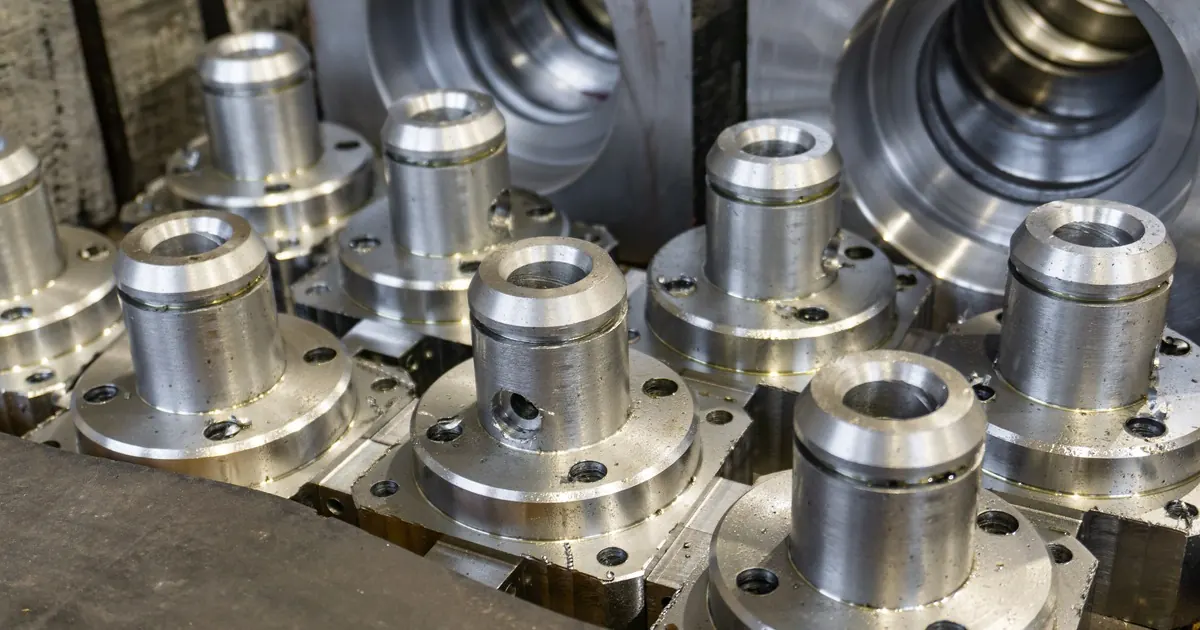
Not a photograph of machines. A list. Make, model, quantity, number of axes, and the numbers that decide whether a part fits: X, Y and Z travels, maximum swing and turning length, table size, maximum part weight, spindle speed and power, bar capacity, pallet count, and the size of your largest press or brake. Then the secondary operations, with the in house or subcontracted status against each one, because a buyer working to a date needs to know how many gates the part passes through and how many companies it has to sit in a queue at.
Then publish the inspection side, which almost nobody does. CMM make and model, vision systems, surface roughness and hardness testing, whether you hold calibration traceability, whether your inspectors are qualified to a recognised NDT scheme and at what level. In the corpus of sites we reviewed this year, one engineering firm employed ASNT Level III inspectors and documented that fact nowhere on its own website, while listing an email address at a consumer internet provider as the only route in.
Two objections come up when we suggest this, and both are worth answering.
The first is that competitors will see the list. They will, and they already know. Your competitors have walked your floor, hired your people, and quoted against you for years. The machine list is not the moat. The person who cannot see it is the buyer.
The second is that the list dates. It does, and that is the real risk. A machine list needs an owner, a review date, and a visible last-updated stamp. Engineering is the sector least likely to keep any of that current: across 54 Singapore B2B sites we reviewed in August 2026, engineering and M&E was the sector most likely to be running WordPress and least likely to have patched it, with 12 of the 54 sites overall carrying an outdated or end-of-life CMS or plugin. Publishing detail you never revisit is how a shop ends up advertising a machine it sold in 2019.
How should a manufacturer publish tolerance?
Carefully, and never as a single heroic number.
The instinct is to put one figure on the capabilities page and let it stand for the whole shop. Every engineer who reads that discounts it immediately, because they know a tolerance is meaningless without a process, a feature, a material and a part geometry attached to it. A bore in hardened steel and a thin wall aluminium housing do not behave the same way, and a number that ignores the difference tells the reader you are quoting a spec sheet rather than describing a capability.
What works instead is a layered statement.
Start with the default. Say which general tolerance class your drawings are read against when nothing is specified. In practice that is usually an ISO 2768 designation in the title block, with the linear and angular class from part one and the geometrical class from part two combined into a single callout. This is a small thing to publish and it immediately signals that you and the buyer share a language.
Then the geometry. List the geometric callouts you routinely hold and inspect, in the notation your customers actually use, whether that is ASME Y14.5 or the ISO GPS system. Flatness, position, concentricity, runout, profile. A buyer with a drawing full of feature control frames wants to know that yours is a shop that reads them.
Then capability by process. Turning, milling, grinding and EDM each get their own line. If your ground finishes hold significantly tighter than your milled ones, say so. This is the part that reads as competence, because it is the part a supplier who has never held tight tolerance cannot fake.
Then what moves the price. Tighter tolerance means slower feeds, more setups, more inspection, more scrap, and sometimes a different machine. Buyers respect a supplier who says which callouts on a drawing are the expensive ones. It is the single most useful sentence you can write on a capabilities page, and it usually starts a conversation rather than ending one.
Then the evidence. What you inspect with, at what frequency, and what documentation the customer receives. First article inspection reports to AS9102, in process control data, material certificates traceable to heat number, and whether you can supply them as standard or on request.
The rule underneath all of this: do not publish a tolerance you cannot hold on a Monday morning with your second-best operator. Overstating capability on a website does not win work. It wins one RFQ, one failed first article, and one supplier removed from an approved vendor list, which is a considerably more expensive outcome than not being asked.
Certification is a scope statement, not a badge
Most manufacturers treat certification as a row of grey logos in the footer. Buyers treat it as a document with a scope, an issuer, a number and an expiry date, and they read it in that order.
Which system matters depends entirely on who is buying. ISO 9001 is the generic quality management baseline. AS9100D contains the full ISO 9001:2015 requirement set and adds the aviation, space and defence layer on top: counterfeit part prevention, configuration management, product safety, risk management and human factors in root cause analysis. IATF 16949 governs automotive supply. ISO 13485 governs medical devices. API Q1 covers manufacturers of equipment for the oil and gas sector, and Nadcap sits underneath all of it for special processes such as heat treatment, welding, chemical processing and non-destructive testing.
Certification is also not permanent. It runs in 3 year cycles with annual surveillance audits in between, which makes the expiry date on your page live information rather than decoration.
What belongs on the page is not the logo. It is the issuing body, the certificate number, the scope wording exactly as written on the certificate, the expiry date, and a current PDF that opens the right way up. Scope is the part that decides things. “Machining of aluminium components” and “design, manufacture and assembly” are wildly different promises, and a buyer who cannot see which one you hold assumes the smaller.
This is also where the neglect shows most painfully. In our review this year, one firm held API Q1 accreditation on a site whose footer still read 2019 and whose newest content was older than that. Another held AS9100D while its news link returned a server error and the most recent downloadable document was a 2018 brochure. A third displayed a management systems certificate marked valid until a date in 2017, which was also the newest dated item anywhere on the site.
None of those companies are bad manufacturers. Two of them hold accreditations that took years and real money to earn. The website is simply the only part of the operation with no owner, and it is quietly telling every visiting buyer that the quality system stopped being maintained around the same time the copyright year did. An expired certificate on a live page is worse than no certificate page at all.
Export control, and the answer you cannot improvise
If you supply into aerospace or defence, at some point a buyer will ask about export control before they send you anything. It is worth having the answer written down rather than assembled in a hurry over email.
The regime most often named is ITAR, the United States International Traffic in Arms Regulations, administered by the State Department’s Directorate of Defense Trade Controls and covering defence articles, services and technical data on the US Munitions List. The registration requirement at 22 CFR 122.1 applies to persons engaged in the United States in manufacturing, exporting or temporarily importing defence articles, which will not be you if you are a Singapore shop. The consequence lands on the other side of the transaction. Your American customer cannot release controlled technical data to a foreign person without authorisation, so what they need from you is a clear statement of who would have access to a drawing, where the file would be stored, and whether you can segregate controlled work.
There is a domestic layer too. Singapore controls the export, transhipment and transfer of strategic goods and related technology under a permit regime administered by Singapore Customs, which applies to the technology as well as the hardware.
None of this needs to be a policy document on your website. Two paragraphs and a named contact will do: what categories of work you can take, what you cannot, how controlled files are handled, and who to email about it. If you do not do controlled work at all, publishing that plainly is just as useful, because it saves a procurement team a call and saves you a meeting.
What to do with the site you already have
The useful first move is not a redesign. It is an inventory, and it takes an afternoon.
Write down your equipment with travels and capacities. Your tolerance capability by process. Your material list. Your secondary operations, marked in house or out. Your inspection equipment and personnel qualifications. Your certifications with scope wording and expiry dates. Three to five representative jobs, described by part type, material, tolerance class, batch size and lead time, with the customer anonymised if the contract requires it. Your export control position. And a named engineer a buyer can reach directly.
Then open your website and count how many of those appear at all, and how many clicks each one takes.
Most manufacturers find that the majority is either missing or three levels down. That is the brief, and it is a content problem before it is a design one. It is also why so many of these sites feel thin without being obviously broken: across the 54 sites we reviewed, 19 published no project record, portfolio or case study of any kind, and where products were listed there was very often nothing behind them at all. No datasheet, no dimension table, no material specification. Just a name and a photograph.
We build this kind of site for engineering, marine and infrastructure companies in Singapore. The THK Engineering project is a fair example of the approach, where the question the site had to answer was whether one contractor could deliver five M&E disciplines without subcontracting parts of the package out, so the five are presented as one continuous capability rather than a services menu. The broader pattern is one we have written about for industrial companies more generally.
Projects start from S$4,000 where the technical content already exists in a usable form, and the bands are published rather than quoted on request. What moves the number is almost never the design. It is how much of the equipment list, the tolerance data and the certification detail has to be gathered from the shop floor for the first time. Every build includes 30 days of post-launch support, extended to 45 days on the larger technical sites, because a specification page that nobody can correct in the first month is a specification page that will be wrong for years.