

An Offshore Capability Page Without Empty Safety Claims

"Safety is our top priority" tells an offshore buyer almost nothing. A useful capability page shows how work is planned, controlled, recorded and reviewed for the service being offered.
The page does not need to publish the full HSE management system. It should explain the public part of the system and make clear which controlled evidence is available during qualification.
PETRONAS publishes current supplier planning material through its official Activity Outlook page. Use the applicable operator, client and contract requirements when deciding which safety evidence a qualification must contain.
What should an offshore capability page say about safety?
State the work scope, principal hazards, planning and control process, responsible roles, competency requirements, stop-work route, incident and learning process, and the period and boundary of any performance data. Link every certification or statistic to its issuer, scope and date.
| Weak claim | Useful replacement |
|---|---|
| Safety first | Work is planned through the named risk and permit process |
| Zero harm | State the period, workforce boundary and measure used |
| Fully certified | Name the certificate, issuer, entity, scope and validity |
| Highly trained crew | Name required competencies and verification process |
| Rapid emergency response | State coverage, escalation and tested arrangements |
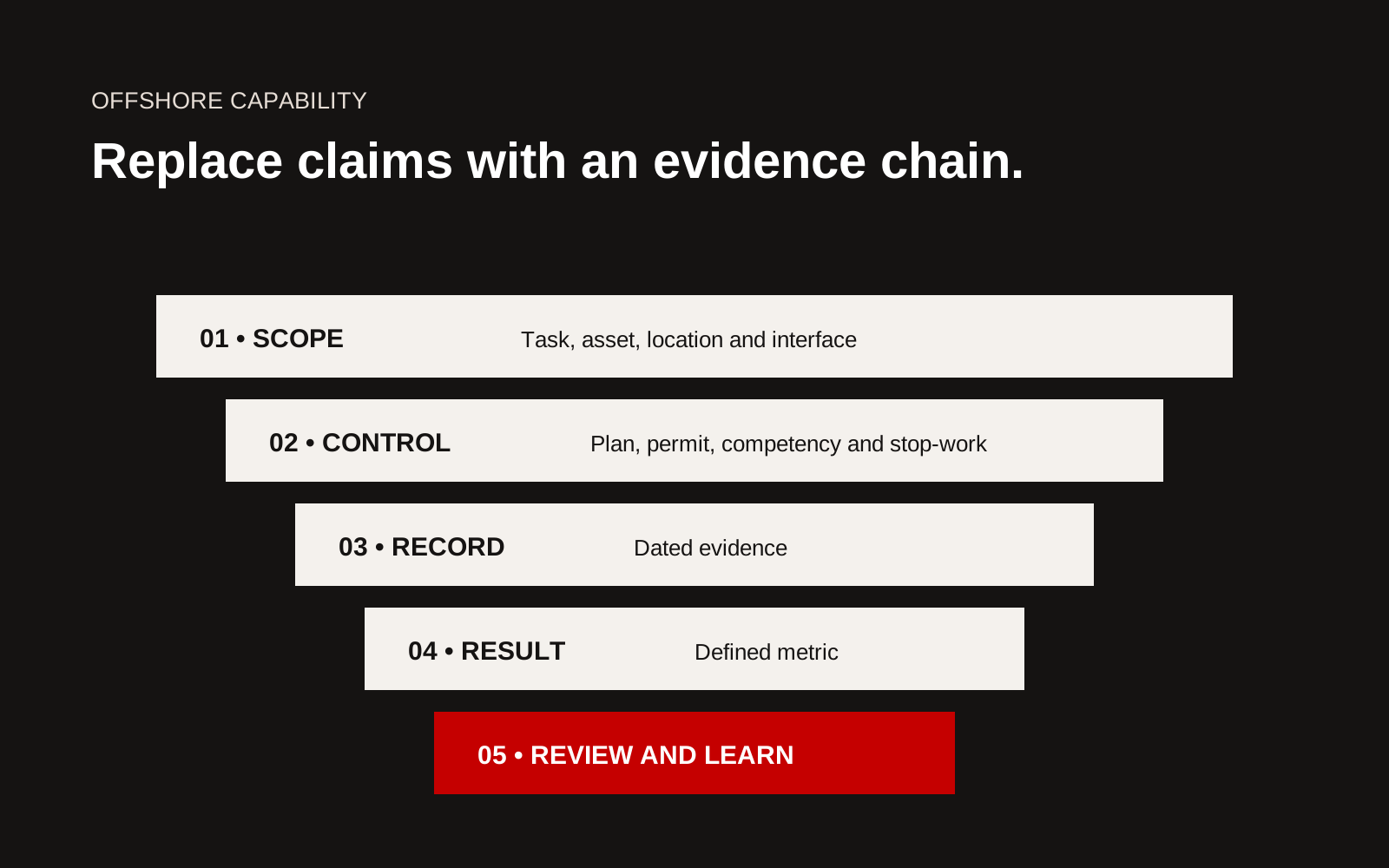
Offshore safety evidence stack connecting scope, control, record, result and review.
Begin with the exact service
Hazards and controls differ across vessel support, diving, lifting, inspection, fabrication, maintenance and commissioning. Put safety information on or beside the relevant service page rather than relying on a corporate HSE paragraph.
Describe:
- work performed and excluded
- operating setting and interfaces
- who controls the worksite or vessel
- permits and planning steps
- critical equipment and inspection
- competency and supervision
- change and stop-work authority
- handover and close-out records
This lets the buyer see whether the system fits the work.
Show how risk moves into the job
A policy matters only when it changes planning and execution. Explain the sequence from task scope to risk assessment, method, permit, toolbox discussion, work, close-out and learning.
Use one approved example, stripped of sensitive detail, to show how a material change was handled. A weather window, equipment substitution or SIMOPS conflict can demonstrate the management process better than a list of values.
Put performance data in context
If publishing safety statistics, define the legal entity, workforce, contractor inclusion, hours basis, geography and period. State whether the measure covers all operations or only the service described.
Avoid comparing rates without checking definitions. A recordable incident rate, lost-time measure and client-specific KPI can use different boundaries.
Publish:
- metric name and definition
- reporting period
- hours or exposure basis
- included workforce and operations
- source owner
- restatements or material boundary changes
If the sample is small, counts and context may be more honest than a rate.
Explain competency and verification
Do not publish employee certificates or personal data. Explain how role requirements are set and checked before mobilisation, how expiry is controlled and how project-specific familiarisation works.
A qualification page can state:
- role and competency matrix is maintained
- required external certifications are verified
- medical or fitness controls apply where relevant
- vessel, site and task familiarisation is recorded
- supervisors confirm readiness before work
- client-specific requirements are mapped before mobilisation
Keep actual personnel records in the controlled system.
Label certifications precisely
A management-system certificate does not approve every service or project. Display the certified entity, standard, certification body, scope and validity. Link to a current document where publication is appropriate.
For class, flag, equipment or client approvals, state exactly what is covered. Do not place logos together under "accredited" when the relationships differ.
Separate public and controlled evidence
| Public page | Qualification stage | Controlled project record |
|---|---|---|
| HSE system overview | Certificates and selected performance | Risk assessments and permits |
| Competency process | Role matrix and verification method | Individual competency records |
| Incident and learning process | Approved trend or example | Investigation files and actions |
| Emergency arrangements overview | Response capability and contacts | Detailed plans and security data |
This division helps procurement without exposing information that should remain controlled.
Capability-page checklist
- Service and operating scope defined
- Safety process connected to the work
- Responsibilities and stop-work route explained
- Competency verification described
- Certifications show entity, scope and validity
- Performance metrics show definitions and period
- Contractor and geography boundaries stated
- One approved process example included
- Controlled evidence clearly available at qualification
- Page owner and review date recorded
An offshore capability page should make a buyer's next review easier, not try to complete it on the public website. Creatif Work designs marine websites that separate credible public proof from controlled records. Our website service can turn an existing HSE and prequalification library into clear pages, while our guide to AMSA safety evidence provides another evidence-first model.