

What Is AI SEO and Is It Different From Normal SEO?

AI SEO is a useful name for work aimed at visibility in AI-generated search answers and assistants. It is not a separate replacement for SEO. Crawlability, clear pages, original evidence and trustworthy information remain the foundation.
The differences are mostly in how questions are researched, how evidence is structured and how visibility is measured.
Is AI SEO different from normal SEO?
Not fundamentally. Google's official guidance says its generative AI search features use core Search ranking and quality systems, so established SEO practices still apply. AI-focused work adds attention to direct questions, entity clarity, original evidence, media and measurement across AI features. It does not require special AI schema or an llms.txt file for Google.
Google's guide to generative AI features in Search explicitly recommends effective SEO over “AEO/GEO hacks”. It says Google ignores llms.txt and does not require special schema or tiny content chunks for AI features.
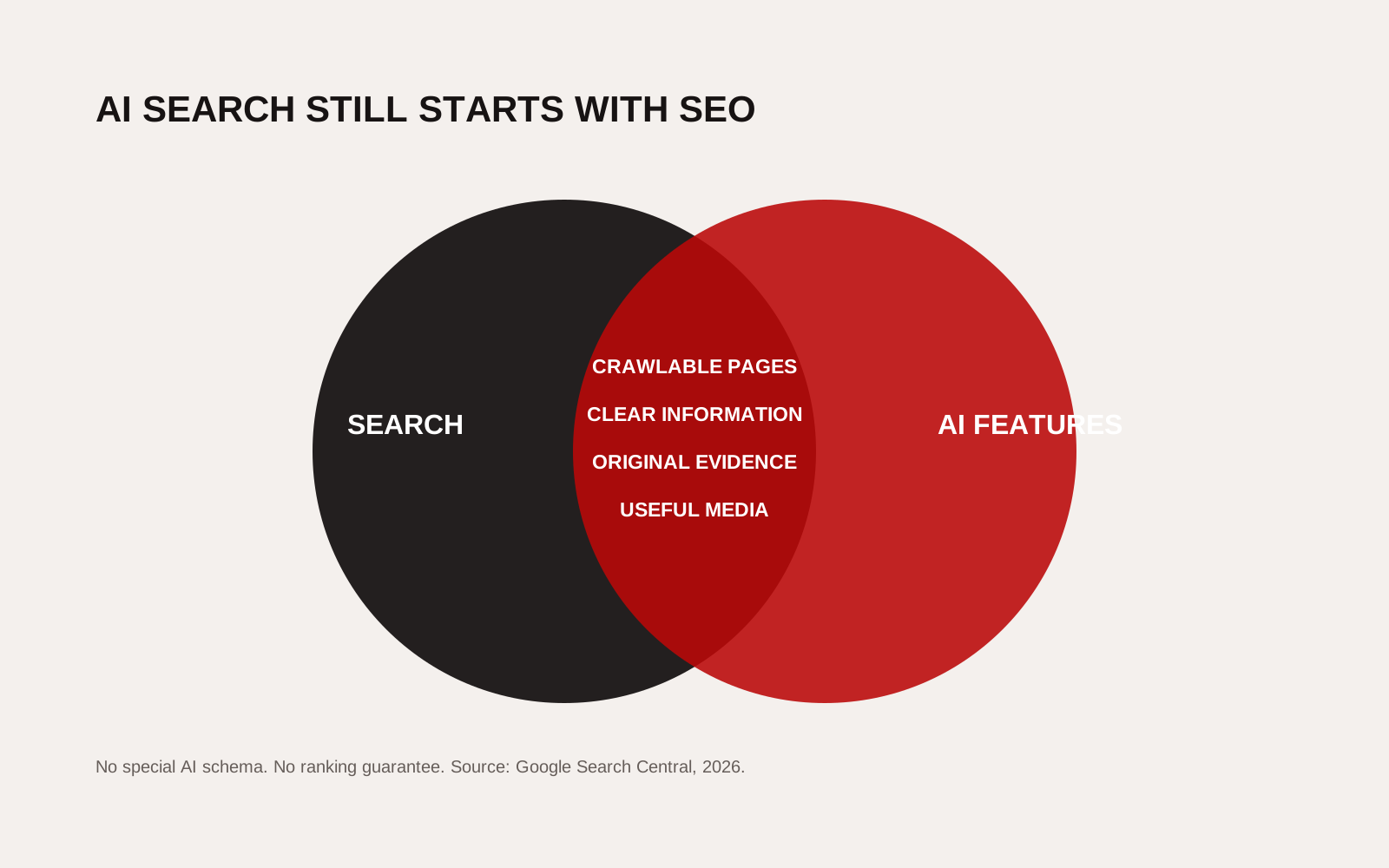
Overlap diagram showing technical SEO, useful content and clear evidence supporting both search results and AI search features.
What stays the same
| Foundation | Why it still matters |
|---|---|
| Crawlable pages | Search systems need access to the content |
| Clear site structure | Important pages must be discoverable and connected |
| Useful original content | Commodity summaries add little reason to cite or visit |
| Accurate titles and headings | People and systems need to identify the page purpose |
| Internal links | They connect services, evidence and related questions |
| Page experience | Visitors still need to use the result on any device |
| Measurement | Search Console and analytics show discovery and action |
If these are weak, an AI-specific tactic will not repair them.
What deserves more attention
Direct answers with evidence
Answer the actual question near the top, then show method, boundary and source. Do not write a one-sentence answer that removes every condition.
Company and service clarity
State the legal or trading name, location, service, industry experience and evidence consistently. An assistant should not have to infer whether a company designs equipment, sells it or only installs it.
Non-commodity material
Publish things the company can genuinely know: project decisions, measured results, diagrams, checklists, field methods and named limitations. Google's guide contrasts this with common-knowledge content that could come from anyone.
Useful media
Descriptive images, diagrams and video can appear in search experiences. Give them relevant filenames, alt text and nearby context. Do not add decorative images simply to meet a quota.
What not to buy as an “AI SEO” shortcut
Be cautious when a service promises guaranteed citations, secret model metrics, hundreds of near-identical question pages or a special file that supposedly makes a site visible everywhere.
Google's third-party SEO guidance notes that outside tools do not have access to Google's internal ranking data and cannot guarantee results.
Ask any provider:
- Which search systems are in scope?
- What technical issue will be changed?
- What original evidence will be created?
- How will accuracy and permissions be reviewed?
- Which first-party data will measure progress?
- What is ongoing work and what is one-time setup?
Does schema make a site visible in AI answers?
Structured data can help search engines understand eligible page content and support rich results where documented. It is not a guarantee of AI inclusion. Use schema that matches visible content. Do not add unsupported ratings, FAQs or organisation claims.
Google says there is no special schema required for its generative AI search features.
How should a B2B company measure AI visibility?
Start with business evidence, not screenshots of occasional prompts.
| Measure | What it tells you | Limitation |
|---|---|---|
| Search Console generative AI report | Visibility in Google's AI search features | Availability and definitions can change |
| Search queries and landing pages | Topics that drive discovery | Does not cover every assistant |
| Qualified enquiries | Commercial relevance | Attribution may be incomplete |
| Assisted conversions | Role in a longer journey | Requires reliable analytics |
| Manual prompt checks | How answers and citations appear | Results vary by time, account and context |
Google announced dedicated generative AI performance reports in 2026. Use current Search Console documentation because reporting evolves.
One-time setup is not enough
Technical access and company information can be corrected once. Search demand, competitors, projects, services and source guidance change. Ongoing work should review queries, update evidence, maintain pages, fix technical issues and publish genuinely useful material.
Our article on whether AI search can understand an engineering company shows how entity and service clarity works in practice. Our SEO service combines technical foundations with continued evidence-led publishing.
Creatif Work does not treat AI visibility as a badge or one-time file. If the website is indexable but still difficult to describe accurately, start with the problem.
Run an evidence-led content review
Take ten questions that real buyers have asked sales, procurement or technical staff. For each one, identify the person who can answer it, the record that supports the answer and the page where it belongs. Do not publish a new article when an existing service or product page should carry the information.
Check whether the answer states its date, market, method and limitation. Add a direct summary, then keep the underlying detail close enough for a reader to assess it. Link to the relevant service, case and primary source.
After publication, review Search Console, enquiries and sales conversations. AI visibility screenshots can be noted, but they should not replace first-party evidence. Record which pages are being discovered, which questions produce qualified visits and which claims need updating.
Repeat this process as projects and guidance change. The useful ongoing work is not rewriting every paragraph for a model. It is keeping company facts, technical evidence and buyer answers accurate, accessible and connected.