

The First UK Maritime ETS Reporting Cycle: Data Owners and Deadlines

The first UK maritime ETS cycle is short, but the data chain is not. Operators in scope need to connect vessel activity, fuel, emissions factors, claims, verification and regulatory submission to named owners.
The deadline is the end of the process. The practical risk begins when nobody owns the source data or the evidence behind a correction.
What are the first-cycle deadlines?
Domestic maritime activity for ships of 5,000 GT and above entered the UK ETS on 1 July 2026. An operator must apply for an emissions monitoring plan within 42 days of its first covered activity, monitor through 31 December, and submit a verified annual emissions report by 31 March 2027. Allowances for 2026 and 2027 are surrendered by 30 April 2028.
Those dates and scope come from the current GOV.UK guide, UK Emissions Trading Scheme for maritime: how to comply. The guidance may be updated, so operators should use the live version and their approved monitoring plan.
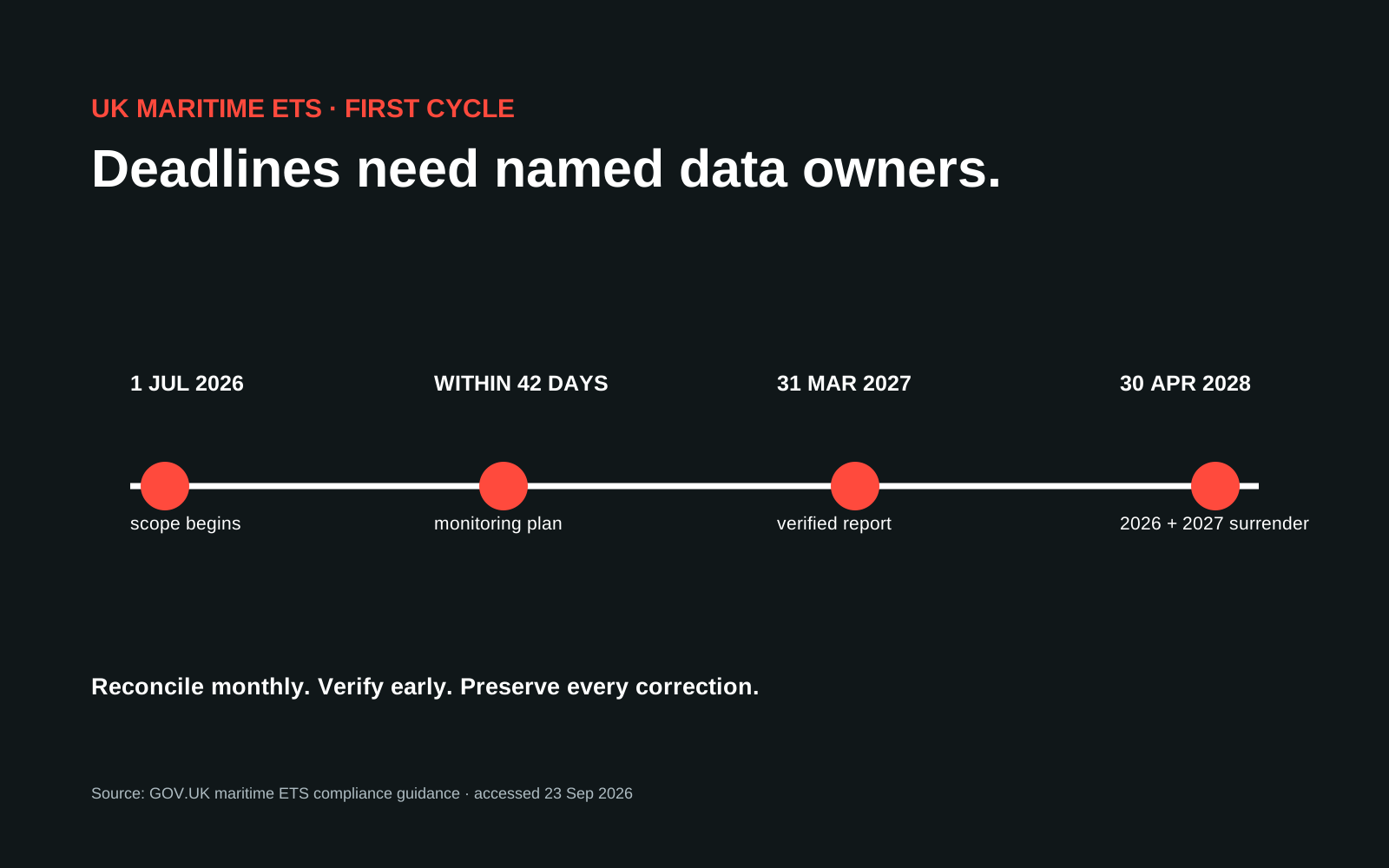
UK maritime ETS first-cycle timeline showing monitoring plan, data control, verification and surrender deadlines.
Build the ownership map now
| Data or decision | Operational source | Accountable owner | Control |
|---|---|---|---|
| Voyage and port activity | Vessel logs and voyage system | Fleet operations | Port-call classification review |
| Fuel consumption | BDN, tank, flow meter or direct measurement | Technical or marine operations | Method in approved plan |
| Emissions factor | Approved reference and fuel record | ETS lead | Version and fuel match |
| Eligible-fuel claim | Purchase, certification and delivery evidence | Procurement and ETS lead | Claim completeness review |
| Annual report | Aggregated controlled dataset | Maritime operator | Management and verifier review |
The title of the team matters less than having one accountable owner and a documented handoff.
Confirm the legal operator and fleet boundary
The registered owner is generally responsible unless UK ETS and ISM responsibilities are delegated to the ISM company through a qualifying written agreement. GOV.UK states that the delegation cannot be backdated.
Record the legal entity, IMO company and registered owner number, fleet, dates of responsibility and any transfer evidence. Reconcile that list with the ships in the monitoring plan, but remember that responsibility can apply even when a ship was omitted from the uploaded list.
Our earlier UK maritime ETS 2026 guide explains the scope and monitoring methods in more detail.
Lock the monitoring method and source trail
The official guide allows fuel monitoring based on bunker delivery notes and stocktakes, tank monitoring, flow meters or direct emissions measurement, subject to the approved plan and rules.
For each ship, record the selected method, source system, unit, time basis, responsible person, quality check, correction route and evidence retention. Align timestamps where data moves between vessel and shore systems.
Document missing data and corrections when they happen. A year-end spreadsheet that replaces values without a reason or approval will be difficult to verify.
Prepare verification before year-end
All annual emissions reports require independent verification by a UKAS-accredited verifier. The GOV.UK guide advises operators to engage early so the verifier can review data during the year.
Prepare a sample evidence pack:
- operator and fleet responsibility;
- approved monitoring plan and procedures;
- activity and fuel source records;
- aggregation and calculation logic;
- quality checks, corrections and approvals;
- claim evidence where applicable;
- change and improvement records.
Run the sample from reported figure back to original source and forward again. Fix gaps before the final reporting window.
Manage the reporting timeline
Use these internal gates:
- Now: confirm operator, METS access, plan, fleet and data owners.
- Monthly: reconcile activity, fuel, factors, changes and missing data.
- December: agree year-end cut-off and verifier sample.
- January: freeze the initial dataset and resolve exceptions.
- February: complete verification work and management review.
- Before 31 March 2027: submit the verified annual report in METS.
- Before 30 April 2028: surrender allowances for the combined 2026 and 2027 obligations.
Do not treat the 2028 surrender date as extra reporting time. The verified 2026 report is still due in March 2027.
Reconcile operational and financial records
The ETS record and the fuel-purchase ledger answer different questions, but material differences should be understood. Reconcile purchased, delivered, transferred, measured and remaining fuel by the approved monitoring method.
Document timing differences, tank uncertainty, transfers, corrections and fuel classifications. Do not force records to agree by overwriting one source. Preserve the explanation and approval.
Eligible-fuel claims need purchase, certification and delivery evidence that meets the current rules. Give procurement an evidence checklist before the purchase rather than asking for missing documents at year-end.
Exercise the METS submission route
Confirm users, permissions, verifier access and data-provider links before the deadline. Test the XML or API route where used and retain evidence of validation errors and corrections.
Give one person responsibility for final submission and another for review. Record the approved version submitted because the annual emissions report cannot simply be edited after submission without contacting the Environment Agency.
Put public information in the right place
A website can explain scope, governance and service capability. It should not expose vessel-level records, commercial fuel data or system access information.
Our maritime emissions data ownership checklist provides a structure for public governance claims and internal evidence. Use it to separate what buyers need to understand from what verifiers need to inspect.
Creatif Work builds marine websites that make compliance capability clear without publishing controlled records. Our custom software service can also help when reporting evidence is spread across disconnected operational files and handoffs.