

Singapore's New Construction Innovation Procurement Route Explained
Singapore is reducing some of the practical barriers that keep built-environment pilots from becoming adopted solutions. For suppliers, that does not mean a weak demonstration will move straight into a contract. It means the route from problem, pilot and evidence to procurement can be designed more deliberately.
The preparation work is commercial and technical: define the user's problem, operating environment, trial responsibility, measurable outcome and evidence needed for a buyer to proceed.
What is Singapore's construction innovation procurement route?
BCA and partner agencies are supporting more structured test-bedding and public-sector pilot procurement, including sandbox support at the Built Environment Innovation Hub and a route for qualified solutions to be procured for pilots by MND Family agencies. Suppliers should confirm the current programme, eligibility and buyer before planning around it.
BCA's 17 July 2026 announcement describes rental waivers for qualifying BEIH sandbox use and a new government procurement approach intended to reduce barriers to pilots. Its 2 September update also discusses continued support for technology adoption, robotics leasing and virtual inspection.
| Stage | Supplier output | Buyer's decision |
|---|---|---|
| Problem | Named workflow, user and current loss | Is this worth testing? |
| Qualification | Company, technology and readiness evidence | Can this supplier run a responsible pilot? |
| Sandbox | Test setup, responsibilities and safety controls | Can the idea work in a relevant setting? |
| Pilot | Measured operational result and limitations | Should use continue or expand? |
| Procurement | Clear scope, ownership, support and commercial basis | Can this be bought and operated? |
| Scale | Repeatable deployment and change plan | Can other sites adopt it? |
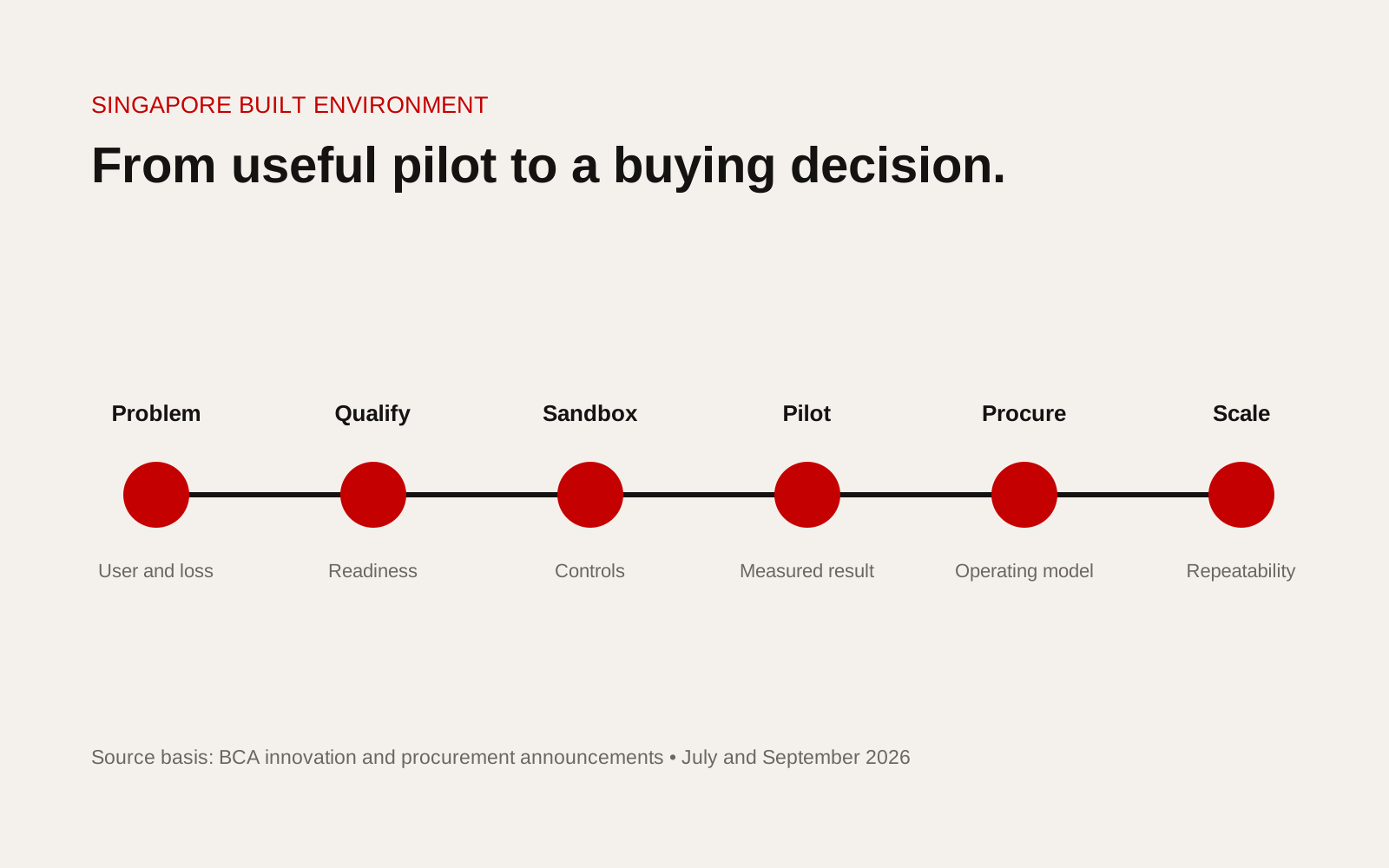
Singapore built environment innovation route from industry problem through sandbox pilot and qualified procurement evidence.
Start with the worksite problem
Do not begin with a broad technology label such as AI, robotics or digital twin. Describe the task, current process, people involved and cost of failure. A useful problem statement includes frequency, location, required inputs, current time, safety concerns and the decision the user must make.
For example, "automate inspection" is too broad. A better scope names the element inspected, access constraint, defect types, output record, reviewer and required turnaround.
Design a sandbox that resembles the real constraint
A convenient demonstration can hide the condition that determines success. Define the relevant environment, interfaces, work sequence and users before selecting a sandbox.
Prepare:
- test objective and acceptance rule
- current baseline and data source
- site, equipment and access requirements
- roles of supplier, facility and end user
- risk assessment and stop criteria
- data ownership and retention
- system configuration and version
- training and support needed
- incident and exception process
- post-test evidence pack
BCA's Building Innovation Panel provides a central route for regulatory advice on innovative building solutions. Engage relevant agencies early when the pilot touches approvals or compliance.
Agree what the pilot will prove
The pilot should support a procurement decision, not simply show that the equipment can run. Use outcome measures linked to the work:
- time per inspection or installation
- labour hours and supervision needed
- rework or defect detection
- safety exposure or manual handling
- completeness and retrieval of records
- uptime and recovery from failure
- training time and user acceptance
- integration effort
Record the baseline using the same boundary. If project volume or complexity changes, explain the normalisation.
Prepare the buying case during the trial
Buyers need more than a positive result. They need to understand the operational model. State who owns equipment and data, required connectivity, support hours, maintenance, consumables, software access, cybersecurity responsibilities and exit arrangements.
Also show what adoption requires from the buyer. New supervision, training, permits, connectivity or data review can move effort rather than remove it. Include those inputs in the operating case and pilot evaluation. A productivity result that excludes additional client labour will be difficult to defend during procurement.
Procurement readiness checklist
- User and current workflow named
- Baseline agreed before the pilot
- Site and regulatory needs mapped
- Safety controls and stop-work authority defined
- Trial configuration recorded
- Metrics and acceptance rules signed off
- Data and intellectual-property terms agreed
- Support and fault response tested
- Full operating inputs stated
- Scale-up conditions and limitations documented
Publish the result at the right level
A useful case study states the problem, site context, trial period, configuration, measured result and remaining limits. Do not call one controlled demonstration a sector-wide solution. If the buyer cannot be named, retain the project type and test conditions.
Creatif Work helps construction technology firms organise this path in public and controlled content. Our construction practice connects capability to project evidence, while custom software can support the trial workflow when data, approvals and exceptions need a dependable system. The guide to Singapore construction tender pages shows how the resulting proof can support later buyer qualification.